Labor Day Links

Lois Weiner has a very interesting piece in Jacobin, “This Labor Day, Thank a Teacher,” on how teacher’s unions are revitalizing the labor movement.

The levels of radiation leaking out of Fukushima are considerably higher than was previously reported.

And there may be a bigger surveillance system then PRISM, as reported on in The New York Times by Scott Shane and Colin Moynihan in “Drug Agents Use Vast Phone Trove, Eclipsing the N.S.A.’s.”

Hyperarchival Realism, Surveillance, and the Control Society

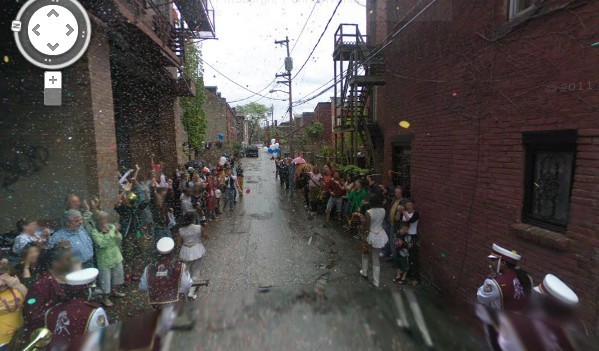
Christine Jun for Dazed Digital has posted an  A-Z list of some incredible contemporary art that engages with technologies of surveillance in “The dA-Zed Guide to Surveillance: Drones in the Sky, Whistleblowers in Jail: How Art is Responding to Big Brother’s Watch.” Of especial note is Robin Hewlett and Ben Kinsley‘s Street with a View, which was done a number of years ago while both were pursuing Master’s of Fine Arts degrees at Carnegie Mellon University, just down the street from me. I have met Ben a few times and had the opportunity to talk with him about this project while he was working on it. A pic (and a link to the Street with a View at Google maps):

Street with a View

I especially appreciate Hewlett and Kinsely’s hyperarchivally realist work here for integrating the archival processes of contemporaneity, the all-surveilling  eye of Google and their maps, the social and local residents of the area, and what in the end is pretty high-concept performance art. Simply wonderful. (And that they somehow got Google to come out and take part, all the better. I also probably should have posted something about Street with a View years ago, but I’m glad being pointed toward Dazed Digital‘s A-Z list reminded me of how excellent this happening was.)

Fukushima, Apple, The Manhattan Project, and The Anthropocene

A bunch of interesting stories today:

“Water Leaks on the Fukushima Plant Could Contaminate Entire Pacific Ocean.”

The Faces of Project Y: the security badges for those working on the Manhattan Project.

And in further news from the Orwellian security state: “Apple has patented a piece of technology which would allow government and police to block transmission of information, including video and photographs, from any public gathering or venue they deem ‘sensitive,’ and ‘protected from externalities.'”

The Atlantic has amazing time-lapse satellite images showing the massive changes to the human-built world. An archive of disaster.

A conversation with Leigh Phillips, Gwyneth Jones, Marge Piercy, Ken MacLeod and Kim Stanley Robinson.

And from The Chronicle of Higher Education: “The National Institutes of Health announced on Wednesday that it had reached an agreement to give the family of Henrietta Lacks, an African-American woman who died of cervical cancer in 1951, some control over researchers’ access to the genomic data of cells derived from her tumor, according to The Wall Street Journal.”

Historical Leaks and Contemporary Cover Ups

Two interesting stories:

An NPR story on Daniel Ellsberg, “the military analyst who in 1971 leaked the top-secret Pentagon Papers detailing the history of U.S. policy in Vietnam.”

And for Reuters, John Shiffman and Kristina Cooke write, “U.S. Directs Agents to Cover Up Program Used to Investigate Americans”: “A secretive U.S. Drug Enforcement Administration unit is funneling information from intelligence intercepts, wiretaps, informants and a massive database of telephone records to authorities across the nation to help them launch criminal investigations of Americans.”

Leaking or Spying?

R. drew my attention to this vexing article in yesterday’s New York Times: Adam Liptak‘s “Court Rulings Blur the Line Between a Spy and a Leaker.” An excerpt:

The federal government is prosecuting leakers at a brisk clip and on novel theories. It is collecting information from and about journalists, calling one a criminal and threatening another with jail. In its failed effort to persuade Russia to return another leaker, Edward J. Snowden, it felt compelled to say that he would not be tortured or executed.

These developments are rapidly revising the conventional view of the role of the First Amendment in national security cases. The scale of disclosures made possible by digital media, the government’s vast surveillance apparatus and the rise of unorthodox publishers like WikiLeaks have unsettled time-honored understandings of the role of mass media in American democracy.

Is it just me, or is contemporaneity becoming Orwellian far faster than I can keep up with?
Out of Our Control: Links on Solar Flares and PRISM

Paul Bedard wroate a rather scary account of a recent narrow miss with a solar electromagnetic pulse. In other words, human technological civilization was almost completely wiped out two weeks ago and this is the first we’ve heard of it.

And PRISM is getting more and more coverage.

Via Metafilter: Thanks to the NSA future historians will have a record of everything we did in the early 21st c. Welcome to the hyperarchive.

Googling things like “pressure cooker” or “backpack” will now get you a visit from the police. Welcome to the Orwellian present.

“The NSA’s Massive Call Record Surveillance Barely Accomplishes Anything.” Welcome to total and futile control.

From The Guardian: “Edward Snowden’s Not the Story: The Fate of the Internet Is.”

And James Fallows in The Atlantic, “Why NSA Surveillance Will Be More Damaging Than You Think.” Welcome to the desert of the real.

Freedom of Information and the University on Fire

David Harris Gershon has submitted a concerning report: “NSA Rejecting Every FOIA Request Made by US Citizens.” Specifically regarding PRISM, the letter sent back to Clayton Seymour after his FOIA request is fairly chilling: “we cannot acknowledge the existence or non-existence of such metadata . . . . Therefore, your request is denied because the fact of the existence or nonexistence of responsive records is a currently and properly classified matter in accordance with Executive Order 13526, as set for in Subparagraph (c) of section 1.4″ (emphasis mine).

Gershon unpacks the meaning of the letter: “the NSA is classifying every single bit of data it receives from ordinary American citizens based on the premise that it has been gathered covertly. Meaning: the NSA’s advertised justification for not granting FOIA requests is to protect our country. However, the real justification is the NSA’s covert violation of Americans’ Fourth Amendment right not to be subject to unwarranted searches and seizures (in this case of their personal, digital data).”

And this image seems just too apt regarding my brief post about the decline of the humanities/higher ed the other day.

Eco-Disaster and Surveillance, Some Links

So some articles of interest.

At Jacobin, Alyssa Battistoni has followed up her piece on disaster in the wake of Hurricane Sandy with “Back to No Future,” a pretty bleak essay on environmental change and the (lack of a) future.

Jeff Goodel has a piece in Rolling Stone“Goodbye, Miami,” about what (now inevitably) rising sea-levels will do to Miami.

And here’s a number of links re: the ongoing NSA drama.

Philip Bump has reported at The Atlantic Wire that the US has filed espionage charges against Edward Snowden.

Naomi Wolf raises a number of questions about Snowden, and then raises some more.

Falguina A. Sheth writes for Salon, “Snowden’s Real Crime: Humiliating the State.”

And Michael McCanne has a very interesting essay, “Total Information Awareness,” at The New Inquiry.

And linking ecological disaster and surveillance together, Nafeez Ahmed wrote a piece for The Guardian, “Pentagon Bracing for Public Dissent Over Climate and Energy Shocks.”

Repackaging the Archive (Part X): The Hyperarchivalism of the NSA’s Prism with Links

In a recently published essay, I have defined the term “hyperarchive” as “an archive whose goal, whether stated or not, can be seen in an attempt to gather together as many documents and texts as it can, regardless of content.”[1] This term clearly applies to the recent revelations about the National Security Agency’s (NSA) data collection. In fact, Prism may well be the best example of a hyperarchive to date (besides the Web). To not at least gesture toward talking about Prism and massive data collection on this blog would constitute gross negligence.

One of the things that this blog consistently tries to demonstrate, draw attention to, and complicate/challenge, is the relationship between technologies of destruction and accumulation, even if only by noting (and sometimes enacting) such relationships with little-to-no commentary. I have refrained from saying much about the recent and developing story about Prism and the NSA,[2] both because it seems too “obvious” and too complex. Prism is an accumulatory technology with clear dangers and evils (which I do not think I have to spell out). Some of these dangers and evils are quite old now, and quite familiar.[3] Others are just emerging, and the potential for misusing the kind of data collected by Prism appears to be limitless. Given the parameters of the hyperarchival impulse of contemporaneity, and the reality of ubiquitous access to massive amounts of information, it is not even vaguely surprising that the NSA has been amassing massive amounts of data. And obviously there is quite a bit wrong with this (part of which is the fact that Edward J. Snowden’s revelation is not surprising).

Glen Greenwald, the writer for TheGuardian who broke this story and has been consistently reporting on it, asked nearly a month ago, “Are All Telephone Calls Recorded and Accessible to the US Government?” Most of us have probably been asking this question for a number of years. The fact that we have been asking this question seriously, for a sustained amount of time,[4] only reinforces the realities of contemporary informatics: that many of us have always tacitly assumed that we were being watched, recorded, etc., pretty much all the time. The fact that we are not much, much more upset about this scandal is probably due to this reality of contemporaneity. Thus Snowden’s whistleblowing is functioning as a confirmation of what everyone always already knew: the emperor is naked, we know, are not pretending otherwise, and don’t seem to mind. This is disturbing, to say the least.[5]

Basically, the issues being raised by the NSA scandal, the implications for thinking about information, surveillance, discipline, and control, issues regarding archives and literature, technology and war, media and communication, contemporaneity and the risk society, immigration, the nation, and the state, are many. I will not dwell on them here, in hopes that thinking about these issues will take the form of an essay (hopefully destined for a more permanent home in a [slightly] different kind of archive). In lieu of more sustained reflection and further remarks, here is a pretty decent smattering of links related to the issue in (more-or-less) chronological order. I imagine I will continue to post links regarding Prism well into the future.

Continue reading