Revisiting DFW’s Infinite Jest a bit today, I re-stumbled across these fantastic pics that imagine some images from the novel. From Poor Yorick Entertainment:
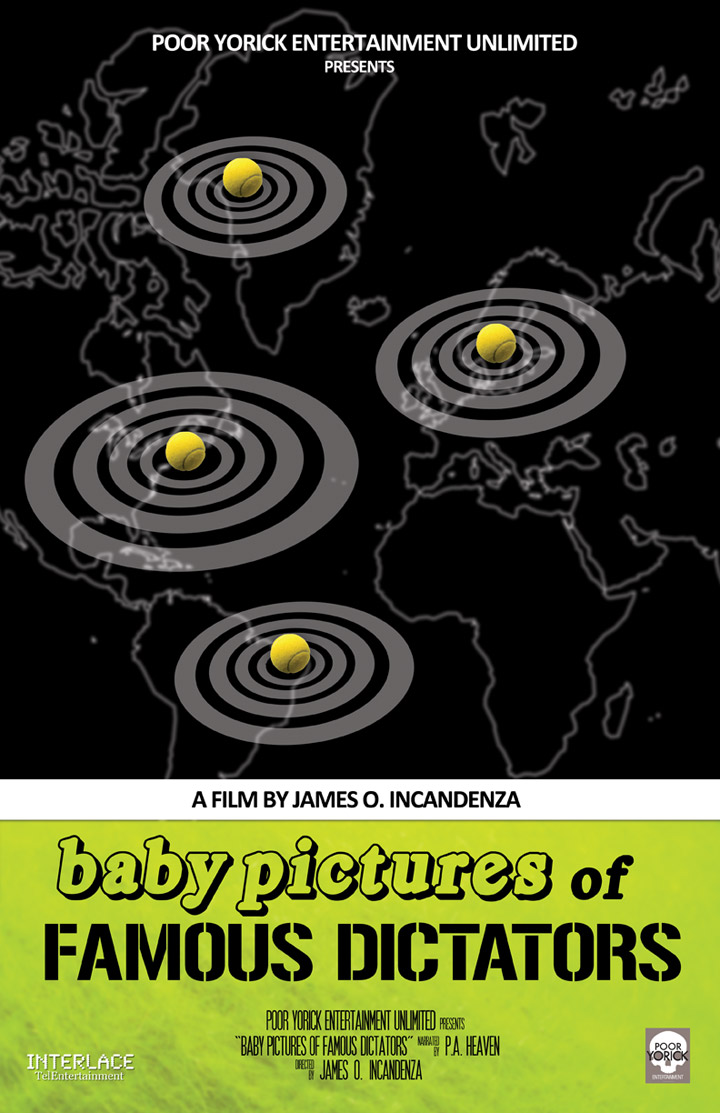
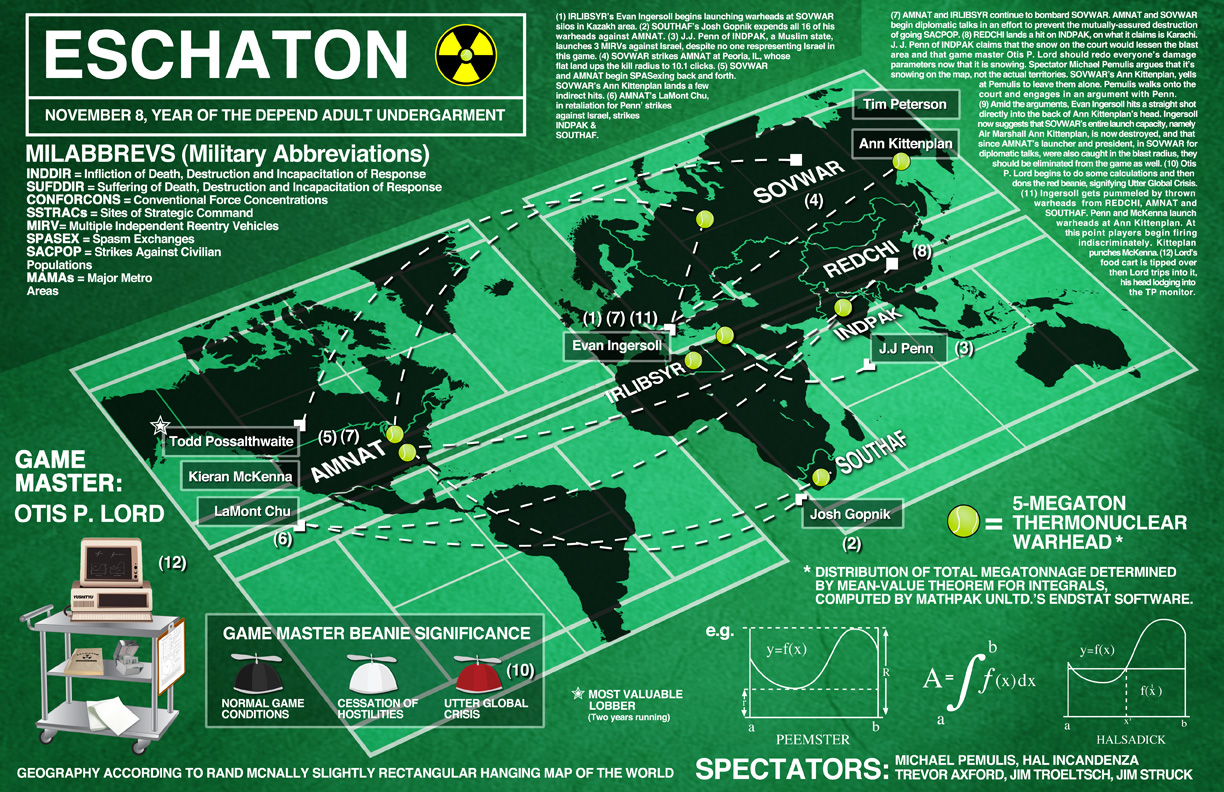
Revisiting DFW’s Infinite Jest a bit today, I re-stumbled across these fantastic pics that imagine some images from the novel. From Poor Yorick Entertainment:
So, first my good friend Alexander Provan, editor of the excellent Triple Canopy, and accomplished writer in his own right (see him, for example, on our post-nuclear future and Yucca Mountain at The Believer), is interviewed in this fairly interesting article on the future of literacy, print culture, etc (“Post-Print: Digital Publishing Comes of Age”) written by Ian Erickson-Kery over at The Eye.
Uncylopedia: what happens when Wikipedia intentionally gets it wrong. I find this fascinating in the extreme, and pretty much what I (sometimes) mean by “hyperarchival.”
In commemoration of DFW’s 50th b-day, 46 things of his to look at on the internet.
Star Wars Uncut: mashing together homemade scenes of Star Wars into one, gigantic, hyperarchival gem.
(Since I’ve been playing quite a bit of Skyrim recently [and am actually currently planning on writing a bit for it here], “Fuck Forever, and Never Die.” Though I’m not sure really why sex is really part of this conversation, this is a fairly interesting article.)
And from io9: “Rock You Like an Apocalypse: Art that Destroys the World!” A whole smorgasbord of eschatological imagery. A couple examples:


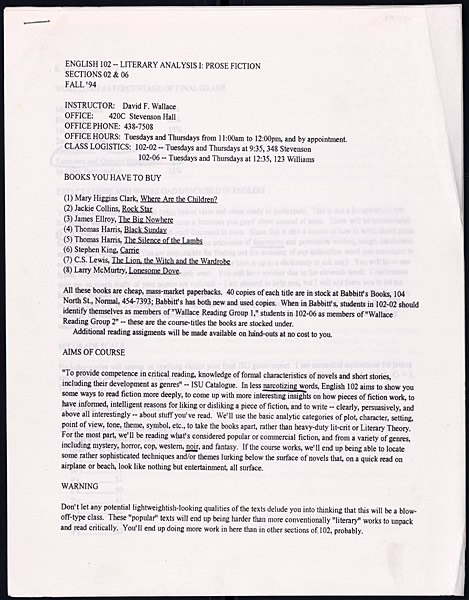
Katie Rophie over at Slate discusses David Foster Wallace’s syllabi: “The Extraordinary Syllabi of David Foster Wallace: What His Lesson Plans Teach us About How to Live.”

The New York Times‘ Julie Bosman informs us that Mark Z. Danielewksi is going to publish a 27 volume serialized novel, The Familiar, appearing every three months beginning in 2014. I wonder how long each volume will be. . . . Also, an interesting interview w/ Danielewski.
From Inside Higher Ed: report finds literary research an inefficient use of university money according to Marc Bousquet, in his article from The Minnesota Review, “We Work.”
George Orwell on the nuclear bomb.
And a pretty great nuclear bibliography.
Thanks again to Dave Keaton for telling me about this awesome Decemberists, Infinite-Jest-inspired-video for “Calamity Song.” Escaton is alive and kicking. There’s also a NY Times article on it here. Watch it.
My review of the first collection of essays on DFW, Consider David Foster Wallace: Critical Essays edited by David Hering, just appeared in the most recent issue of Critical Quarterly. Check out the first page here, and you can access the whole thing if you have university library access.
It makes total sense that some of the work being done in AI right now is in the realm of video games–i.e. a computer teaching itself English to win at Civilization.
One of my favorite posthuman-SF writers, Charles Stross, on why the singularity won’t happen.
On how X-Men: First Class misreads the historical archive.
How China is making prisoners do what millions of other people do voluntarily: play World of Warcraft.
And from Poor Yorick Entertainment, a front page for Infinite Jest and a great tourism poster for my good ole hometown, Tucson:


So I found the following below at The Howling Fantods. I guess a bunch of people have been engaged in creating the films Himself made in Infinite Jest (985-93, n. 24). This is probably the first post among many, and clearly there are some things to be said about making a film from an imagined archive in a novel that is already highly archival (recursive feedback loops. . . go!).
Times they are a changing. The spring is struggling like Sisyphus to get here once and for all in the ‘burgh; one class on American Literature is ending, and my first foray into Introduction to Critical Reading [1]is beginning; one dissertation chapter’s first draft is complete, and Pynchon is officially on the docket now [2]; but in the middle of all this, and slightly unexpectedly, along comes—like a thief in the night (i.e. early), an unexpected (boredom) drug left Moses-like on my doorstep, and a cruel, cruel joke from the dissertation gods—David Foster Wallace’s The Pale King.
And oh has it come. Even the print rags are on fire about it (though surely nothing like DFW’s compatriot’s most recent novel Freedom). I haven’t even had the stomach to check out The Howling Fantods to see where they might be pointing me w/r/t Wallace’s posthumous novel. I guess I just didn’t think it would be such a big-deal release as it has proven to be; I mean, even my mom is practically cutting out newspaper articles and sending them to me. And the public attention to Wallace is, frankly, only exacerbating my weird working-relationship w/ him. I.e., I feel kinda done for a while, happy to get on to the next thing; and of course, waiting on my doorstep in the end is this novel. My students are reading it (either explicitly or clandestinely). David James Keaton, for chrissakes, sent me a text about it. [3] In other words, it feels like something to be written about. [4]
But I honestly would prefer not to. And this isn’t just because Tom McCarthy ended his recent review of the novel, “The Last Audit,” w/ a reference to the scrivener. Really, I kinda just don’t want to say anything about it right now. Everyone else who’s saying stuff is saying it pretty well. I think everyone agrees w/ the basic fact that, well, yes, this is an unfinished novel. There are moments that are intensely boring to read (I guess on purpose). And that it truly is one of the great tragedies of our time to lose such a gifted writer so young.
In terms of giving it a “critical” reception at this time, I suppose it just simply seems a bit early. I mean, the novel isn’t even fresh up out’ve the ground yet (or something).[5] That and I’m just exhausted, and basically need some DFW-breathing-room. So instead I’d like to offer a couple occasional notes that glanced across my brain which could potentially be pursued as moving toward a definition of my term “hyperarchival realism”:
—the novel is hyperarchival realism. W/o a doubt. Any discussion of this novel has to start from this point and perhaps take that as a given.
—What does this mean?
—§25 (pp. 310-313) is a particularly brutal/obvious/hammer-over-the-head-type example of this.
—Claude Sylvanshine, able to recall or forsee seemingly unimportant facts about people—he is a “fact psychic”—and how that allows Wallace to emphasize the value of certain information; being able to sort through massive amounts of data for the relevant facts is a certain kind of ethical/quasi-spiritual ontology. (See pp. 330-333.)
–Two important lengthy quotes from the substitute Jesuit teacher:
“‘In today’s world, boundaries are fixed, and most significant facts have been generated. Gentleman, the heroic frontier now lies in the ordering and deployment of those facts. Classification, organization, presentation. To put it another way, the pie has been made—the contest is now in the slicing.’”
“I think part of what was so galvanizing was the substitute’s diagnosis of the world and reality as already essentially penetrated and formed, the real world’s constituent info generated, and that now a meaningful choice lay in herding, corralling, and organizing that torrential flow of info. This rang true to me, though on a level that I don’t think I even was fully aware existed within me.”[6]
—Wallace is talking about in each of these moments is what Charles Stross calls Economy 2.0.
—Drinion is either a zen-tax-man, or a machine. I’m going for machine. Big fat posthuman tax-machine. Donna Harraway and the whole nine yards.
–It is important that in Infinite Jest, when Hal is attempting to communicate but is really just making sub-animalistic noises–he says, “‘I believe, with Hegel, that transcendence is absorption.”
—and perhaps last, this novel would have been really good if Wallace had finished it.
[1] My major intellectual struggle right now: how and why would/should I teach N.’s The Birth of Tragedy.
[2] Which also means I’ll be renaming any space/home/desk/library/cathedral of learning I may be inhabiting anytime soon The White Visitation Research Facility for Neglected Sciences.
[3] Though dude, I could totally do w/o the random nude photo the other day. dude.
[4] Even if I hesitate to, b/c, of course, there might be more dissertation here. . . .
[5] This is of course also to suggest that something like a “DFW cottage industry” has sprung up around his untimely demise, and though I cannot help but to participate in it (and tell myself I was going to be writing about him now long before 2008), it is also something I would like to avoid in a self-serving fashion if possible (which, of course, put in Wallace’s terms we all now know how such a statement would occasion perhaps a quite-lengthy aside regarding the fact that acknowledging one’s own self-serving nature did not in fact reflect/deflect the additional fact that even such a statement is capable of being eminently self-serving, etc., so will not put it in such terms), so will attempt to.
[6] David Foster Wallace, The Pale King (New York: Little, Brown & Co., 2011), 232, 240.
In commemoration of tax day tomorrow (The Pale King‘s official release date) and in light of the oh-so-wonderful government budget-slashing going on everywhere, I thought I’d provide this nice little excerpt from Wallace’s The Pale King (a conversation set in 1980):
“Let’s get back to how a Bush or Reagan would triple the [IR]Service budget for a second? Is this good for us on a District level? What are the implications for a Peoria or a Creve Coeur?”
“Of course the marvelous double irony of the Reduce Government candidate is that he’s financed by the coporations that are the backs governmnent tends to be most oppressively on the back of. Corporations, as DeWitt pointed out, whose beady little brains are lit by nothing but net profit and expansion, and who we deep-down expect government to keep in check because we’re not equipped to resist their consumerist seductions by the strength of our own character, and whose appeal to the faux rebel is the modern rhetoric that’s going to get Bush-Reagan elected in the first place, and who are going to benefit enormously from the laissez-faire deregulation Bush-Reagan will enable the electorate to believe will be undertaken in their own populist interests–in other words we’ll have for a president a symbolic Rebel against his own power whose election was underwritten by inhuman soulless profit-machines whose takeover of American civic and spiritual life will convince Americans that rebellion against the soulless inhumanity of corporate life will consist in buying products from corporations that do the best job of representing corporate life as empty and soulless. We’ll have a tyranny of conformist nonconformity presided over by a symbolic outsider whose very election depended on our deep conviction that his persona is utter bullshit. A rule of image, which because it’s so empty makes everyone terrified–they’re small and going to die, after all–”
“Christ, the death thing again.”
“–and whose terror of not really ever even existing makes them that much more susceptible to the ontological siren song of the corporate buy-to-stand-out-and-so-exist gestalt” (David Foster Wallace, The Pale King [New York: Little, Brown & Co., 2011], 149).
 The Hyperarchival Parallax