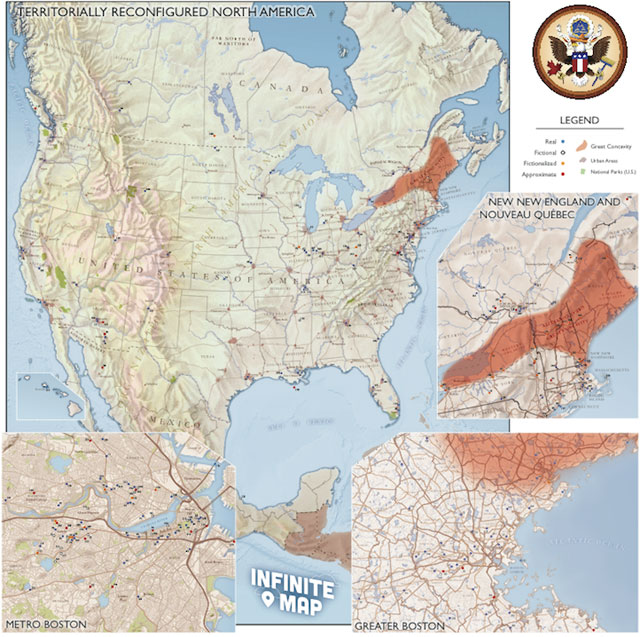
A few months ago I reported about how William Beutler was photographing locations around Boston that appear in Infinite Jest. I don’t know why I haven’t yet linked to his next project, Infinite Atlas, but its pretty amazing, mapping every single geographic location mentioned in the novel. Cool. And a map of ONAN and “Territorially Reconfigured North America”:
David Foster Wallace
DFW Excerpt: “These are tense linguistic times”
My Freshman Composition course just wrapped up a lively discussion of DFW’s “Authority and American Usage” (originally published in Harper’s as “Tense Present”), and though I think I probably wanna do some different stuff w/ it next time . . . here’s a lovely excerpt:
The insecurities that drive [Politically Correct English], [Academic English], and vocab-tape ads are far from groundless, though. These are tense linguistic times. Blame it on Heisenbergian uncertainty or postmodern relativism or Image Over Substance or the ubiquity of advertising or PR or the rise of Identity Politics or whatever you will–we live in an era of terrible preoccupation with presentation and interpretation, one in which the relations between who someone is and what he believes and how he “expresses himself” [DFW’s fn.: (Notice the idiom’s syntax–it’s never “expresses his beliefs” or “expresses his ideas.”)] have been thrown into big-time flux. In rhetorical terms, certain long-held distinctions between the Ethical Appeal, Logical Appeal ( = an argument’s plausibility or soundness, from logos), and Pathetic Appeal ( = an argument’s emotional impact, from pathos) have now pretty much collapsed–or rather the different sorts of Appeals now affect and are affected by one another in ways that make it nearly impossible to advance an argument on “reason” alone. (David Foster Wallace, “Authority and American Usage,” in Consider the Lobster and Other Essays [New York: Little, Brown and Company, 2006], 116, my emphases.)
Mark Sussman on DFW and D.T. Max’s Biography
A buddy of mine from back in my Arizona days, Mark Sussman, has an interview with D.T. Max on his new DFW biography and DFW as a “Burkean conservative,” and an article/review of the book as well. Check’em out. (There’s also a nice little nod to Prof. Charles Sherry in the interview, who was probably one of the most important teachers I’ve ever had, even if I did write a nonsensical disaster of a senior thesis on Nietzsche for him.)
Brett Easton Ellis . . .
. . . is making a fool of himself. Though I’ll admit D.T. Max’s Every Love Story is Ghost Story left me slightly disappointed (actually, I could probably criticize much of it, like on a sentence level, but I won’t), it is still a welcome addition to our understanding of DFW’s life and work, and it surely doesn’t make me want to submit this kind of twitter fiasco Ellis is involved in: “Reading D.T. Max’s bio I continue to find David Foster Wallace the most tedious, overrated, tortured, pretentious writer of my generation…” It is precisely this kind of vitriolic internet rambling, of the upset nerd commenting on well, whatever, that is beginning to define the critical atmosphere of today. If Matthew Arnold was around today, and answered the question of what the function of internet criticism is at the present time, I don’t think things like Culture and Anarchy (1869), or much of anything else, would have been written; he would’ve been too despondent. Further, to me the atmosphere of constant, instant, widespread, poorly-thought-out, and loud criticism from hardly qualified and anonymous people with nothing better to do that dominates “comments”-discourse today, this culture of easy and quick dismissal (of anything), practically requires of us the most generous, considered criticism we can muster. Ellis’s words don’t make me want to read his significant oeuvre any less generously (though I do think DFW has a point in “Fictional Futures and the Conspicuously Young,” a salvo he launched against Ellis in 1987, so yes, he got the first shots in quite a while ago). In fact, for those of us who are seriously in the business of criticism, this kind of thing only re-emphasizes the need for us to be as generous, thoughtful, and, well, kind as we can. It is much easier to say what is “bad” about a work of art–really, any art, how easy is it to call, say, Jackson Pollock’s paintings bad b/c my “five year old could have painted that”–and it is esp. easy to say what is “bad” about a dead artist. It is much more difficult to figure out what is worthwhile in a work, particularly something that does not immediately strike one as worthy of one’s attention. And even more difficult is actually trying to figure out what kind of aesthetic work something is trying to do, what the poem, novel, painting is trying to say, what meaning it is constructing, etc. I have to imagine Ellis’s own work would benefit from seriously considering DFW and, if he were still around, vice versa. But, for now, being loud and mean surely gets oneself a minute of attention, “but a minute was all it was. After nature had drawn just a few more breaths the planet froze and the clever animals had to die.”[1]
[1] Friedrich Nietzsche, “On Truth and Lying in a Non-Moral Sense,” in The Birth of Tragedy and Other Writings, Trans. & ed. Ronald Speirs. Ed. Raymond Geuss (New York: Cambridge University Press, 1999), 141.
DFW Biography
So I just read D.T. Max’s competent biography of DFW, Every Love Story is a Ghost Story. Both Salon and The Awl have interviews w/ Max, and The Howling Fantods has collected the reviews so far (though the pretty scathing one from Harper‘s I don’t think is available online yet. . .).
DFW Usage
I will be teaching all of Strunk & White followed by DFW’s “Authority and American Usage” to a freshman Composition course in a few weeks, and will probably be becoming a bit of a usage weenie during that time, so this little find from MetaFilter, that provides a .pdf of DFW’s “Word Notes” (among others) from the Oxford American Writer’s Thesaurus was a particularly good find today. (I guess this is especially popping up on Mac OS X’s native Dictionary app.)
all of: Other than as an ironic idiom for “no more than” (e.g., Sex with Edgar lasts all of twenty seconds), does all of have any legit uses? The answer is a qualified, complicated, and personally embarrassed yes. Here’s the story. An irksome habit of many student writers is to just automatically stick an of between all and any noun that follows— All of the firemen posed for the calendar; She gave the disease to all of her friends—and I have spent nearly a decade telling undergrads to abjure this habit, for two reasons. The first is that an excess of of’s is one of the surest signs of flabby or maladroit writing, and the second is that the usage is often wrong. Over and over, in conference and class, I have promulgated the following rule: Except for the ironic-idiom case, the only time it’s correct to use all of is when the adjective phrase is followed by a pronoun— All of them got pink-eye; I wanted Edgar to have all of me—unless, however, the relevant pronoun is possessive, in which case you must again omit the of, as in All my relatives despise Edgar. Only a few weeks ago, however, I learned (from a bright student who had gotten annoyed enough at my constant hectoring to start poring over usage guides in the hope of finding something I’d been wrong about that she could raise her hand at just the right moment in class and embarrass me with… which she did, and I was, and deserved it—there’s nothing worse than a pedant who’s wrong) that there’s actually one more complication to the first part of the rule. With all plus a noun, it turns out that a medial of is required if the noun is possessive, as in All of Edgar’s problems stem from his childhood or All of Dave’s bombast came back to haunt him that day. I doubt now I’ll ever forget this. DFW
Long Interview w/ DFW
“I’ll stay out of politics. It’s too upsetting.” –DFW (2003)
An 83 minute interview w/ DFW on German TV:
The whole thing is linked at Open Culture.
Infinite Boston
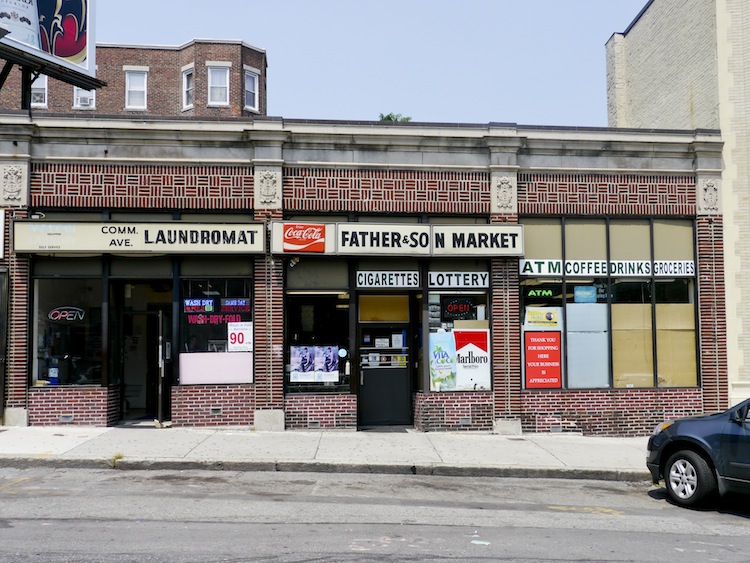
William Beutler just informed me about a really interesting project he has recently begun. Infinite Boston is a tumblr blog that will present photographs from approximately 50 locations around Boston that are referred to in DFW’s Infinite Jest. Now, if someone could do that for Tucson . . . (where I grew up and went to school. . .). A couple samples:
More DFW Archive
Thanks to my friend Shaun for drawing my attention to this, the David Foster Wallace Audio Project. There are quite a few interviews, readings, and remembrances there. Looks like I have some listening to do.
No Pulitzer for DFW’s The Pale King. . . or Anything Else
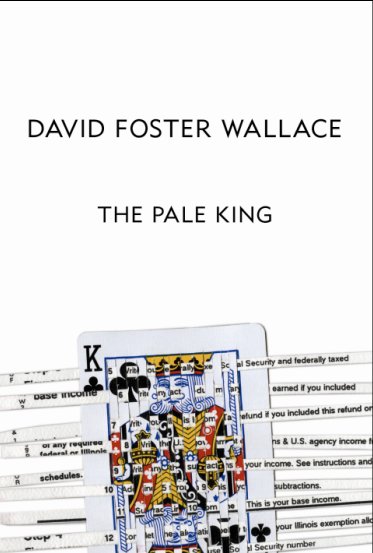
So again, I somehow missed some DFW news (or non-news), but DFW’s The Pale King was one of three finalists for the Pulitzer Prize, the other two being Denis Johnson’s Train Dreams and Karen Russell’s Swamplandia. As Ann Patchet wrote in an op-ed for the New York Time, “And the Winner Isn’t. . . ,”:
With book coverage in the media split evenly between Fifty Shades of Grey and The Hunger Games, wouldn’t it have been something to have people talking about The Pale King, David Foster Wallace’s posthumous masterwork about a toiling tax collector (and this year’s third Pulitzer finalist)? Wallace is not going to have another shot at a win, which makes the fact that no one could make up their minds as to whether or not he deserved it all the more heartbreaking. (The Times also had a few people weigh in on who should have won the award.)
In my mind, however, the decision by the Pulitzer board makes a kind of sense. Admittedly, I haven’t read Johnson or Russell’s books yet, but if we just allow for the moment that The Pale King was the best U.S. novel of 2011, then the lack of an award speaks volumes. The Pale King is fantastic, but it obviously unfinished, and as such, I would have a hard time giving it any kind of award. (I guess I’m of the mindset that awards should be given for complete, fully realized works. My weird conservatism I guess.) Giving no award, however, is a kind of implicit acknowledgment of The Pale King’s value–i.e. in a year when one of the best novels was unfinished, and clearly had quite a ways to go toward completion, perhaps no one should win. In other words, I don’t think The Pale King is award-worthy, but in a year when an unfinished DFW novel is “more worthy” than a host of other texts, no one should get it. This isn’t a travesty, or the Pulitzer dropping the ball, or them doing harm to the ailing literary establishment, or not doing their part to encourage reading, etc. (and of course they did give out many other awards). Rather, it is a quiet statement that acknowledges DFW by not acknowledging him. And perhaps for such an unpublished, posthumous novel, no matter how deserving it or the rest of his writing may have been for a gaggle of awards (I need hardly mention Infinite Jest was roundly snubbed come award-time), the decision displays a kind of quiet poetic justice. (I also have to imagine he would have appreciated this sort of thing.) In a time when we are all too ready to quickly level hyperbolic and unfounded judgments and critiques against anything and everything, when loudly voiced opinion seems to be the only discourse with any traction in the public sphere, choosing not to judge, refraining from a decision, being mindful that doing nothing is preferable to doing something just for the sake of doing it, in short, preferring not to. . . perhaps the Pulitzer went to the only person that could win it in a year that saw the publication of one of the most important writers of the late 20th-c.’s final, posthumous, unfinished work: no one else.