A poem of mine, “One Summer Near Niagara,” was just published in the summer issue of The 2River View. This is an older poem and I’m delighted to finally see it in print. There is also an audio file on the page of me reading the poem, which will play automatically if you are using Chrome, has a button to play if you are using Internet Explorer, and won’t play at all if you’re using Firefox.
Bradley J Fest
Edge of Tomorrow and the Gamification of Being
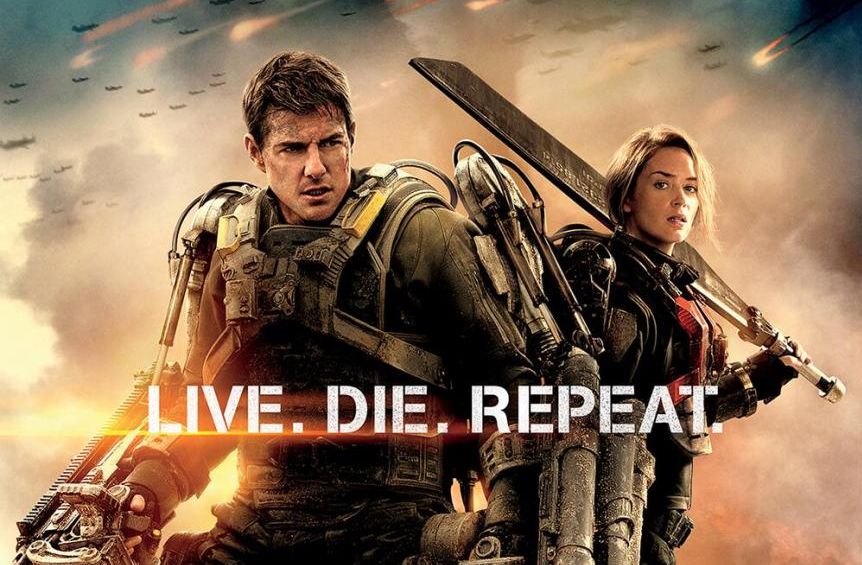
As Jon Stewart commented to Tom Cruise on The Daily Show the other night, Edge of Tomorrow (2014) resembles a videogame. Cruise’s character, William Cage, dies over and over.[1] Each time he dies, he is resurrected with the knowledge of what transpired before he died, and so, much like a videogame, he is able to get “further” than he did before with each “play-through.”[2] Also, like videogames (in general), there is something deeply nihilistic and doomy about this kind of ontological state, this state of being “reset” (often intentionally) so that a better outcome can transpire, again and again, for ends that seem largely unobtainable, and, after a while, not even desirable or coherent.[3] This representation of human life as infinitely repeatable, as a “gamified”[4] set of conditions and procedures to be mastered, as a teleological striving toward a singular objective, a boss battle at the end of every single life for the survival of humanity . . . I would like to suggest that such a vision of Being signifies a deep and abiding despair with contemporaneity, a hopelessness with life as we know it, an acknowledgment of the finitude of human life (and, indeed, the species), and an insight into the brutal logic of the gamification of the world in the twenty-first century. It also, of course, holds out a weird hope that the gamification of the very things that make us human (our experience of time, our finitude, love, knowledge, et cetera) might allow us to access transcendent, messianic, heroic existence. This hope, however, only reinforces the audacious despair at the heart of the film.
Edge of Tomorrow’s cinematic forerunner is obviously the endearing, (still) funny, and (at this point, for me at least) nostalgic film, Groundhog Day (1993). I’m surprised it has taken Hollywood this long to revisit this concept of serious repetition, for there is something weirdly fascinating about the idea of living the same day (or week, or month, or life! the possibilities are endless . . .) over and over again. There are clear “affective” pleasures that this kind of narrative produces. A single human life is littered with regrets, reflections on what could have or should have happened, words that shouldn’t have been spoken, actions taken that cannot be undone, a litany of mistakes, an index of petty tragedies. Groundhog Day takes this regret and funnels it into a single, relatively typical day, experienced by a relatively ordinary bourgeois American subject. The despair at the heart of Groundhog Day is normal: everyday life, with all its attendant regrets and failures. We take pleasure in its comedy—in all senses of the word—because the fantasy it depicts is not, as my students like to say, “relatable,” but because it is wholly other. We cannot undo the past, rework our mediocrity into perfectible “goodness,” living for others, being our best selves, et cetera. We like to imagine that we can be perfect bourgeois subjects, interpolated as Bill Murray is by the end of the film, and we take pleasure in perpetuating the illusion that such subjectivity is possible, but we cannot help but be haunted by our own selfishness, pettiness, despair, complacency, and hopelessness, a state of being that characterizes Murray’s character at the beginning of the film. Groundhog Day is an ideological fantasy that briefly covers over our own dumb, inert selfishness, and for that, it is a balm for everyday life. It briefly holds out a hope that we aren’t all the worst, and as such, we enjoy the illusion.
Edge of Tomorrow, though formally almost exactly the same, is quite different. Yes, Cruise’s character is “unlikable” at the beginning of the film, but not in a genuinely “human” fashion (i.e., Bill Murray: he’s a jerk, a misogynist, a drunk, et cetera). Rather, Cruise doesn’t want to go to war. Sure, he is in the military, performing some sort of military-media duty, but his desire to not go to war (I hope after over a decade of US military adventurism) is not unnatural.[5] At this point the alien invasion seems limited to the area Germany occupied during World War II, so why would one want to go into battle, when there are so many places on Earth that one could still live relatively unharmed (e.g., the US)? Are we really, at this late date, to sincerely accuse Cruise’s character of cowardice at this point? I would hope not. (And, as he points out to the general, he’s playing a legitimately important role in global propaganda! Why would you send one of your chief propagandists into battle?) But of course, the general is nonplussed with Cruise’s cowardice, so (I assume, drugs him? and) Cruise finds himself waking up in handcuffs, his paperwork listing him as a private, being sent into battle on the whims of a sadistic general.
Let me stress how different this is from Groundhog Day. First of all, the physical, material reason for Murray’s repetition is never explained. Cruise’s is explained quite quickly: the alien-hive-mind-Mother-Brain-glowing-thing can transcend space and time, resetting the world every time one of its special-time-whatever-units is destroyed, thus insuring its victory . . . or whatever, and Cruise accidentally got some of that magical alien goo in his blood the first time he died on the shores of, I assume, Normandy, so the Mother Brain thinks Cruise is one of its temporal units. Further, Cruise, unlike Murray, has only been characterized as a media maven with little backstory (family, wife, kids for a man clearly in his forties?[6]) and no discernible character traits. (Murray was able to distill an entire life’s failures into the first twenty minutes of Groundhog Day.) So Cruise is just a tabula rasa, a one dimensional man that, because he finds himself in this extraordinary situation, soon becomes a valiant badass, like we all could (if we were playing a videogame). In other words, Groundhog Day’s repetition does not resemble a game. It resembles the fantasies of what all us poor schlubs would do differently if we had the chance. The Edge of Tomorrow, on the other hand, places us in a (now classic) videogame situation: we don’t know who or what we are, nor why we find ourselves in this extraordinary situation, but through repetition and mastery, we will get to the final castle and save the princess![7]
Just think about the first time you played Super Mario Bros. (1985). Why am I here? What am I supposed to do and why? What are these bricks and question marks? What are these little goombas coming toward me? I doubt anyone pauses to ask themselves such questions. No. The player immediately sallies forth, knowing there is a clear teleological direction (right, always right!) and gamic procedure, and through enough repetition, the gameplay will be gradually mastered. After Cruise wakes up for the first time after having died, he is exactly in the same position as the eight-year-old player of Super Mario Bros. who has died for the first time, maybe even on the first goomba, and finds herself back at the starting position. (And, much like with videogames, his situation is only made clear to him with the introduction of another “player,” Rita, played by Emily Blunt, who also had and then lost Cruise’s ability to play the situation over and over again. She effectively becomes “player 2” in Edge of Tomorrow.)
For the logic of The Edge of Tomorrow is its banal teleology. The one scene where Cruise steps off the path, goes into London to watch the war on the television and throw back a couple of beers, results only in the alien destruction of the city. The message is clear. There is only one direction to go in. Either kill the final boss or nothing.[8] Being, with this kind of telos and repetition, then becomes mechanized, enframed, controlled, and reified. The only possibility for subjectivity, for a subject’s ontological experience of the world, is to abide by the strict limitations imposed by this experience of repetitive time. Cruise has no other choice than to abide by the logic imposed upon him (or else isn’t imaginative enough to articulate other ways of being within the logic of his gamified existence. He’s like the player of Grand Theft Auto who never deviates from the main narrative path. . . .)
Compare this to Groundhog Day. Murray’s first reaction, unlike Cruise, is a deep realization of the banality and horror of his situation. The endless repetition of the same day over and over is an utter nightmare. And so he confronts this horror not by gamifying his existence, but by playing with it, without parameters, for fun (even going so far as to kill himself in a number of clever ways). He then uses his situation to master a host of tasks, but few of them are blatantly teleological. Yes, he masters the piano, but there is no need in the diegesis of the film for him to do so. Achieving his love relationship does not get him out of his situation. Only by becoming selfless, a better person, caring, et cetera, can he get off his track. And, as we might (hope we) know, there is no clear, easy direction toward such caritas, no telos for this kind of love. Groundhog Day flirts with the gamification of Being, but it is clear there is something very much more at stake with the cosmic loop that has been imposed upon Murray.
Cruise’s situation is more horrifying than Murray’s, for he has to die to reset the “game,” and he dies over and over and over. The experience of such constant death, I have to imagine, is unpleasant, as are all those moments prior to death (he breaks his back, arms, et cetera, at points in the film, usually before being shot in the head). And it is this repetitive death, rather than resurrection or repetition, which is the clearest site of the horror of Edge of Tomorrow’s gamification of Being. In a slightly different context, communications scholar Lizbeth Klastrup has suggested that in videogames, “the experience of ‘death’ is thus not one of termination, though it may definitely cause a player grief. In most gameworlds, ‘dying’ is an activity similar to a number of other repeatable activities that occur as a part of the everyday life in the world.”[9] Death is just another mechanic, part of the aesthetic form of the game, something that ultimately can be “playful and explorative, fun and entertaining, or merely be considered an unfortunate nuisance that obstructs the flow of playing the game.”[10] Jesper Juul has taken his reflections one step further, noting that “I dislike failing in games, but I dislike not failing even more,” and as such, “failure in games tells us that we are flawed and deficient. As such, video games are the art of failure, the singular art form that sets us up for failure and allows us to experience and experiment with failure.”[11]
This is all well and good. Failure and death in games are fundamental aspects of the medium’s form, its aesthetics. Death is not an ontological condition in videogames, but a structural one, like a law of physics, a mechanic, a limitation that, by limiting one’s experience, creates meaning and pleasure. If one could not die in, say, Super Mario Bros., it would be drained of whatever (perhaps limited) meaning or pleasure it may have or produce. (This is the same reason that, though cheat codes are initially fun to use because of how they transgress the boundaries of the game mechanics, players quickly get bored with being invincible, or whatever, in games.)
Let me be clear. Death in Edge of Tomorrow is not “playful and explorative, fun and entertaining . . . an unfortunate nuisance.” It is death, clear and simple. Yes, it isn’t really death, because Cruise comes back over and over, but there is nothing playful or fun about it. It hurts. It must take a psychological toll upon him. He sees Emily Blunt die over and over again, which becomes more and more painful as he begins falling in love with her (for reasons that are largely unclear; she is also quite one dimensional). When Bill Murray plays with death in Groundhog Day, it is darkly comic, playful, and, at least for the audience, unsettlingly fun. Like videogames, death in Groundhog Day is aesthetic and formal. But it isn’t, really, in Edge of Tomorrow. By the midpoint of the film, Cruise has ceased trying to save his comrades from often grisly deaths, realizing that only the teleological goal of killing the Mother Brain matters (and if the Mother Brain had been where he thought it was in the first place, we wouldn’t have the redemptive ending we do). Death in Edge of Tomorrow never loses its feel of “reality,” with all its attendant pain, regret, loss, and horror. And gamifying death only makes it more horrifying. If the horizon of Being is death, as Martin Heidegger once suggested, and that Being is Being-toward-death, that Being is constructed on the abgrund (or lack of ground) that is death, Edge of Tomorrow only multiplies the anxieties and horrors of human existence, of Being.[12]
And here is the audacious despair at the heart of the film. Edge of Tomorrow reveals that the horizon of the contemporary fad of gamification, of gamifying increasingly nongamic aspects of life, is the gamification of Being itself. And this is not fun. It is horrific.Indeed, gamification as it is practiced today is not necessarily fun. Who really wants to earn “experience points” rather than grades, or become the mayor of an area because of their savvy shopping? (Well, actually, clearly many people.) But the logic of gamification, extended toward the horizons of human life, of our existence and not just our activities, toward our very Being, our love, knowledge, death, imagination, et cetera, is a threat to ontology itself, a threat to the very Being that is specific to humans. When we gamify human existence, the result is pain, horror, and death. And do not let the ending of Edge of Tomorrow distract us into thinking that it could be redemptive, happy, and fulfilling. It is only by resetting the entire world, by undoing what had been done, by making human activity and life meaningless, that it can achieve anything other than horror.
The ending of the film, and the film’s clear historical references to the Second World War and the invasion of Normandy, point toward a deeper despair than simply the gamification of Cruise’s Being. The film effectively gamifies the existence of the species. It seems to suggest that World War II is a repeatable, recursive activity that humans get involved in, that they will always be fighting evil, landing on Normandy, dying in the thousands (and of course the film cannot help to obliquely point toward the Shoah, another site of the horrific reification of the human). The only way to confront the present alien invasion is to reimagine the site of so much twentieth century trauma. So it is here, with this repetition of the past, the gamification of history, of war, of trauma, of suffering, of militaristic ideology, of American exceptionalism, that the film’s real despair shines through. In short, the film suggest that humanity, unless it figures out a way of gamifying the species, is doomed. Doomed toward a single end. The aliens in this film do not necessarily stand in for climate change, but they might as well. There is no reset button on the glaciers sliding into the ocean, for the disastrous effects of climate change, for the seemingly endless wars of the twenty-first century, for the increasingly nonhuman forces of capitalist exploitation.[13] And the film acknowledges that there is no other way to prevent human extinction other than resetting history. The despair at the heart of the film is this. We are already past the point of resetting anything, and we literally cannot imagine anything else except the fantasy of going back in time to make it right. And we cannot. The gamification of Being covers over this brute reality to suggest that things are alright, we can just try again. By gamifying death, the film obscures the most basic facts of human existence: that we are doomed and repetition cannot save us. And we clearly need something else.
[1] See Jesper Juul, The Art of Failure: An Essay on the Pain of Playing Video Games (Cambridge, MA: The MIT Press, 2013).
[2] Indeed, there are multiple points in the movie where Cruise says something along the lines of “I haven’t gotten this far before.”
[3] For anyone who has played games on the Nintendo Entertainment System, this frequent resetting of the game, often quite soon after one has started the game, should feel familiar. Cruise’s character is often intentionally shot in the head, or “reset,” throughout the film.
[4] For an outstanding essay on gamification, see Patrick Jagoda, “Gamification and Other Forms of Play,” boundary 2 40, no. 2 (Summer 2013): 113-144. Jagoda says that “gamification,a term that derives from behavioral economics, refers to the use of game mechanics in traditionally nongame activities” (114). So, for example, rather than give out grades in a classroom, students might “level up” and earn experience points. (A quick search of “gamifying the classroom” yields many results.) Gamification is happening all over, from corporate offices, to exercise (see that recent iPhone commercial), to shopping (e.g., Foursquare), to other social media.
[5] In fact, the beginning of the film, with its clear imperative to be “patriotic” in some sort of extra-national sense (i.e., when patriotism is applied to the species), is deeply disturbing. It’s as if the last decade and more didn’t happen. That anything less than “fighting for one’s country” (or something) against a clear “evil” (and it is no mistake the film blatantly recalls D-Day right around its seventy-fifth anniversary) is morally questionable . . . is morally questionable.
[6] Though Cruise is fifty-one now?
[7] So often games begin in media res, the player having little idea of who are what their character is, that this has become a trope of videogames. Think of all the Elder Scrolls games, which all feature characters waking up imprisoned with little or no backstory.
[8] The film implies that Cruise repeated this day many, many times. I couldn’t help but wonder how many “days off” he took. Did he structure his repetitions like a work week? Fighting Monday through Friday, but then doing something different two other days? The banality of dying over and over, I have to imagine, would require a bit of rest and recreation after a while.
[9] Lisbeth Klastrup, “What Makes World of Warcraft a World? A Note on Death and Dying,” in Digital Culture, Play, and Identity: A World of Warcraft Reader, ed. Hilde G. Corneliussen and Jill Walker Rettberg (Cambridge, MA: The MIT Press, 2008), 145.
[10] Ibid.
[11] Juul, 2, 30.
[12] This is a radically condensed and oversimplified account of Heidegger. See Martin Heidegger, Being and Time: A Translation of Sein und Zeit (1927), trans. Joan Stambaugh (Albany, NY: State University of New York Press, 1996). SUNY has recently issued a revised edition of this book. Obviously this is not the place to get into a discussion of Heidegger’s forthcoming notebooks. . . .
[13] And it is perhaps telling that immediately after seeing this film, I wandered into a bookstore and picked up Thomas Piketty’s Capital in the Twenty First Century, trans. Arthur Goldhammer (Cambridge, MA: The Belknap Press of the Harvard University Press, 2014).
Abstract: Apoclaypse on Repeat: William Carlos Williams’s Spring and All and the Nuclear Imagination
Below is an abstract for a paper I will be presenting at the 2014 American Literature Association Conference, taking place May 22-25. I will be presenting this paper on a panel organized by the William Carlos Williams society, titled, “William Carlos Williams: The Poet-Doctor as Environmentalist.” The panel will be taking place 11:10-12:30 on May 23.
Apocalypse on Repeat: William Carlos Williams’s Spring and All and the Nuclear Imagination
Long out of print after their initial publication in 1923, the prose sections of Spring and All offer remarkable critical avenues for discussing William Carlos Williams’s environmentalism. Serving as both a frame for some of his more well-known poetry and a theoretical engagement with the volume’s central concern—the imagination—the prose of Spring and All cannot help but strike a contemporary reader with its anticipation of the post-apocalyptic and eco-disaster narratives of the twentieth and twenty-first centuries. To begin the aesthetic work of poetic composition, Spring and All enacts total destruction followed by material repetition in order to allow Williams to formulate an imagination distinct from a romantic apocalyptic, a formulation essential for the development of his ecopoetics. The imagination in Spring and All is a material force. It is vibrant, organic, and radioactive. It is scientific and geological, and it is concerned with atomic physics well before the atom was split. This paper will argue that Spring and All articulates what I have called elsewhere a nuclear imagination. Drawing upon current reconsiderations of modernism’s relationship to atomic technology and my own conversations with J. Hillis Miller about Williams’s poetry and romanticism, I will suggest that Williams, through embracing this destructive, recursive, ironic, nuclear imagination, abandons an eschatology that could in any way be positive, even as something to be gone “beyond.” In this way, reconsidering Spring and All opens up a space for the contemporary environmental imagination that is neither apocalyptic nor post-apocalyptic, but rather thoroughly material and ecological.
“If the Marianas Trench Were a Gathering of Sound” in The After Happy Hour Review
A poem of mine, “If the Marianas Trench Were a Gathering of Sound,” was just published in the very pretty first issue of The After Happy Hour Review, along with work from my friends Dean Matthews, Amy Hayes, and others.
Poetry Reading March 27
Since this event is being sponsored by the Sprout Fund, I actually just heard a plug for it on Pittsburgh’s local NPR. So I thought it only appropriate to advertise here as well.
Reading at Assemble March 27
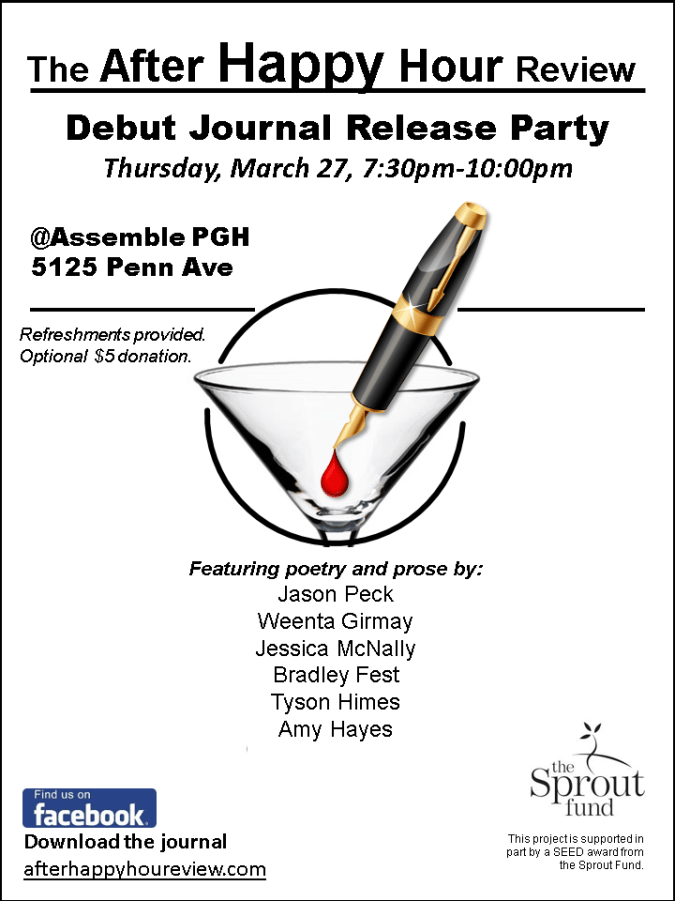
I am quite pleased to announce that, for the first time in quite a while, I will be reading some of my poems at Assemble in Pittsburgh, PA on Thursday, 27 March 2014. The reading has been put on by the Hour After Happy Hour Writing Workshop & Journal. Weenta Girmay, Tyson Himes, Jessica McNally, Jason Peck, and one of my former students, Amy Hayes, will also be reading. I am quite looking forward to sharing some of my recent writing with an audience. It has been far too long.
Headed to MLA
I am headed to Chicago to attend the 2014 Modern Language Association Convention. I’m looking forward to a fun and stimulating time, and am especially excited for a panel on Thomas Pynchon’s Bleeding Edge (2013).
Infinite Oppenheimers and Postnatural Metahistory: Jonathan Hickman’s Manhattan Projects
Now that one of the more tense periods of the Cold War is over fifty years behind us, quite a bit of interesting information about the more speculative military activities of the United States during the late-1950s and early-1960s is getting declassified and coming to light.[1] Among the more absurd revelations, it was reported in November of 2012 that “the United States planned to blow up the moon with a nuclear bomb in the 1950s as a display of the country’s strength during the Cold War space race.”[2] In his recent book, Arming Mother Nature (2013), Jacob Darwin Hamblin discusses how in 1958 President Dwight D. Eisenhower commissioned a special committee on weather modification.[3] The committee discussed a number of purposeful modifications to the environment, including “increasing global temperatures, in the hopes that this would increase the quantity of cultivated land and make for fairer weather . . . and melt[ing] the polar ice cap by exploding nuclear weapons on it, thus raising the global sea level.”[4] For those of us who have seen some of the recent photos of this summer’s radically diminished polar ice caps, the postnatural imagination of this earlier period of US history is both chillingly prescient and deplorably, laughably short-sighted.[5]

I begin with such anecdotes for a number of reasons. Among these is an attempt to emphasize the historicity of this year’s SLSA conference theme. Though the “postnatural” is clearly timely, as by all sane accounts we are now living in the Anthropocene, an epoch of observable and often catastrophic climate change, a time when the possibility of reversing or even mitigating humanity’s effects on the environment is looking increasingly impossible, I would also like to stress that there is a long twentieth century history of the postnatural imagination, and that this imagination has been intimately tied to the development of nuclear weaponry in a number of instances. These recently declassified speculative responses to the Cold War are only the most obvious examples of a conception of human technological prowess able to dominate not only our immediate ecological existence, but our extra-global, lunar environment as well. And indeed, we might trace a genealogy of the postnatural from well before the atomic explosions at Alamogordo, Hiroshima, and Nagasaki. For instance, reflecting on the 1900 World’s Fair in Paris, Henry Adams famously wrote in TheEducation (1916) that with the construction of what he called the “dynamo,” “Man has translated himself into a new universe which had no common scale of measurement with the old.”[6] Or recall H. G. Wells’s prophetic imagining of nuclear war in his 1914 novel, A World Set Free. Or as Martin Heidegger wrote in his 1951 essay, “The Thing”: “Man stares at what the explosion of the atom bomb could bring with it. He does not see that the atom bomb and its explosion are the mere final emission of what has long since taken place, has already happened.”[7] One might easily write a literary, philosophical, and military history of the long postnatural twentieth century.
But I also begin anecdotally with these fantastic yet very serious Cold War proposals because they are precisely the type of thing one might find in the true subject of my talk today, The Manhattan Projects (2012- ).
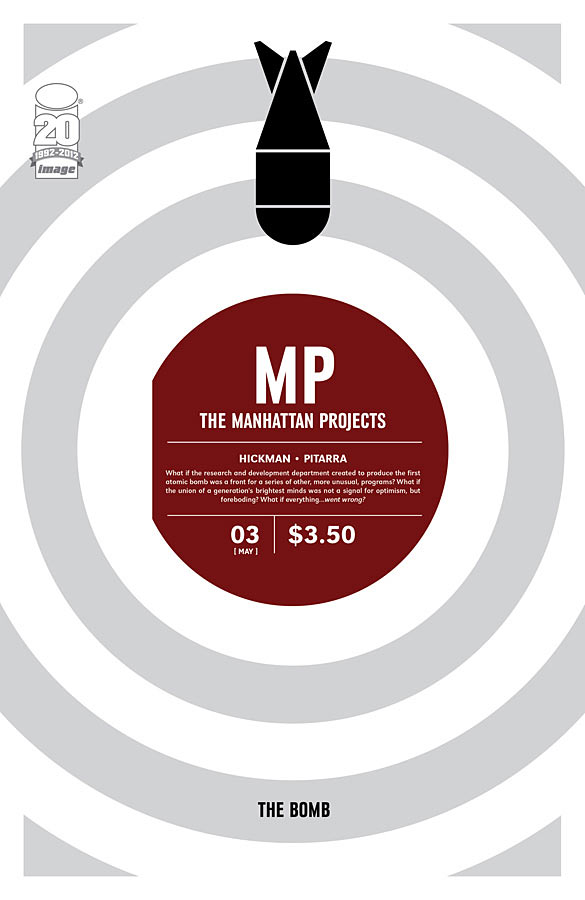
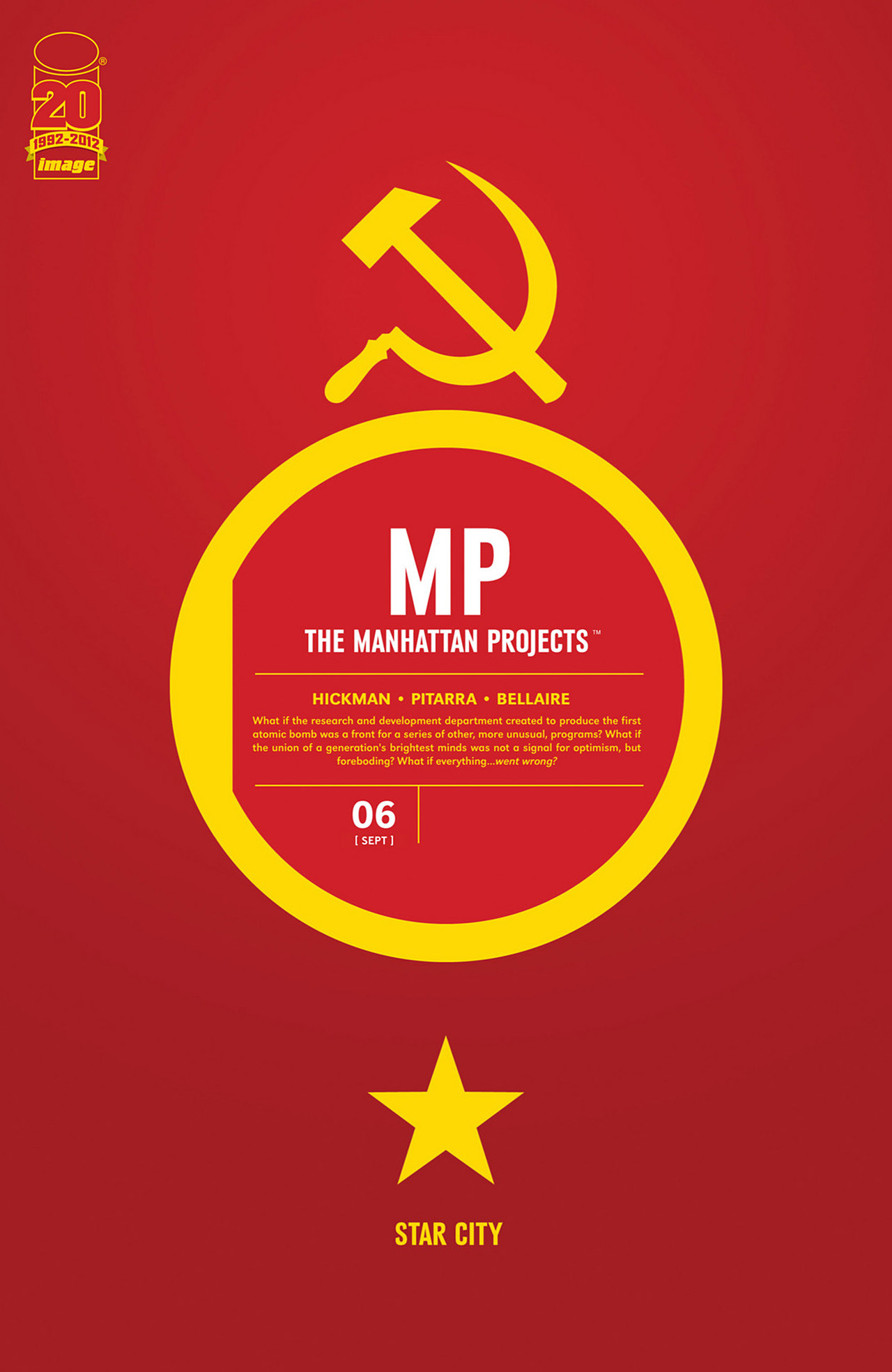
First appearing in March of 2012 and still continuing today, The Manhattan Projects is a serial comic book published by Image Comics, written by Jonathan Hickman and illustrated by Nick Pitarra. The premise of the comic is announced on the cover of each and every issue: “What if the research and development department created to produce the first atomic bomb was a front for a series of other, more unusual, programs? What if the union of a generation’s brightest minds was not a signal for optimism, but foreboding? What if everything . . . went wrong?”[8] Or as director of the Manhattan Project Lieutenant General Leslie Groves puts it in the series’ first issue: “We’re protecting the country’s secrets. The problem with these secrets is many of them are wrapped in conspiracy, and nothing tickles like curiosity and mystery. . . . So we hide our most important lies underneath a more tolerable one: ‘That the Manhattan Project is a research and development program tasked with building and deploying the world’s first atomic bomb.’”[9]
Despite the radically alternative, fantasmatic history that The Manhattan Projects is principally concerned with, and perhaps even in spite of the comics’ insouciant humor, it is an incredibly timely text, and one that I think deserves significant critical attention. It has emerged from a contemporary moment in which the limitations of human scientific and technological capability to effect environmental change are becoming clearer. The acknowledgement of these limitations are exacerbated, on the one hand, by the knowledge that climate change was itself wrought by human science and technology, and on the other, by the continuing intransigence of certain US politicians to even acknowledge the present global ecological crisis. By reimagining a grand meta-narrative woven together by densely mixing science, history, and politics together, The Manhattan Projects asks us to reconsider our current relationship to the long postnatural twentieth century and to see that the realities of the contemporary human condition have perhaps long been hidden underneath more tolerable fictions.
One of the most important of these reconsiderations is the series’ engagement with nuclear technology. Rather than concern itself with the dominant specter of the first nuclear age, what critic Donald E. Pease calls the “national fantasy” of Mutually Assured Destruction,[10] The Manhattan Projects acknowledges a truth about the Cold War that has really only become possible in its wake. The Manhattan Projects, by fantastically reimagining nuclear history, dramatizes certain realities of that history that are so often overlooked in the face of apocalyptic nuclear fantasy, a fantasy that still dominates cinema and literature today, albeit often in different forms. The comic acknowledges that the true legacy of nuclear technology for our present post-Cold War contemporaneity is less the bomb’s potential destructive effects, its speculative futurity in an apocalyptic conflict between global superpowers, but rather a number of more insidious, subtle effects. Principal among these is how the comic takes for granted and is deeply concerned with the unstoppable inevitability of technological advance, and that from its position in the wake of the nuclear history the comic is reimagining, technology might very well be considered an emergent property of human activity, something that Manuel DeLanda explores in his early book, The War in the Age of Intelligent Machines (1991). (For instance, as Edward Snowden’s revelations about the National Security Agency made clear this past summer, it seems that if something is simply possible, it will be done, regardless of whether or not it is something that should be done.) The comic also asks us to pause over a number issues intimately tied to a potential alterative history of nuclear weaponry, a history exemplified in the anecdotes that I opened my talk with. The Manhattan Projects acknowledges that the legacy of the Cold War should be located in nuclear war’s failure to occur, and that it is precisely the non-event of global nuclear warfare and the efforts made to prevent such warfare that have shaped so much of our world today: from ARPAnet and information technology, to the space race, to trying to control the climate, to attempting to master biological life itself. The Manhattan Projects complexly explores how contemporary scientific discourse, current notions about human technological mastery, the “enframing” of the world as “standing reserve,”[11] and a wide array of political and ideological forces are the result of the lasting impacts of the Cold War. And if nothing else, The Manhattan Projects asks us to recall that we are still living in an epoch defined by nuclear weaponry, something we might do well to call, as a number of critics are doing, a “second nuclear age.”
Unlike other notable alternative histories, novels like Philip K. Dick’s The Man in the High Castle (1962), Kim Stanley Robinson’s The Years of Rice and Salt (2002), or Philip Roth’s The Plot Against America (2004), The Manhattan Projects eschews narrative and scientific realism in favor of a fantastic, fabulous metahistory closer to something like Thomas Pynchon’s Mason & Dixon (1997). The comic understands the development of nuclear technology as a small aspect of a grander alternative history, a madcap, maximalist approach to a speculative postnatural past in which the only bounds to science were the limits of the imagination. In its fourteen published issues, The Manhattan Projects has radically rewritten history, particularly the role that science has played in the twentieth century. The comic’s principal characters are prominent scientists and politicians who are depicted as hyperbolic, at times monstrous caricatures of their historical counterparts.
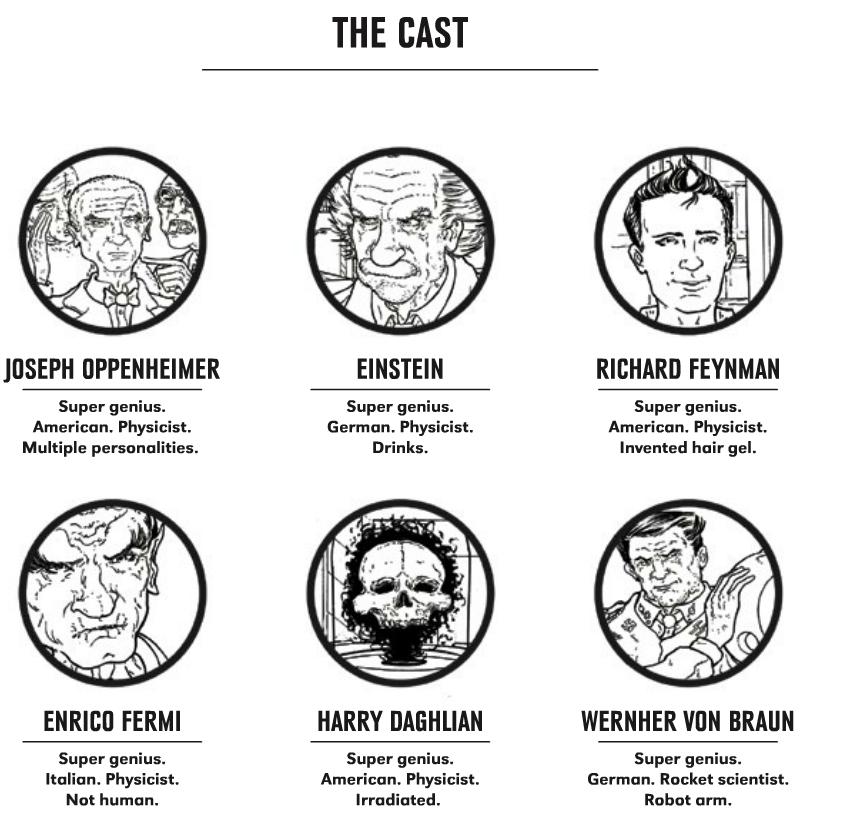
For instance, J. Robert Oppenheimer, the series’ true villain, is imagined to have had a twin brother Joseph who, upon learning of Robert’s invitation to participate in the Manhattan Project, kills Robert, literally eats his body and brain, and thereby absorbs the knowledge and personality of Robert, leading to a fracturing of Joseph’s personalities that approaches infinity. Enrico Fermi, another father of the atomic bomb, is an alien who has been sent to disrupt humanity’s efforts at space exploration and colonization. Harry Daghlian, who in real life was irradiated in an accident with what became known as the “demon core,” and who died twenty-five days later, in The Manhattan Projects has survived as a fleshless, irradiated skeleton housed in a containment suit. Franklin Delano Roosevelt is reincarnated as a rogue artificial intelligence. Albert Einstein has been replaced by another version of himself from an alternate dimension, going on to become what one early reviewer called the series’ version of Wolverine (from X-Men fame).[12]
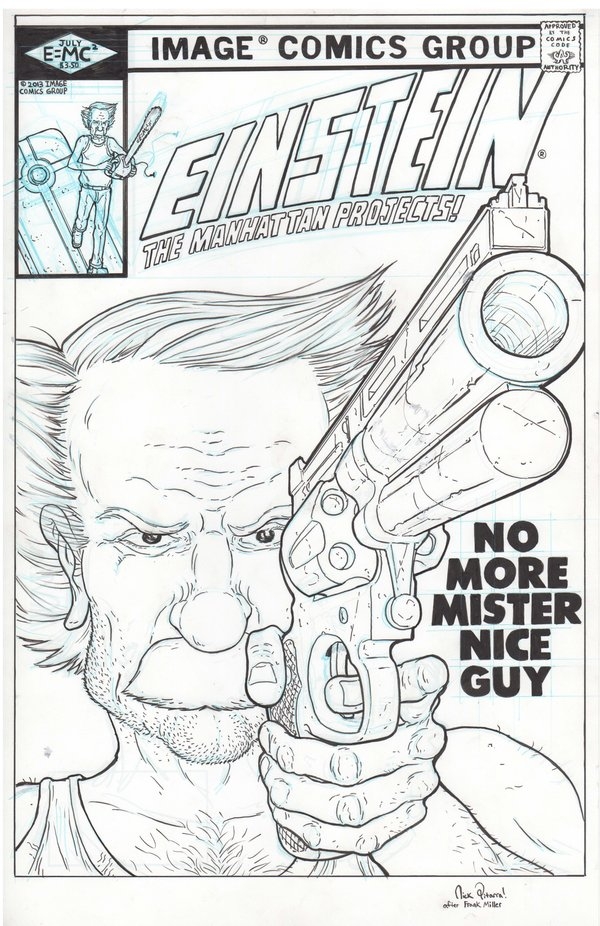
German scientist responsible for the V-2 rocket and later a key figure in US ballistic missile development, Werhner Von Braun is a cyborg with a robotic arm, and after a conflict with a cabal led by crazed Masonic Priest Harry S. Truman, has his legs and eyes replaced with technological prostheses. President John F. Kennedy is a drunk, drug-addled frat boy. And Richard Feynman, the series’ protagonist, is a self-absorbed pretty-boy, whose journal entries are interspersed throughout the series, giving the proceedings an intellectual and historical heft that give many glimpses into the deep, complex history that Hickman has imagined for the comic.
At first glance, the actual Manhattan Project, and the development and deployment of the nuclear bomb appear to play only a tangential role in the series. In issue three, in a radically condensed version of historical events, the comic portrays the bombing of Hiroshima. With Oppenheimer sitting in his office, President Truman gets a phone call from Groves informing him of the existence of the bomb and that the Enola Gay is en route to its target, giving the President mere minutes to decide whether to drop the bomb on Hiroshima. Truman screams into the phone, “Don’t drop the bomb. . . . Terminate the operation. Call the plane back. . . . No! No! ABORT THE MISSION.”[13]
Groves pretends not to hear Truman and drops the bomb anyway. The final page of the issue shows a striking, sublime mushroom cloud with no text.
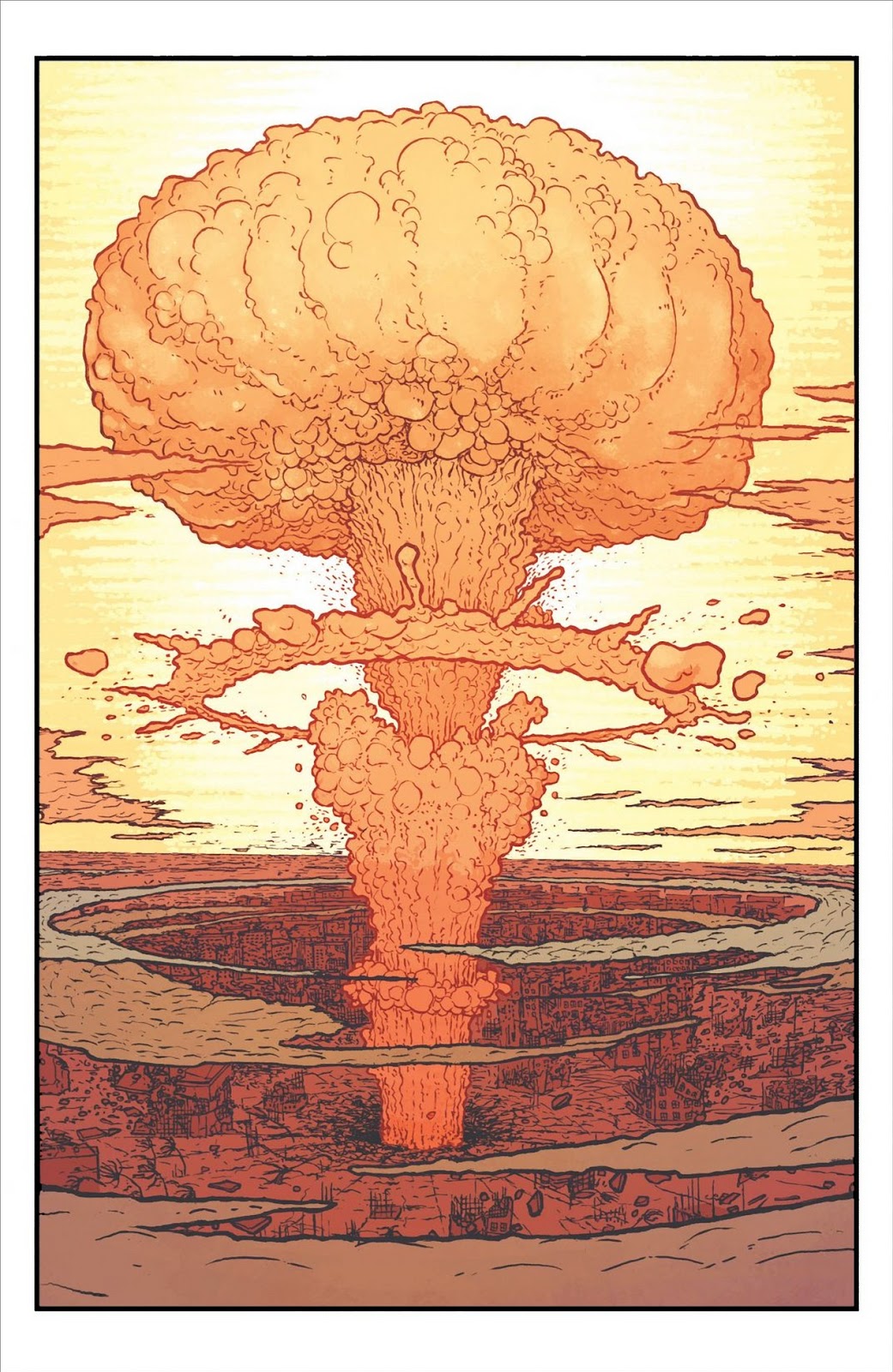
Though this image is the centerpiece of the trade-paperback volume collecting the first five issues of the series, it should also be noted that by the next issue, Hiroshima has been seemingly forgotten, the scientists of the Manhattan Projects already moving on to other concerns. The implications are fairly clear. The bomb’s target here is elsewhere. As certain historians read the true motivation behind the bombing of Nagasaki to have been a show of force and a deterrent against the Soviets, as well as something that would prevent Russian military involvement in the Pacific theater, in The Manhattan Projects this bomb’s true “target” is elsewhere. In order to enable the continued secrecy of the more strange activities of the Manhattan Projects, Hiroshima here is both inevitable—something closely corresponding to the “decision” to drop the bomb in the first place—and a cover; it functions merely as the visible, public achievement of the Manhattan Project, thereby effectively covering up the deeper conspiracy the comic narrates. Implicit in this treatment of nuclear war, a treatment that radically departs from many of its other narrative representations in the last seventy years, is an acknowledgment that after the initial horrific destruction of Hiroshima and Nagasaki, the bomb quickly comes to serve ends that are largely not motivated by military strategy, but rather by politics and ideology. Certainly this is not a new insight into the cultural role the bomb played during the Cold War, but it is to suggest that in The Manhattan Projects the bomb’s ideological function is its primary role, something that we can also perhaps assert in the aftermath of the Cold War.
There are other aspects of the comic that should be noted which revolve in nuclear and postnatural orbits. In issues four and five, the Manhattan Projects scientists make contact with an alien hivemind race and send emissaries through a galactic portal to meet their leader. Acting upon the order of Groves, an unnamed scientist cracks open Dahglian’s radiation containment suit, thereby irradiating all of the aliens and consequently eradicating their entire race, as their collective hivemind communicates the radiation to their entire species. As an ominous demon named Raal who appears from seemingly nowhere in the wake of this annihilation says, “But by all measurements, the first extraplanetary odyssey initiated by your world ending in the genocide of a species. . . . Not the best way to make your mark in the cosmos.”[14] Here Dahglian, who is a personification and physical instantiation of nuclear technology, unintentionally realizes nuclear science’s genocidal horizon. If the nuclear threat in the comic dissipates on earth, it in no way undercuts or changes the genocidal, eschatological thrust of human scientific endeavor, here extrapolated to intergalactic dimensions. In other words, even in the absence of the threat of Mutually Assured Destruction, the ultimate result of human technology ends in the unintentional eradication of a species, clearly mirroring the massive current extinction event attending global climate change.
But perhaps the most clear reflection on the more subtle and insidious legacies of the Cold War is how, in issues six and seven, the Manhattan Projects and the Soviet Union’s own secret research facility, Star City, band together. Under the cover of a continuing Cold War, both projects unite, hoodwinking their respective governments into continuing the massive funding of their research in order to pursue the goals and dreams of their respective scientists. As Feynman muses to Einstein in the closing pages of issue seven, a space station they have constructed “says [to him] look at what we’ve achieved. It says sleep well . . . because we are in control, and those dreams you are having . . . we are the men who can make them real. It says we’ve won, Doctor.” Einstein, however, being the voice of reason responds, “Are you really foolish enough to think that Richard? That we have won . . . ? Because we have not—not yet. This is just ze beginning of the oldest story in ze world.”[15]Einstein’s words are prophetic, in that the powers that be, “These lords of commerce. These KINGS. These DICTATORS. These PRESIDENTS,” discover the ruse being propagated by the Manhattan Projects and attack their facility, killing and injuring many of the scientists. But I would also like to suggest that his words resonate on other frequencies. Namely, that this “cooperation” between the US and USSR that Hickman so fantastically imagines looks, in the wake of the Cold War, like perhaps a more accurate description of nuclear and technological development in the twentieth century. In other words, the arms race, in motivating each side to massively fund and escalate research and development, and in the absence of any deployment of that research, essentially acted in tandem, the result being rapidly developing technology. In the absence of this kind of conflict (or “cooperation”), the funding to undertake the very kinds of scientific endeavors that current US public discourse about science so prides itself on, would perhaps hardly have existed as we now know it today. Here, as throughout The Manhattan Projects, the fantastic fiction and radical alternative metahistory it creates captures the unacknowledged realities and legacies of the Cold War.
Though a final assessment of The Manhattan Projects may be a bit premature in that the series looks to continue for a while yet, the timeliness of its simultaneous critique and celebration of twentieth century science can be seen in the concluding scene of the fifth issue, immediately following the annihilation of the aliens. In a revision of Robert Oppenheimer’s famous words about the first nuclear explosion at Alamogordo, staring into the gateway connecting earth to anywhere else in the galaxy, flanked by his infinite personalities, Joseph Oppenheimer says, “Yes, indeed. We have become death, destroyers of worlds.”[16]

What this moment gestures toward is what the entirety of The Manhattan Projects concerns itself with: that the destructive forces captured by and introduced into the world by Robert Oppenheimer have become multiple and indefinite. No longer is the threat to human existence on earth singular, taking the form of the fantasy of global nuclear annihilation. Rather, the contemporary realities of global risk have multiplied, expanding into a diverse array of potential ecological, posthuman, economic, and archival catastrophes. Further, as Ulrich Beck’s work has so importantly pointed out, the imaginative projection of risk now cannot be coherently separated from the reality of risk.[17] In the twenty-first century, the eschatological horizon of the species has kicked loose of its nuclear origins and multiplied; Oppenheimer has multiplied, and one of the horrors of the postnatural condition may very well be the dawning realization that this multiplication may be infinite, that our ability to imagine various horrific futures both shapes and is shaped by this multiplying horizon. In the wake of the long twentieth century that saw the dissolution of any coherent barrier between humans and their global and extra-global environment, the figure of the infinite Oppenheimer, who is the still largely unrealized evil of the series, is a remarkably apposite figure for the contemporary postnatural condition. If our future depends upon articulating better projections of global risk informed by a more rigorous sense of our postnatural past, then The Manhattan Projects holds out a glimmer of hope that perhaps the human imagination has not yet been made obsolete by the inhuman forces unleashed by the twentieth century.
[1] This paper was delivered to the annual Society for Literature, Science, and the Arts Conference at Notre Dame, Indiana, 6 October 2013. The theme of the conference was: PostNatural.
[2] “Confirmed: US Planned to Nuke the Moon,” at RT (26 November 2012), http://rt.com/usa/news/ us-moon-nuclear-project-631/, emphases mine.
[3] Hamblin’s first book two books also may be of interest to readers of this blog, as they both address the legacy of nuclear radiation and the Cold War: Jacob Darwin Hamblin, Oceanographers and the Cold War: Disciplines of Marine Science (Seattle: University of Washington Press, 2005) and Poison the Well: Radioactive Waste in the Oceans at the Dawn of the Nuclear Age (Piscataway, NJ: Rutgers University Press, 2008).
[4] Jacob Darwin Hamblin, “We Tried to Weaponize the Weather,” Salon (27 April 2013), http://www.salon.com/2013/04/27/we_tried_to_weaponize_the_weather/. This is excerpted from Hamblin, Arming Mother Nature: The Birth of Catastrophic Environmentalism (New York: Oxford University Press, 2013).
[5] See Richard Schiffman, “What Leading Scientists Want You to Know About Today’s Frightening Climate Report,” The Atlantic (27 September 2013), http://www.theatlantic.com/technology/archive/2013/09/leading-scientists-weigh-in-on-the-mother-of-all-climate-reports/280045/.
[6] Henry Adams, The Education (1916), in Henry Adams: Novels, Mont Saint Michel, The Education (New York: Library of America, 1983), 1068.
[7] Martin Heidegger, “The Thing” (1951), in Poetry, Language, Thought, trans. Albert Hofstadter (New York: Perennial Classics, 2001 [1971]), 164.
[8] The Manhattan Projects 1 (March 2012): front cover.
[9] Ibid., 10.
[10] See Donald E. Pease, The New American Exceptionalism (Minneapolis: University of Minnesota Press, 2009).
[11] See Martin Heidegger, “The Question Concerning Technology” (1954), in The Question Concerning Technology and Other Essays, trans. William Lovitt (New York: Harper & Row, 1977), 3-35.
[12] See Chris Sims, “The Manhattan Projects is Pure Mad Science in Comic Book Form,” Comics Alliance (16 May 2012), http://comicsalliance.com/the-manhattan-projects-review/.
[13] The Manhattan Projects 3 (May 2012): 21, emphases in original.
[14] The Manhattan Projects 5 (July 2012): 22.
[15] The Manhattan Projects 7 (November 2012): 25-26.
[16] The Manhattan Projects 5 (July 2012): 24, emphases mine.
[17] See Ulrich Beck, World at Risk (2007), trans. Ciaran Cronin (Malden, MA: Polity, 2009).
The Hyperarchival Parallax Turns Five
Today marks the fifth anniversary of The Hyperarchival Parallax: Making Eschatological Anxiety Fun for 4000 Years. Somehow I have been at this for five years! I started from a relatively modest place, where I really didn’t have a coherent idea of what I was doing, why I was doing it, or how I would proceed. Since that first strange post, this blog has become, over these five long years, years in which much has happened to me as a scholar and writer, something much, much more (or at least I would like to think). I thank you for continuing to read and frequent my site. This year I have gotten more “followers” than in the previous four combined. I hope this is an indication that people like what I do here. I’m going to continue. And for at least another five years I hope to continue to map the intersections between disaster and archives. And as I will (hopefully) complete my current project on such things in the next year or so, I look forward to being able to also take this blog in other directions, perhaps even one day inviting others to contribute, turning it into something maybe a bit more ambitious.
But for now, this is also to acknowledge that I have been shirking my duties. I have been quite busy with professional matters, working on essays, writing conference papers, and most of all teaching 3 enjoyable, if time-consuming classes. (Here’s the blog to one that is just wrapping up.) So I haven’t had much time to post new content recently, and have not even posted many links. I will hope to rectify this in the coming weeks, as a major amount of work is now in my rear-view mirror. I will empty out my backlog of links (that is sitting dormant in a folder on my browser). In the coming weeks I will post a recent conference paper that I’ve been threatening to put up but haven’t yet (my discussion of The Manhattan Projects [2012- ]). And I hope to be putting up considerably more original content in the coming year.
So thank you again for reading. And here’s to five more years of The Hyperarchival Parallax.
“The Inverted Nuke in the Garden” Receives SLSA’s Schachterle Prize
I am honored to have received this year’s Schachterle Prize from The Society for Literature, Science, and the Arts for my essay, “The Inverted Nuke in the Garden: Anti-Eschatology and Archival Emergence in David Foster Wallace’s Infinite Jest,” which appeared in the Fall 2012 issue of boundary 2. This year’s conference was nothing short of incredible, and it remains one of the most vibrant, stimulating, and humbling conferences I have attended. I will probably post my own paper from the conference in a few days.
 The Hyperarchival Parallax