“2015.01,” a poem from my ongoing sonnet sequence, was just published in TXTOBJX. The journal, edited by Andrew Kiraly, publishes what it calls “text objects,” which are “pieces of automatic fictoidal writing produced in one or two sessions.” A text object will be up on the site for a few days and then “the text object sinks into the shuffle and is accessible only randomly via the ‘nxtobjx’ link.” You can read more about the journal here.
Bradley Fest
Geologies of Finitude: The Deep Time of Twenty-First-Century Catastrophe in Don DeLillo’s Point Omega and Reza Negarestani’s Cyclonopedia

I am pleased to report that my essay, “Geologies of Finitude: The Deep Time of Twenty-First-Century Catastrophe in Don DeLillo’s Point Omega and Reza Negarestani’s Cyclonopedia,” was just published in the most recent issue of Critique: Studies in Contemporary Fiction. This essay has been in the works for some time, and I am happy to see it emerge into the light of day.
An abstract: The twenty-first century has seen a transformation of twentieth-century narrative and historical discourse. On the one hand, the cold war national fantasy of mutually assured destruction has multiplied, producing a diverse array of apocalyptic visions. On the other, there has been an increasing sobriety about human finitude, especially considered in the light of emerging discussions about deep time. This essay argues that Don DeLillo’s Point Omega (2010) and Reza Negarestani’s Cyclonopedia: Complicity with Anonymous Materials (2008) make strong cases for the novel’s continuing ability to complicate and illuminate contemporaneity. Written in the midst of the long and disastrous United States incursions in the Middle East, DeLillo and Negarestani raise important political questions about the ecological realities of the War on Terror. Each novel acknowledges that though the catastrophic present cannot be divorced from the inevitable doom at the end of the world, we still desperately need to imagine something else.
Critical Game Studies Syllabus
With the aid of a Course Development Grant from the Office of Undergraduate Studies, this past year I had the chance to develop a new course at the University of Pittsburgh, ENGLIT 1002 Critical Game Studies. As I may not likely get to teach this course anytime soon, I thought I would share the syllabus.
The course’s reading includes Tom Bissel’s Extra Lives (2010), Alexander R. Galloway’s Gaming (2006), Jesper Juul’s The Art of Failure (2013), McKenzie Wark’s Gamer Theory (2007), and many interesting critical essays on play, narratology v. ludology, gender, empire, countergaming, and other related concerns. The majority of games on the syllabus are quite recent, and indie games in particular dominate, including (but not limited to): Between (2008), Braid (2008), Depression Quest (2013), Goat Simulator (2014), Papers, Please (2014), Sunset (2015), and The Stanley Parable (2013).
Review of The Rocking Chair
My debut poetry collection, The Rocking Chair (Blue Sketch, 2015), just received its first review by Mike Good in volume 53, no. 2 of the Hollins Critic (their website). Though not available online, I was able to access it through my library and the AcademicOne File database, and a print copy looks like it should be available shortly for order.
An excerpt: “The poem’s content reaches often and expansively, shifting from personal narrative, classics, baseball, to philosophy, politics, pop-culture, sci-fi, western, geology, mathematics, and academic double-speak, sometimes in the span of a single sequence. . . . While annotations across a book-length outline of a poem might deter even the most intrepid reader, in the end, Fest’s debut is heartfelt, entertaining, and laugh-out-loud funny. . . . [It] appears to be an invention to tame, preserve, and organize culture’s excess, but evades easy definition” (19).
Architects and Their Books
A poem, “Architects and Their Books,” was posted recently on Verse‘s blog. The poem is an excerpt from a forthcoming portfolio, “The Shape of Things,” which was selected as a finalist for the 2015 Tomaž Šalamun Prize and will be in print later this year in Verse.
Review of David Foster Wallace and “The Long Thing” at C21: Journal of 21st-Century Writings


In the fourth issue of the new journal, C21: Journal of 21st-Century Writings, Mark West has written a nicely positive review of David Foster Wallace and “The Long Thing”: New Essays on the Novels (2014), edited by Marshall Boswell, in which I have an essay, “‘Then Out of the Rubble’: David Foster Wallace’s Early Fiction.” West also reviews Gesturing Towards Reality: David Foster Wallace and Philosophy (2014), edited by Robert K. Bolger and Scott Korb (somewhat less positively).
“The Megatext and Neoliberalism” and “Metaproceduralism: The Stanley Parable and the Legacies of Postmodern Metafiction”
I’ll be giving two talks in Pittsburgh over the next two months on May 13 and June 22, 2016.
1. Friday, May 13, 2016 — 2:30 – 4:30. Part of a panel on “The Novel in or against Neoliberalism” at the 2016 Studies in the Novel Conference, The Novel in or against World Literature, Wyndham University Center – Oakland Room II.
Chair: Jen Fleissner, Indiana University
“The Megatext and Neoliberalism,” Bradley J. Fest, University of Pittsburgh
“The Novel in India and Neoliberalism,” H. Kalpana, Pondicherry University
“The Novel and Neoliberal Empathy,” Alissa G. Karl, The College at Brockport-SUNY
“Immanent Value in The Golden Bowl,” Paul Stasi, University at Albany-SUNY
The Megatext and Neoliberalism
With the steadily increasing storage capacity and processing power of contemporary information technology, enormously large texts are beginning to emerge that rival the books and libraries once imagined by Jorge Luis Borges. For instance, at some point in the near future, poet and novelist Richard Grossman will install Breeze Avenue—a five thousand volume, three million page “novel”—as a reading room in Los Angeles, and will also make this text available online in a fluid version that will change roughly every seven minutes for a century. Grossman’s text is, quite simply, too big to read; it is a megatext. This paper will consider the appearance of the unreadably massive novel as an emergent form native to the neoliberal era.
The writing, publication, and distribution of megatexts are impossible without the informatic, technological, and economic transformations of neoliberal globalization. For instance, the composition of Breeze Avenue would be inconceivable without big data and algorithmically generated text, without significant funding and personal wealth (Grossman was a high-level executive for a multinational financial firm in the 1970s), and without transforming the labor of the author from writing to managing. Mark Z. Danielewski’s twenty-seven volume meganovel-in-progress, The Familiar (2015- ), takes full advantage of contemporary digital composition and production to create a work deeply enmeshed in the digital present by self-reflexively remediating the new media forms made possible by the distributed networks and posthuman technologies of the twenty-first century—including electronic literature, premier serial television, social media, videogames, and YouTube. And Mark Leach’s seventeen volume, ten thousand page, open source, digitally generated meganovel, Marienbad My Love (2008), takes advantage of crowd-sourced, collective authorship, reflecting the always-on unpaid digital microlabor that has come to characterize work in the overdeveloped world. Understanding such texts as unique outgrowths of and important critical reflections upon the age of neoliberalism allows us to explore important questions about the role of the novel in the twenty-first century and the possibilities for responding to the nonhuman logics of contemporaneity.
2. Wednesday, June 22, 2016, 1:30 – 3:00, I’ve organized a panel on “Videogame Adaptation” with Jedd Hakimi and Kevin M. Flanagan, colleagues in the Film Studies Program at the University of Pittsburgh, for the Keystone DH 2016 Conference, Hillman Library, University of Pittsburgh. (A schedule of the conference.)
Videogame Adaptation
As videogames continue to emerge as a dominant twenty-first-century form, it is becoming clearer that they have complex relationships to other media. This panel, part of a larger collaborative project, will address issues of adaptation and videogames from a transmedia perspective, drawing particularly on the resources provided by film and literary studies.
Videogame Adaptation: Some Experiments in Method
Kevin M. Flanagan, University of Pittsburgh
This paper outlines the concerns and conceptual practices of videogame adaptation, noting the many ways in which videogames shape, or are shaped by, ideas, narratives, and mechanics from other media. In situating videogames into the discourses of textual transformation that animate current work in adaptation studies, I argue that traditional approaches to adaptation in English departments (which privilege novel-to-film adaptation in a one-to-one correspondence) have a lot to learn from games, which function as adaptations at all stages of their production and consumption. I also demonstrate how adaptation studies challenges claims to medium specificity that form a foundational conceit of videogame studies.
Metaproceduralism: The Stanley Parable and the Legacies of Postmodern Metafiction
Bradley J. Fest, University of Pittsburgh
Most critics of contemporary literature have reached a consensus that what was once called “postmodernism” is over and that its signature modes—metafiction and irony—are on the wane. This is not the case, however, with videogames. In recent years, a number of self-reflexive games have appeared, exemplified by Davey Wreden’s The Stanley Parable (2013), an ironic game about games. When self-awareness migrates form print to screen, however, something happens. If metafiction can be characterized by how it draws attention to language and representation, this paper will argue how self-reflexivity in videogames is best understood in terms of action and procedure, as metaproceduralism.
Playing Los Angeles Itself: Experiencing the Digital Documentary Environment in LA Noire
Jedd Hakimi, University of Pittsburgh
Almost everything about the predominantly faithful depiction of 1947 Los Angeles in the recent, police-procedural videogame LA Noire (2011) was based on archival material, including period maps, photography, and film footage. And while scholars have thought extensively about how film spectators experience mediated depictions of real-world cities, the videogame player’s parallel experience has been relatively unexplored. Accordingly, I take LA Noire’s simulacrum as an opportunity to reflect on what happens when a real-world environment is adapted into the setting for a videogame. Specifically, I position LA Noire in the tradition of the “city-symphony” film and a particular sub-set of Film Noir known as the “semi-documentary” to make the case LA Noire contains crucial aspects of the documentary image. Consequently, LA Noire is not so much creating a fictional, diegetic world, as it is presenting our own world back to us in a manner that changes the way we experience the world in which we live.
An Interview with Jonathan Arac
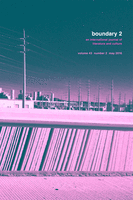
I just published “An Interview with Jonathan Arac” in the most recent issue of boundary 2. I am honored to have had the chance to interview Arac, who has been such a important mentor to me in so many ways. An even further honor is having the interview appear in an issue with work by Tom Eyers, David Golumbia, McKenzie Wark, and others, along with Bruce Robbins’s interview of Orhan Pamuk and Jeffrey J. Williams’s interview of Wai Chee Dimock. What a fantastic issue.
Spring Semester 2016
I’m eager to begin another semester at the University of Pittsburgh. This spring I am teaching three classes: Seminar in Composition (ENGCMP 0200), Reading Poetry (ENGLIT 0315), and Introduction to Critical Reading (ENGLIT 0500). I have taught all three courses before and enjoy each one. Seminar in Composition is a newly redesigned course on the campus novel and the syllabus can be found on my Academia.edu page. I’d be happy to send along the syllabi for the other classes to interested parties, which tweak previous versions. (Among other texts, I’m eager to return to Mark Z. Danielewski’s House of Leaves [2000] in Introduction to Critical Reading, and quite excited to read Claudia Rankine’s Citizen [2014] in Reading Poetry). I have again decided not to do any class blogs this semester. For the blogs of previous classes, see the category “Teaching” to the right.
MLA 2016 Panel: The Anthropocene and Deep Time in Literary Studies
At this year’s MLA Convention in Austin, Texas, I will be on a panel on The Anthropocene and Deep Time in Literary Studies. I have included the information on the panel and an abstract for the paper I will be presenting below.
670. The Anthropocene and Deep Time in Literary Studies
Saturday, 9 January, 5:15–6:30 p.m., 6B, ACC
Program arranged by the forum LLC 20th- and 21st-Century American
Presiding: Heather Houser, Univ. of Texas, Austin
Speakers: Gerry Canavan, Marquette Univ.; Bradley J. Fest, Univ. of Pittsburgh; Kristin George Bagdanov, Univ. of California, Davis; Rebecca Wilbanks, Stanford Univ.
Session Description:
The notion of the Anthropocene was coined in 2000 to highlight that human beings’ transformation of the planetary environment will be visible in the geological strata. Beyond its crucial influence in the environmental humanities, the Anthropocene links to discussions of deep time in literary studies. This session taps into and elaborates on these two ongoing discussions.
“Fictional Quantities That Make Themselves Real”: Speculation, Petropolitics, and Deep Time in Reza Negarestani’s Cyclonopedia
Since its publication in 2008, Reza Negarestani’s experimental work of “theory-fiction,” Cyclonopedia: Complicity with Anonymous Materials, has become somewhat of a literary touchstone for a variety of writers and thinkers revolving in the orbit of speculative realism. Resembling what would happen if Deleuze and Guattari collaborated with H. P. Lovecraft, Cyclonopedia is a serious, albeit ironic encounter with non-correlationist thought, with speculation, deep time, and hyperobjects of all kinds. It is also a rigorous literary attempt to think through climate change, the War on Terror, and the petropolitical realities of the twenty-first century. This paper will explore a variety of issues that converge in Negarestani’s remarkable book. Beginning with Cyclonopedia’s implicit emphasis on how speculation is necessary for thinking the present (rather than, say, rationalism, measurement, or management), this paper will argue that Negarestani’s encounter with geology and nonhuman hyperobjects indicates that experimental literature may be uniquely suited to thinking about deep time and the realities of climate change in a way unavailable to more conventional narratives. If Steven Shaviro has recently suggested that “at its best, speculative philosophy rather resembles speculative fiction,” then Negarestani’s “novel” is evidence of what might happen when speculative philosophy becomes speculative fiction. Cyclonopedia is not only an important text for thinking about nonhuman entities and deep time in an age of observable climate change, it is also an important entry into the ancient debate between poetry and philosophy. Less a “novel after theory” than theory as novel, Cyclonopedia demonstrates that literature will continue to play an important role for understanding the Anthropocene.
 The Hyperarchival Parallax