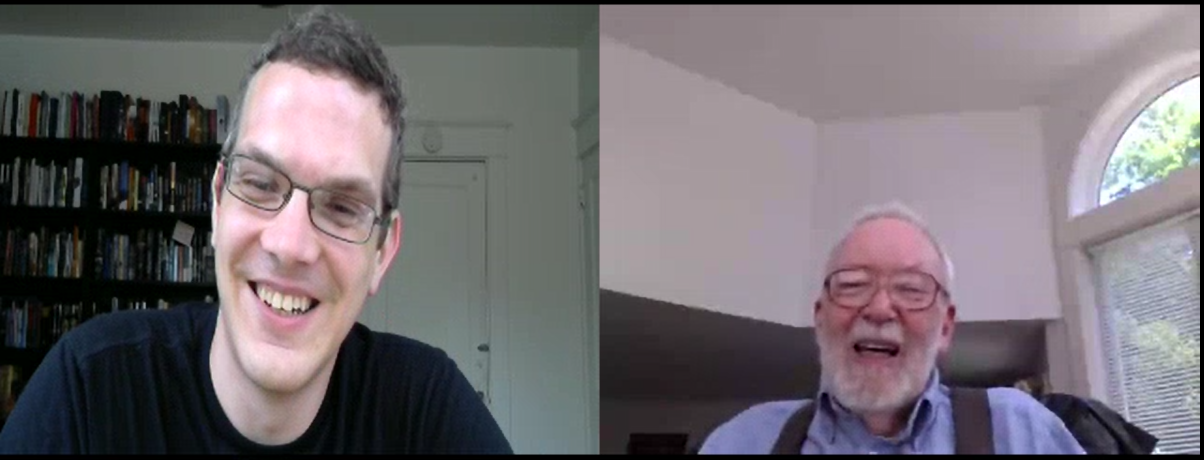
Screenshot of Skype interview on July 17, 2013. Bradley J. Fest, Pittsburgh, PA; J. Hillis Miller, Deer Isle, ME.
I was deeply saddened yesterday to learn that J. Hillis Miller, at the age of 92, has died.[1] Though I was never his student and only corresponded with him electronically via Skype and email, Hillis had been a powerful presence in my life since 2013 and over the years showed me unflagging (at time flabbergasting) generosity and support. I owe a great deal of my post-PhD intellectual and professional development to his influence, as I probably learned more about late twentieth-century literary criticism and theory from researching his work and conducting and collaboratively editing an interview with him than anything else I did in graduate school or since. Perhaps most importantly, however, in every exchange, Hillis was simply a model of grace and kindness. He represents for me a way of being gently in the world that I still look to as an aspirational ideal. He was not only an intellectual giant and an unparalleled reader and critic, J. Hillis Miller was a torch-bearer for what our profession—and the life of letters—could be at its best. His passing may very well mark the end of an era in United States intellectual culture and is a huge loss for the uncountable number of people he touched with his life and work.
When I think back to what should have been one of the most important memories of my career—my dissertation defense in April 2013—my primary recollection of that day is how it marked the beginning of my correspondence with Hillis. During the defense, in a discussion of my chapter on William Carlos Williams and its engagement with Hillis’s important 1966 edited collection on Williams’s work, along with that book’s recovery of the prose sections of Spring and All (1923), my dissertation chair, Jonathan Arac, suggested, “Why don’t you interview Miller? Would you be interested in doing that?”[2] My mind on many other things, understandably, I think I stammered out a, “Sure, yeah, um, that’d be great,” but I figured it was just an idea that burst briefly into the air during a public conversation, a possibility never to seriously be pursued, something that would fade imperceptibly away. I didn’t really give the possibility much more thought as I then spent the rest of the day celebrating my successful defense with my partner and brother, who had flown in for the occasion. So, it was with some surprise when, later that day, at a talk by Priscilla Wald in advance of her faculty seminar at the University of Pittsburgh’s Humanities Center, Jonathan came up to me and said, “I emailed Hillis and he already got back to me. He’s up for it. I’ll forward you the email and you can go from there.” (So: thank you Jonathan. See Robert T. Tally Jr.’s recent post on Jonathan Arac’s mentorship on the occasion of his retirement.)
Oh my. I had thought I was done with this huge task—writing a dissertation—and all of a sudden, I had what I felt was an even more daunting one: doing justice to the work of J. Hillis Miller. But I was up for it. Hillis and I corresponded and he, knowingly or not, immediately made me feel like interviewing him was something I could actually, like, do. And then I got to work. I read and read. I went on vacation to Rocky Point in Mexico with my brother and his family and spent the majority of the time reading. During my one day on the beach, I forgot to put sunscreen on my feet and they got very badly burned, which rendered me basically supine inside for the remainder of the trip. Which wasn’t so bad, as I spent it reading Poets of Reality: Six Twentieth-Century Writers (1966) and The J. Hillis Miller Reader (ed. Julian Wolfreys, 2005) and Theory Now and Then (1991) and a lot of things surrounding his famous essay “The Critic as Host” (1977).[3] I read more, as much as I could, so much, but, as he had authored well over thirty books at the time, I also realized that I wasn’t going to be able to be exhaustive (as I have strived to be in subsequent interviews) if I had any hope of conducting the interview by July. And then I wrote some questions and figured out how to record a Skype call and Hillis and I talked and then I sat down to do the work of transcription and editing. And then he gave me his real gift: I got to see, just a little bit, what it was like for him to write, as we exchanged a couple drafts back and forth, editing the piece collaboratively. That interview, “Isn’t It a Beautiful Day? An Interview with J. Hillis Miller,” published in 2014 in boundary 2, is probably the publication of which I am the proudest and it’s the one I feel might have the most lasting import. It gives a glimpse on an entire intellectual world and speaks directly to many of the present concerns of that summer (the Snowden revelations, the ongoing crisis in the humanities, et cetera). (The interview was also reprinted in a collection of interviews with Hillis edited by Jonathan Y. Bayot, Reading Inside Out: Interviews and Conversations [2017].)
But that wasn’t the end of our correspondence. Year in and out, he supported me on my seemingly interminable quest to find a tenure-track job and also kept me in the collaborative loop, suggesting me as a respondent for a special two issues of the journal CounterText devoted to his book with Ranjan Ghosh, Thinking Literature across Continents (2016). That essay, “Reading Now and Again: Hyperarchivalism and Democracy in Ranjan Ghosh and J. Hillis Miller’s Thinking Literature across Continents,” was published in 2018, and it represents for me an opportunity to think through his body of work (somewhat obliquely, admittedly) while also trying to respond directly and specifically to a small moment in that corpus.
And let me be clear: I was not a student, not a colleague at Johns Hopkins or Yale or the University of California Irvine, not a Victorianist nor a modernist; I was just a kind of random person he didn’t really know or have any connection with whom he graciously invited into his working world and kept supporting after the immediate work of the interview was over (and whom he could have reasonably told, at any point, “Alright, thanks, that was great, goodbye,” or even, “Go jump in a lake!”). I can only imagine the impact he has had on so many students, critics, scholars, and writers over the past sixty plus years if he was able to play such a large role in my life. And, as I’m writing this, I am also realizing that I’m in the midst of finalizing my spring 2021 syllabi (the semester is starting a few weeks later than normal because of the global pandemic) and just remembered that I had already, of course, put one of his essays on a draft of my ENGL 190 Introduction to Textual Analysis syllabus. I know that, for as long as I’m writing and reading, I will continue to think with him.[4] COVID-19 has taken so much from so many. I look forward to a time when I can again be in a classroom (without masks) sharing Hillis’s work with a new generation of readers. And I sincerely hope that one day I can look back on this particular moment as another turning point, when life went off in a new, unexpected, positive direction, a direction that, once again, changed everything.
Notes
[1] Eric Hayot, in a moving memory of Miller from Hayot’s first year at Yale, reports the cause of death. There has also already been an outpouring of grief, memory, and gratitude on Twitter: see Merve Emre, Harris Feinsod, @V21collective, and many others.
[2] See J. Hillis Miller, ed., William Carlos Williams: A Collection of Critical Essays (Englewood Cliffs, NJ: Prentice-Hall, 1966).
[3] I still feel a burning, aching pain on the tops of my feet when I think about Hillis’s discussion of Wallace Stevens in Poets of Reality. See J. Hillis Miler, Poets of Reality: Six Twentieth-Century Writers (Cambridge, MA: Belknap Press of Harvard University Press, 1966), 217–84.
[4] There are so many of his books that should be required reading, but I have definitely thought on multiple occasions that Reading Narrative (1998) is perhaps criminally under-read.


 The Hyperarchival Parallax