Excerpt from “The Inverted Nuke in the Garden”

So I’ve just finished drafts of my project papers, and as they address some of the concerns of this blog, I thought I would post a short excerpt from the second one, titled “The Inverted Nuke in the Garden”:

That this total destruction of the archive immediately opens a field for the production of more literature, that clearing away the ground will inevitably make way for subsequent archival accumulation, makes [Hawthorne’s “The Earth’s Holocaust”] parable speak equally to the logic of archives themselves and of the anagogic phase of literature.  For Hawthorne’s speaker does indeed receive an answer to his query about whether or not “everything” was consumed from a “grave friend”: “Come hither tomorrow morning—or whenever the combustible portion of the pile shall be quite burnt out—and you will find amongst the ashes everything really valuable that you have seen cast into the flames.  Trust me; the world of tomorrow will again enrich itself with the gold and diamonds, which have been cast off by the world to-day.  Not a truth is destroyed—nor buried so deep among the ashes, but it will be raked up at last.”[1] Though the parable ultimately ends on a discussion of the human “Heart,” of “the little, yet boundless sphere, wherein existed the original wrong”[2]—that it is this which cannot be destroyed by all the burning Alexandrias one can imagine—the real anagogic lesson of Hawthorne’s tale resides in those very ashes.  In articulating its destructive encyclopedic logic, Hawthorne makes quite clear that one can never totally destroy the archive.  In the very manner that Whitman’s poetry cannot archivally accumulate itself infinitely but must leave off somewhere, Hawthorne’s text makes clear that something will remain, that even the dust and ashes are archival.  If we recall Derrida’s two fantasmatic limits of the text, the infinite book and the destruction of the archive, both Whitman and Hawthorne point to the fantastic nature of these limits.  They cannot be experienced.  As the nuclear cannot be experienced, its material possibility marks the limits of anagogy, both in terms of destruction and accumulation.


[1] Nathaniel Hawthorne, “Earth’s Holocaust,”  Nathaniel Hawthorne: Tales and Sketches (New York: The Library of America, 1982), 904, emphases mine.

[2] ibid., 906.


Let there be a Postmodern Drip; or, How I Learned to Stop Worrying and Love Milton

[Note: my problem w/ footnotes still remains.  Sorry.]

So I just accidentally caught a bit of PBS’ art:21.  Not having ever really seen the show, I cannot comment at length other than to say I’m mildly surprised by a few things about it.

1)  Its existence.  That, despite the slashing of budgets around the country for publicly-supported arts—perhaps most notably in our public school system—PBS has devoted an impressive amount of time and funding to archiving the contemporary art scene (or at least an institutionalized take on it).  2)  The speed of whatever (might still be said to) come(s) under the heading “avant-garde” in its ability to slink into the “mainstream” of public television.  For instance, I only sat and watched long enough to get what the show was trying to do: interview artists, show their work, talk about their process, etc.—all in a more-or-less banal fashion—but was immediately struck by the “painter” and “sculptor” Jeff Koons sitting and talking to the camera while the shots of his work being created resembled factory floors with many laborers toiling to produce surplus value, and the owner (read: artist) was nowhere to be seen except talking to the camera.  If this is the avant-garde, like a video I watched of the making of Judy Chicago’s The Dinner Party (1979) in a undergrad women’s studies class, at least we don’t have the myth of the lone, toiling, individual artist to contend w/ anymore—it is a collective, Stalinst endeavor, a 5-year Plan, if you will (. . .); and it is formally sanctioned by PBS (better than FOX I suppose).  3)  Baudrillard was “right” (perhaps, at least in this regard) when he wrote:

“Therein lies all the duplicity of contemporary art: asserting nullity, insignificance, meaninglessness, striving for nullity when already null and void.  Striving for emptiness when already empty.  Claiming superficiality in superficial terms.  Nullity, however, is a secret quality that cannot be claimed by just anyone.  Insignificance—real insignificance, the victorious challenge to meaning, the shedding of sense, the art of the disappearance of meaning—is the rare quality of a few exceptional works that never strive for it.  There is an initiatory form of Nothingness, or an initiatory form of Evil.  And there are the inside traders, the counterfeiters of nullity, the snobs of nullity, of all those who prostitute Nothingness to value, who prostitute Evil for useful ends.  The counterfeiters must not be allowed free reign.  When Nothing surfaces in signs, when Nothingness emerges at the very heart of the sign system, that is the fundamental event of art.  The poetic operation is to make Nothingness rise from the power of signs—not banality or indifference toward reality but radical illusion.  Warhol is thus truly null [yay to living in pgh], in the sense that he reintroduces nothingness into the heart of the image [my emphases].  He turns nullity and insignificance into an event that he changes into a fatal strategy of the image” (“The Conspiracy of Art.”  The Conspiracy of Art: Manifestos, Interviews, Essays.  Trans. Ames Hodges.  Ed. Sylvère Lotringer.  New York: Semiotex(e).  2005 [1996].  27-8).

4)  The final spoken line of Mary Heilmann’s segment, which filmed her “finishing” a work: “let’s leave that postmodern drip.”

And this brings me to the point that has been on my mind all day: how is simply leaving a drip, an “accident,” a self-referential awareness of the artifice one is creating postmodern!?  (Has Cervantes taught us nothing?)  Heilmann, here at least, is intentionally inscribing postmodernism not into her painting itself, but into her filmic inscription of that painting, into the institutionalized, publicly accepted portrayal of her artistic process.  This is not really to comment on her art at all (a visual practice that perhaps reached its peak in Mondrian—oops, that’s a comment in-and-of-itself. . .), but rather to suggest that this perhaps off-the cuff, highly edited comment is both obscene and untimely.  Obscene b/c it attests to her own self-aware position as a filmic representative of 21st-c. art, in all the excessive surplus of her reification.  Untimely, b/c I couldn’t help but to inscribe my own current teaching of Paradise Lost upon it—i.e. I am weirdly and perhaps desperately attempting to locate some sort of hip, postmodern take on Milton to “dazzle” my students w/, and am simply not finding it.  Milton is an incredibly drippy poet, this is a given.  But where is that postmodern drip!?

Rather, and I know this is quite an unexpected (except for the title) left turn, but it is precisely the traditional, canonical, and established take on the aporias of Milton’s text which are fascinating me right now, which are dictating my pedagogical approach to something I probably have no right to be teaching in the first place.  For instance, over the past two classes, we talked about light, the Word, language, gender, freedom, predestination, Satan’s status, good vs. evil, authority/discipline/sovereignty vs. the individual, etc. etc.  And it has been kinda gettin’ my rocks off.  I don’t know what it is.  Perhaps it’s the old dead white-guy in me (I’m one of those things, and approaching [the] (an)other[s]), but some of the most enjoyable things I’ve taught in the past couple years, of course w/ some notable exceptions, have been, for lack of a better term, canonical.  Where does this come from?

Well, that is probably a pretty damn (stupid-)easy question, in oh-so-many ways, so let me rephrase it.  Why do I, as someone who has for so long valued the new, the minor, the interstitial, the subversive, the alternative, the marginal (or was I just deluding myself before . . . !? [oh no; damn]), all of a sudden get this supreme satisfaction for engaging, teaching, and in some cases writing about, such a text?  And not even in some sort of new or interesting way? but in the same-ole’ way my a-bit-more-than-slightly-overweight undergrad Miltonist did?  (Seriously, take a look at his page.  He literally looks exactly like what one would expect a corpulent Miltonist to look like.[1] And yet I’m realizing what an incredible debt I owe(d) him.  So I apologize if this is a bit adolescent.  Hell, one of the best things my students said today was that Paradise Lost was like a simplistic teenage drama, w/ Satan as the rebellious son.[2] Sheer gold.)  Is it possible that PL has certain universal resonances that not only myself but my students can appreciate, understand, be frustrated by, and work w/?  Or is this simply yet another case of the ability for PL to be, in short, Blakean?

Or is something entirely different going on?

Like, where’s the postmodern drip?  If Stanley Fish’s Surprised by Sin is the major contemporary reinterpretation of PL (and of course, I’m drawing upon his introduction to the second edition of Is There a Text in This Class for the title of this piece. . .[3]), it would appear there is still an ample amount of work to be done w/r/t this question.  And so of course it is here rather than somewhere else that perhaps even an inkling of what this work might consist of can be posited.

In other words, if PL is anything, it is a case of absolute archival over-accumulation, excess, abundance.  It splits its seems.  There is simply too much textual, historical, critical, and classical crap, which it holds gravitationally w/in its constellation, to dismiss its archival logic, its hyperarchivization.   The manner in which it has presented itself to me and the manner I cannot but help to present it to my students is wholly reliant on the fact that it is a significant node w/in the archive, not least b/c it is something I have decided to take into close-account.  Though the archive’s logic may be dictated by virtually anything but oneself, that is perhaps the entire point of PL: I’m Satan; I dictate my own goddamn archive.  No law rules the freedom of my textual play.  I cannot be subsumed systematically.  My freedom spreads, and it is an archival spreading, not necessarily subject to any authority whatsoever.  The Fall is a realization.  Humanity enters historical time, archival time w/ man’s first transgress; holy crap it would’ve been boring otherwise.  The very thing that makes possible the thinking, imagining, or writing of PL is the subject of itself.  W/o the Fall: no archive, narrative, history, art:21. . . no postmodern drip.  No Jayson Green screaming “I am Nietzsche!”  And so for a brief moment, is it perhaps alright to, I don’t know, love Milton a bit? to be all Christ-y w/ him and break the law (in more ways than one, if you know what I mean)?

Walking home from the liquor store tonight, reading as usual (re: walking, not the liquor store), I was pointed to/reminded of a text I’d forgotten about w/r/t the Fall: chapter 3 of Žižek’s The Puppet and the Dwarf.  Re-reading it tonight, thinking it would offer me that postmodern drip, the only thing that really stood out (as it often does in the case of that Slovenian) was a joke in a footnote:

(Before the footnote (i.e. in the text proper): “In a wonderful alternative history essay, ‘Pontius Pilate Spares Jesus,’ Josiah Ober entertains the hypothesis that Pilate did not yield to the pressure of the mob, and spared Christ, who survived, and thrived to a very great age as a successful preacher, supported by the Roman authorities against the Jewish establishment; his sect gradually became dominant, and also became the Roman state religion, albeit in its more Jewish version, without the Cross and Redemption by Christ’s death.  The coincidence of Fall and Redemption makes this hypothesis strict sensu beside the point.”)

“This also makes meaningless the well-known Christian joke according to which, when, in John 8:1-11, Christ says to those who want to stone the woman taken in adultery, ‘Let him who is without sin among you be the first to throw a stone!,’ he is immediately hit by a stone, and then shouts back: ‘Mother!  Didn’t I ask you to stay at home!’” (The Puppet and the Dwarf: The Perverse Core of Christianity.  Cambridge: The MIT Press, 2003.  77, 181).

And perhaps therein lies the ultimate lesson of any take on PL.  Subverting it ultimately, imagining that therein (and, by proxy, in Genesis too) Eve (and Adam) never eat that fruit, but remain in Eden forever, happy, genuflecting, praising God, and fucking/multiplying in the most holy of ways (read: w/o pain)—what would be the point of that?  The reversal of the Fall, unlike the reversal of so many other things that we encounter in the phenomenal world, isn’t funny.  There is no irony possible if Eve doesn’t eat the fruit.  No laughter at all (Dionysian or otherwise).  Unlike most jokes, which require some small amount of distortion from the “real,” the only thing that is funny about the Fall is the Fall itself rather than its inversion.  There is no humor in an unfallen world.  The Fall literally produces the possibility (and thus the instantiation) of laughter! And this is perhaps the real question of PL: what is happiness w/o laughter?  What then is the more privileged human quality: freedom or laughter (and of course we get both in the Fall)?  Happiness isn’t even an issue here—its question is ludicrous.[4] Freedom or laughter, or are they not synonymous?

I cannot help but to think here of Jubal Harshaw’s response to Mike from Mars’ question: “What is ‘Man?’” in Robert Heinlein’s Stranger in a Strange Land.  Faced w/ the near impossible task of defining exactly what makes humans human, Harshaw responds to Mike that “Man is the animal who laughs.”  “Because man is the animal that laughs at himself.”  Ultimately for Harshaw, this ability to laugh resides in our ability to feel pain—we laugh ’cause it hurts.  To watch Laurel and Hardy, the Three Stooges, Jim Carrey and laugh, is to laugh at the pain they are having inflicted upon themselves.  And, at least for Heinlein (here), this is the most fundamental aspect of being human! In other words, Milton’s great ambition (perhaps not realized in something like Paradise Regained) may have been, in a very real way, to write the comedy of the West, the narrative which produced laughter (perhaps as a by-product of freedom or vice-versa).  W/o the Fall, w/o transgression, pride, knowledge, etc. etc., there would be no laughter.  And this is why I am so stricken w/ PL, b/c I want to end on a question akin to: “and is it possible to be human w/o laughter,” when in fact this is a very traditional/canonical/normative question to ask when faced w/ a text such as PL, and, indeed, one which has been asked in far more subtlety, detail, and complexity quite a while ago in Nietzsche.  But I cannot refrain.  Is perhaps the postmodern dripping I am so eagerly and desperately seeking not simply this: wtf does PL have to do w/ laughter?  This: is there any the difference b/t Adam and Eve laughing gloriously at their fall and the final scene of Dr. Strangelove, w/ that dude waving his cowboy hat while straddling the bomb, laughing gloriously?  And yet, still no postmodern dripping. . . .


[1] Btw, take a look at the image on his desktop—priceless.  Esp. w/r/t myself and its archival resonance.  In other words, my moms had a bunch of cheap art books in our massive library (which was of no interest to my young self b/c it was all—except for these art books and a few others—my pops’ English history before 1800 [if only I’d’ve known!]), and one of their covers was that image, one which weirdly assailed me at every point.


[2] i.e. “Fuck you Dad,” you don’t understand me!  I’m moving out as soon as I’m 18!

[3] To say absolutely nothing of Kubrick, the apocalypse, or the bomb. . . .

[4] Like when someone responds to the question: “what do you want out of life,” w/ “I just want to be happy.”  Yeesh.

Repackaging the Archive (Part III): TMNT; or, the Cultural Logic of (Late-)Toys

So hopefully the nearness to my last post might be read as a sign that I will actually update this blog on occasion, combined w/ the fact that I feel very good (and still guilty) about getting whatever apologia I felt was necessary out of the way.

I suppose it is a curious case to write about one’s childhood, to mine that terrible well of rosy-colored (or not, as the case may be) memory.  Not only am I sure there is probably a glut of scholarship, theorization, and practical investment in the specific aporias which accompany this type of activity, the activity of creating significant nodes out of the past which not only seem to inform one another, but also to inform one’s present (of course), but I am also sure that the distinct lack of this type of writing in my own various practices immediately renders me simultaneously incapable of doing it (I have a general aversion to “Children’s Studies,” no reason), while being perhaps uniquely situated to offer something, even it be completely useless or lacking in value.  The reasons for this aversion, reticence, and honestly general glee, should perhaps be generally apparent even in a fairly uncomplicated notion of “archive.”  Archives require selection—what will get in and how?  Where does one draw the line for inclusion?  Does the term “hyperarchival,” one I have at the moment failed to define in this space, suggest some kind of infinite, meta-, or self-aware archive?  (I hesitate to suggest a too ready affinity w/ something like Baudrillard’s “hyperreal,” if for no other reason than I think boiling down the unthought-through (at the moment) neologism “hyperarchive” to something like “more of an archive than an archive,” is not only redu(ctive)/(ndant), but quite simply wrong.)  Or is it, in this case, that the whole point is to withdraw as many markers, boundaries, limits, or definitions upon what actually does get in?  This point/question demands further development, as I have long been invested in theorizing (or perhaps fantasizing) an archive w/o the dimension of selectivity, but perhaps the current entry may function as an entryway into how/what this might look (like).

So anyway, I’ve been meaning to write about the Teenage Mutant Ninja Turtles (hereafter TMNT) for quite some time, and honestly, at this point, I am unsure if any of my initial desire or reason to do so remains.  What does remain, is that I am going to write about them, which in-and-of-itself may be the important thing anyway.  The Turtles, created by Kevin Eastman and Peter Laird in 1986, for the then quite small, independent comic book company Mirage Studios, were initially quite crude, beer-swilling, incredibly violent, sexy, well. . . mutant teenage turtles, who were named for Renaissance painters (and sculptors), and were, of course, very highly-trained ninjas.  Looking back at the first issues of the initial run of the comic, they barely resemble the cute, cuddly, Saturday morning cartoon characters, and their later live-action version, which was to become their familiar presentation.  Shredder was just a dude.  There was no (at least initially) intergalactic dimensional movement, no Krang, no other mutants.  This is probably general knowledge for most people my age, as the heights the TMNT reached during their heyday infected virtually everyone I knew, male and female.  (I distinctly remember arguments on the playground over who got to be which turtle.)  So I won’t bewail their history other than saying their popularity was pronounced, long-lasting—there are still TMNT stuff today, but I am far from nerdy enough to find it for inclusion here—and in some ways inexplicable; there was a whole rash of “ninja” related stuff when I was a kid, perhaps the best was the Ninja Gaiden series on the old NES.  This in-and-of-itself probably deserves and has had attention elsewhere, so I will refrain.  What specifically interests me about them, was and is the logic and my relationship to their toys.

I had a ridiculous amount of toys when I was a kid, which was probably the result of an overzealous imagination/desire, far too generous (or spoiling) parents, an ability to be immersed in worlds of what I thought then were my creation, but really just me reenacting the capitalist narratives I’d been presented w/ already, my general archival impulse manifesting itself at a ridiculously young age, a combination of all these, or something else, which I’d probably have to go to therapy to figure out.  Either way, I had a lot of toys, a lot of different types of toys, video games, books, board games.  I could entertain myself until the world ended w/ the amount of shit I had (none of which remains. . .), and honestly, probably didn’t need any of it for that end.  (I’ve realized now that most of the antagonism b/t my younger sister and myself ultimately resulted from her feeling left out.  I could entertain myself for hours w/o her, but she’d feel whatever it is little sisters feel [still figuring that one out], and hence: fights.)   Most importantly though, for my specific relationship w/ the Turtles, was that it was ultimately encyclopedic.  I somehow felt I couldn’t actually play w/ them as effectively unless I had every one (again, I was probably also a spoiled little shit).  For my unending gratitude, or anger over enabling which only a true addict can feel, my mother was more than willing to indulge this specific problem I had—i.e. one Christmas, when TMNT was still fairly new, I basically received the whole archive of every one that had been released until that point, even a lot of the vehicles and other accompanying shit.  I can’t say I look back fondly on my younger self which felt this genuine archival lack in his ability to play, in having the desire to fill that lack, as well as the means, but hell—I was immersed in an orgy of late-80s/early-90s consumer culture which I not only didn’t have the means/knowledge to critique or resist, but had no idea there was an alternative (which I’m still not sure of. . .).  This was the era of the $600 (or whatever) Neo-Geo, the Sega Genesis which released a Sega CD and Sega Saturn, and some other crap—which makes the thing look simply ludicrous—Virtual Boy, the TMNT stage show, Saved by the Bell, and a host of other ludicrous nonsense which I could list until the eternal return of Casey Jones.  (Note: the above hyperlinks are to videos by The Angry Video Game Nerd, who I find to be actually quite a perceptive and illuminating critic when it comes to this era, if a little crude.  Also see his review of the first TMNT game.  I thought I was wholly alone when I just couldn’t get past the third [or whatever] level in it as a kid; I thought it spoke to a general inability in myself, rather than realizing, as I should have and now very much do, that, for all practical purposes, that game was transcendentally impossible.)  In short, I did, for a short time anyway (more on this later) have access to the entire “published” archive that was TMNT toys, and some of them were quite rad.

Though I may have been a bit spoiled, I truly did have a respect, almost a reverence for my toys.  I took extremely good care of them—usually had all the little annoying accessories w/ nothing missing, kept them housed and organized so no cross-cultural miscegenation would occur b/t worlds (wouldn’t want Optimus getting in w/ Dick Tracy, the lines of flight would shatter).  Furthermore, my mother would notice this, which probably didn’t hurt on the whole accumulation front.  But most importantly, I PLAYED w/ them.  Ad nauseam.  All of them.  I had a weird anthropomorphizing bent, where I would feel guilty (!) if I didn’t play w/ certain toys over a certain stretch of time; whether I thought they had feelings, or I was self-aware of simply how many I had and consequently could only justify the massiveness of accumulation by Catholic guilt play (again, therapy), they did not just sit there in boxes like they do for collectors (read: archivists) today.  I was always a bit thrown off by my friends’ lack of actually playing w/ their toys.  It just seemed like accumulation w/o the glorious release of true, fun play.

It would take me hours too.  I would invent these ludicrously complex narratives during play.  Usually they would be sketched from some initial conception of the field of the narrative, and then, once established, it would be permitted to take interesting, spontaneous, and at times disastrous turns.  There was always a battle royale, and everyone usually ended up dead.  They were practically Sophoclean.  I remember one time, over the course of weeks, I played out an entire scenario for Optimus Prime’s return from the dead, but I had to arrange all the political affiliations and betrayals which would occur, including the messianic ascendance of his son.  And I was like 7 when I did that.  These were not just objects to me, and I don’t think good/real toys ever are for those who really and truly play w/ them.  They were distinct, singular beings, often w/ a narrative history, whose object-status was put into play so as to facilitate the larger demands of the worlds I was constructing.  Perhaps my lack of any religious upbringing whatsoever necessitated, on some James Frazer-esque level, to reconstruct origin myths or whatever in play.  Or perhaps there is something inherently narrative about play, or vice versa.  Either way, the thing which sticks out to me so much about TMNT was the will toward total archival object possession so that this type of play could really take place.  There was never really a possibility w/ other toys—I arrived too late.  G.I. Joe had been around forever, and the Transformers was by then an impossible archival institution (and they were really expensive).  But w/ TMNT there was a brief, shining, early moment when one could actually—w/in the bounds of reason, sense, and a parent’s pocketbook I didn’t really understand—have all of them.

And I did.  For like one season.  See, the whole logic of action-figure toys, of Barbie, really any toy whatsoever, is that you can’t really be a successful toy company unless you are constantly making it impossible to own all of them.  (Of course there is a lot to say about desire, etc., here.)  A toy company that released a line like TMNT and, say, made thirty toys, and no more, would fail.   Esp. if the television show, live action movies, etc. were still being made.  This doesn’t even seem like a point to belabor very much, as it is banal to even be saying it.  But something about TMNT, for a short while, made it seem possible to do just this: own all of them, the entirety of the plastic archive.  Perhaps it was the fact that the four main characters all had exactly the same body mold—i.e. super cheap and easy to produce and get the “core” of the brand.  Perhaps there was something like treasure hunting: certain figures were quite a bit more rare than others, and finding them always felt like a coup.  Perhaps it was the fact that certain really rad looking toys appeared which had no correlative in the cartoon or comic.  Perhaps, after having read the really excellent comic (makes the cartoon look like what it was, for kids), and finding characters that had appeared there, and I knew who they were also felt like a coup.  Perhaps it was so many objets.  Whatever.  For that brief moment when it was possible to play w/ the entire archive—those are my most fond memories of toys.  The times when I, for lack of a better term, “knew what I was doing” w/ toys and play, even if I never could have articulated it.  W/ baseball cards, there is never even the possibility of total archival achievement.  Never.  W/ a new(ish) brand of toys, there was.  Plain and simple.  The logic of each is the same.  The archival play and archival jouissance is the same.  But one can never get at the totality of the archive of something like baseball cards.  To even do so would be to suspend what makes them enjoyable—their status as always partial archive, as always in need of supplement.

Of course the ending of this story is predictable.  Very shortly, TMNT kept releasing toys, and they got increasingly stupid, and in my young mind, unnecessary for addition to the archive.  (Sewer Surfing Michelangelo suggests itself.)  I think, and here my memory is hazy, that just the fact that my archive was “once” complete was enough to render the rest insignificant.  And then I grew up and forgot all this.  I think I eventually gave them all away to Goodwill (which I don’t regret in any way).  And probably ultimately sublimated on other things that could be archived: obscure power-violence, post-structural theory, reference books.  But never again will I have the complete archive of something, unless it be a single author, but even then. . . .  Nor do I really have that same desire anymore.  It is like, having achieved the complete archive of, well, at least something, one never really has to concern themselves w/ totality in the same way ever again.  You’ve seen the promised land, been there, cavorted through the trees for a while, and then realized there was an infinity beyond it, even though it was sufficient in-and-of-itself, so left, not looking back, but were able to retain a few fond memories, and perhaps even nostalgic, throw-back blog posts for a project you didn’t realize you were formulating, but now, after all these years, can accept.  Or perhaps I was just a sucker.

There will be more parts.  The archive will always be repackaged.  It is never total.

Repackaging the Archive (Part II): Inhabiting Rama

This was an astonishing piece of luck, Norton told himself, though he felt that he had earned it; they could not possibly have made a better choice than this Illustrated Catalog of Raman Artifacts.  And yet, in another way, it could hardly have been more frustrating.  There was nothing actually here except impalpable patterns of light and darkness.  These apparently solid objects did not really exist.

—Arthur C. Clarke, Rendezvous with Rama

Having recently had my project proposal approved,[1] and being faced w/ the slightly daunting task of actually reading (for reals, not for fakes[2]) Being and Time,[3] I’ve been mildly—and I stress only mildly, b/c in my mind right now, everything relates . . . —irresponsible in my reading.  Like some (or perhaps most/all) irresponsible acts, however, it emerged from some other fundamental need, obligation, or responsibility, which is, namely, actually finishing all (of the projected 3, but perhaps more) of the parts of “Repackaging the Archive” which have been so wonderfully neglected these past months.[4] Which is to say that I’ve been on a bit of a SF bender of ridiculously relevant books w/r/t/t notion of “archive” recently: Neal Stephenson’s recent and wonderful Anathem(2008), Larry Niven and Jerry Pournelle’s The Mote in God’s Eye(1974), and Arthur C. Clarke’s opaque Rendezvous with Rama(1972).  Though all probably deserve a lengthy entry here, for the purposes of actually “repackaging this/some archive” I will only mention the absolute centrality and necessity the archive plays in the world/civilization (re)building which occurs in every one to some degree or another—i.e. the archive in each novel is a physical instantiation which presupposes and protects against catastrophic, world-wide collapse, so as to rebuild or repair said world (though it is slightly more ambiguous in Rama).  These are active archives, defined by (perpetual) crisis, which are ultimately the only tools to provide any stability to the functioning of the species in its (cyclical) “project.”[5] (Is this not how archives operate always?)  So, for lack of another kind of “disclosing,” it would have felt irresponsible (heh) to not mention this at the outset of something titled “repackaging the archive part II (!).”

In his ridiculously brief discussion of Rama in Archaeologies of the Future,Frederic Jameson[6] writes: “Clarke’s alien mystery story is somehow uniquely more satisfying than any of those with solutions (including his own later sequels) and suggests that God’s creation is best imitated by the invention of questions rather than answers.”[7] He does so in order to locate what he calls Clarke’s “agnostic . . . representation of alien otherness” as opposed to Stanislaw Lem’s wholly atheistic representation.  What is more surprising about Jameson’s statement, however, is that though the crew members of Endeavor didn’t have time to find any “solution” to the “mystery” of Rama before it rocketed out of the solar system[8]—as seen in the epigraph above—at least the possibility of all those answers were right at their fingertips, something that Jameson more-or-less ignores.[9] It is fairly clear that Rama is, among other things, a giant archive, potentially housing all of Raman culture w/in itself—in the form of a holographic (but ultimately a networked/digital) archive; and furthermore, this archive appears to have the express purpose of “re-seeding” that very culture.  W/r/t Jameson’s discussion, what is esp. relevant here, is the fact that the unknowable, alien, radical (or elsewhere formulated “wholly”) Other, literally appears as archive.  The “South Pole” of cylindrical Rama is one giant checkerboard/patchwork of various “crops” (or something, here the mystery is clear[ly ambiguous]), presumably for use by the “biots”[10] whose role it is to maintain and repair Rama.  Rama’s “sea” contains all the necessary minerals from which to construct these biots.[11] And indeed, Rama’s primary goal for tarrying through “our” solar system is to “store-up” enough energy from the sun by “flying”[12] ridiculously close to it, so as to slingshot out into the void of inter-galactic space.  In other words, everything “mysterious” about Rama, whatever there is to be “solved,” is right there on the surface and close-at-hand.  Whatever detective work there is to be done is merely the act of sifting through and deciphering the rules of the archive.  The “wholly/radically” Other finds itself here under the simple nomenclature: archive.

I point toward Rama here under the heading of “unknowability”[13] b/c it appears that something quite essential about the simple act of “archiving” is in play[14] here, something which, though it hasn’t been “ignored,” forms a certain kind of ground for both understanding archives themselves, and, more importantly for myself, describing my own archival foundations, tracing, as I traced my relationship to baseball cards earlier, the paths and limits of “archival-being” (or perhaps “Archsein”[15]).  For this reason, rather than immediately attempting to formulate, theoretically or otherwise, what this foundational thing may be, I feel a few more anecdotal accounts of my own relationship to archiving(-play) may be quite useful here.

It is difficult for me to remember a time when archival organization was not an essential part of my relationship w/ material objects.  Any guest of my current home will surely be aware of my penchant—bordering on (if not wholly a symptom of) an obsessive compulsive disorder—for putting the objects around me “in their place.”  Every single one of the thousands of books I own are organized by category,[16] alphabetized, and—if they haven’t been removed and placed back on the shelf too often—chronologically ordered if I have more than one work by a particular author.  The same goes for my records, divided into “rock,”[17] “classical,” 7”s, and “other,”[18] as well as my DVDs, vids, files, and clothes.  A notable absence at the moment is my lack of CDs or tapes, as they languish in boxes in my basement, mostly b/c those archives have been wholly absorbed into the digital.  (There is no need for their physical presence when they all exist on my computer and iPod.)  The same goes for my file system on the computer.  I literally still have every single thing I’ve typed since I was in about 7th grade, organized incredibly idiosyncratically, w/ many gradations of “filing.”[19] Perhaps one of the more depressing things, is that all of this fits on a 256mb flash-drive.  Thus I am constantly carrying my entire written archive whenever I go anywhere.  (For the extreme logical extension of all of this, look here.)  Otherwise, my living space is quite spartan.  Beyond a few images on the walls, a couple of strange statues,[20] and the necessary furniture and play-back devices, there are very few objects anywhere.  Furthermore, a couple of visitors to my home have noticed this.  Everything around me is highly functional, geared toward “ease-of-access” and a “lack of clutter.”  I do not hoard.  I am not a packrat.  And I would like to think that there are very few extraneous things around me (though why I’d like to think this is up for debate).  In other words, my dwelling, my home, my space, is one of a highly complex order of technicity, various singularities of pattern emerging from a lifetime of (often times random) accumulation.  Why is this?  Where does it come from?

To suggest that this isn’t precisely the case w/ other people would be completely wrong, but that would also ignore the fact that I am more-often-than-not completely baffled by how other people organize the objects in their space.  To see a bookshelf on which the books are organized hurdy-gurdy—that the bookshelf is simply a container and not a logical system—often gives me the howling fantods.  In my younger days when CDs were still in play, seeing them strewn everywhere, w/o cases, oftentimes incredibly scratched b/c of this, confused the heck out of me.  Operating other people’s computers, and for some reason esp. Macs, always feels unheimlich, as their interface is not completely crafted, prioritized, and organized for efficiency and ease-of-access around me (or seemingly anyone else).  Though there is something very important here regarding individuation, subject construction, and my own relationship with various Others, I don’t feel competent to pursue this at the moment b/c of either the threat of a spiraling narcissism or else b/c the questions involved are too complex to pursue answers in this forum.  Either way, this all suggests something about my own relationship to archiving and objects which must be pursued to provide the necessary framework for this entire project, for attempting to explain why this archival accumulation is happening at all.

It is, of course, one of the most difficult things in the world to explain oneself, either to yourself or to other people, and completely ignores the necessary psychoanalytic presence of the Other in doing so, but, as will anecdotally be seen, this isn’t necessarily a vain pursuit (though it might be self-indulgent, but that’s the whole point of blogs anyway, right?).  In other words, I am interested in giving an account for the precedence in my own life of this archival tendency, of providing the same kind of background around baseball cards w/ other things, if for no other reason than the fact that this precedent exists, and may illuminate the present (project).  Hence this (perhaps necessary) apologia for what follows in subsequent parts.  In other words, I am going to talk about Teenage Ninja Turtles and such.  This entry was meant to discuss that, but has now been sitting here unfinished for too long, and now must be posted.  Hopefully it stands (more-or-less) on its own.


[1] The project is pitt’s version of exams.  I don’t even really wanted to get started on how it relates to The Hyperarchival Parallax.


[2] This is not even to approach jargons of authenticity.

[3] as opposed to starting it, getting about fifty-to-one-hundred pages in or so, and getting distracted, oh . . . about five times.  Though I must say I’ll probably finish it tomorrow.  This is not to mention the other 110 or so books on my list.  If Heidegger has the presence of mind to say: “and that means that Da-sein as such is guilty” (Heidegger, Martin.  Being and Time.  Trans. Joan Stambaugh.  Albany: SUNY Press, 1996.  263.), then I for one feel no compunction at all echoing something an old teacher of mine said w/r/t just this problem of not feeling like one is doing enough because one is irresponsibly doing all this other shit (all while doing a thesis on Nietzsche)(i.e. reading): fuck guilt.  And this is all to really say, that this entire entry is now being finished over two months later for just the same reasons as just mentioned—i.e. I finished B and T in MAY!

[4] And have been further neglected since I wrote this.

[5] I feel like I hear the words “difference and repetition” floating around somewhere.

[6] Who was at pitt about a month ago and gave 3 incredibly lucid and (I feel) important talks on realism.

[7] Jameson, Frederic.  Archaeologies of the Future: The Desire Called Utopia and Other Science Fictions.  New York: Verso Press, 2005.  107.

[8] and though I agree with Jameson’s assessment of the novel as “satisfying.”

[9] Presumably because he was talking primarily about Stanislaw Lem rather than Clarke.

[10] Biological Robots.

[11] Freud’s notion of the “oceanic” as archive?

[12] is that the right word for what a cylindrical archive/spaceship/world does in space?

[13] Indeed Jameson’s title for this chapter on Lem/Clarke is “The Unknowability Thesis.”

[14] I use this word quite deliberately here, as will become clear.

[15] And it is perhaps not a coincidence that I realized tonight that “archive” comes from “ark.”  How did I not see this before?

[16] Currently those categories are: SF, Fiction (“Literature”), Poetry, Drama, Essays, Philosophy, Art (History/Crit.), History, Biography, Lit. Crit., Science, and Reference books (much gets placed under this category, including anthologies, dictionaries, thesauri, style guides, almanacs, religious lit. [Bible, Koran, Dead Sea Scrolls, the Rig Veda, etc.], periodicals [less b/c they’re reference books, and more b/c they are closer to “anthologies,”], and “miscellany”).

[17] quite loosely defined.

[18] 10”s, my skull shaped Orchid 8”, Three Mile Pilots propeller-shaped record.

[19] For example, some of the fundamental categories of this particular archive are: “as close to the real world as you’re going to get,” “closer,” “functional important shit,” “useless shit,” “ALL WRITING DOCS,” “a lifetime of petty tragedies,” etc.  I do not envy the person who ever attempts to sort all of this out, but I, of course, know where everything “is.”

[20] One of Jesus teaching a kid how to play golf, but looking more like he’s giving the kid a reach-around.

Repackaging the Archive, Part I

Only in extinction is the collector comprehended.

Walter Benjamin, “Unpacking my Library”

From a very young age there is a discernible, if not wholly explicable, pathology in my relationship to objects, to things.  And this is, of course (or I would like to think), a common pathology.  Though there are surely earlier manifestations of this, perhaps some ur-moment which could(/can never) be located, two exemplary instances of how this pathology worked,[1] even in my pre-adolescent engagement w/ objects, should suffice, should demonstrate just how paramount was the need I had to archive, organize, collect, classify, hierarchize, and ultimately to forget the objects around me, things which, though ultimately objects of play, were always first and foremost objects of my pathological archival necessity.  In other words, toys, the ultimate object(s) of play, usually signifying a certain whimsical and youthful chaos, were for me always already—and indeed could only enact their play function for me w/ this firmly in mind—objects of the archive.  If this entry into the index serves a certain kind of purpose, serves to define the project of this here node (nothing else), serves to describe method and madness, to provide definitions for the neologisms that structure and (un)ground (abgrund) whatever textual outpouring will (is) occur(ring), then it is perhaps appropriate to begin near the beginning of a specific archival life, of life as archive, to begin w/ those first (completely un-)innocent forays into forcing my perceptions of the order of things, of the order of my objects, upon those objects themselves; in short, to begin the work of discerning the outlines and the contours of the hyperarchive through noticing certain forms of power I wrested from it at a young age.

Example 1:  The task (if it can in fact be called a task) of baseball card collecting is a well-known, if perhaps disappearing, phenomenon which the youth of this and other countries have been engaged in throughout the twentieth century.  I hardly need to say this at all.  And for my purposes here, I must admit I am far less interested in this trend socio-historically than I am in my own narcissistic engagement w/ this phenomenon.  (There is probably a wealth to be thought and written about w/r/t baseball cards and the subject of youthful [and adult] archival madness as it is expressed in a plentitude of modes, and perhaps my own story is merely the story as it would be told in many of these other instances, but I’ll leave this task to someone more informed and capable, as I have no inclination to pursue this subject w/ the rigor it would require.)   In other words, though I perhaps began collecting baseball cards for reasons which could be potentially mapped upon a constellation of cultural requirements that inscribed themselves upon the initial and subsequent act of purchasing a pack of baseball cards at the supermarket every Sunday morning,[2] describing this constellation would merely be a tautology.

The thing about baseball cards, is that they accumulate.  This is either b/c they are (or were) relatively cheap, little baubles to assuage screaming and fighting children in the long arduous traversing of aisles at the Campbell Ave. Safeway, or simply b/c that is their logic—they cannot exist singularly, they only make sense as multiple, as multiplicity.  Every year each company has to put out an entirely new line, to make room for the new players (and often teams), creating more and more special, limited, rare, flashy cards to dazzle collectors and clueless kids alike, and thus they cannot help but to proliferate.[3] Add to this the ritualized mode in which I procured baseball cards, and in no time at all, almost instantaneously, I had a “collection.”[4] I was never really interested in that age old pastime of “trading baseball cards.”  The only time I ever attempted this,[5] I was profoundly disappointed by the transaction.  I was always far more interested in the cards I had rather than the cards I didn’t have.  I quickly realized that to be able to find any of my cards, to make any sense of the sheer number of them, that I would have to organize them.[6] This quickly became one of my favorite things to do, organizing, reorganizing, developing complex and highly individualized modes for relating these objects to one another.  Weird hierarchies, psychoanalytically revealing relationships b/t players, ridiculous decisions based on the aesthetics of said individual card—all of these things transpired if merely b/c of the haptic joy I felt shuffling the little cardboard pictures in my small hands.  Soon, the dominant mode of organization solidified itself.  Each card was placed under the heading of the team the player was on.  (If players got traded, then they appeared under multiple teams.)  Then, for each team, a lineup was made out of all the possible combinations, the lineup I felt was best.  These 9 players and their corresponding multiple cards were at the beginning of the binders I soon needed to house this organizational method, the rest of the cards following in a hierarchy of amount—say if I had more Orel Hershiser cards than any other Dodger, he would come first—making up a kind of “standing reserve.”  Basically, this is how I enjoyed my cards, this is how I played w/ them: I organized, obsessively, reorganizing, scrapping entire methods when a novel and whimsical one suggested itself to me.  And I was probably doing all of this by age 7 or 8.

The primary reason for the organization method solidifying that I just described, was b/c of a very strange little game that made use of two die, a board w/ the bases and places for the cards over those bases, and a rubric corresponding to die roll and the players’ batting avg.  I remember making teams w/ my dad evenings, and playing out little mini-World Series’ using this game.  Basically, you chose nine players, one corresponding to each position, made a batting order, and rolled the die to see if the player got a hit, grounded-out, etc., all depending on the batting avg. on the back of each card.  The great thing about this game was that it was completely objective, that the facticity of the die rolls was unimpeachable.  So I soon found myself playing alone, creating 32 team playoffs, that I would enact for hours and sometimes days, meticulously keeping track of who won/lost, all a result or perhaps resulted in my obsessive organization.  There was essentially nothing to this game except a very simple level of math, of numbers and how these numbers interacted.  Nothing made George Brett’s over .300 avg. any better than Don Mattingly’s—they were indistinguishable from one another in terms of the game.  But the drama created by the numbers—and some have suggested that this is really at the heart of baseball itself: a certain aesthetic of numbers—was quite real.

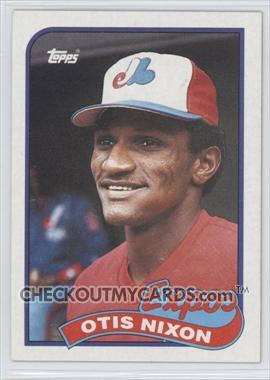
A case in point: Otis Nixon.  Otis Nixon the real person was a journeyman player, playing for nine teams, a career .270 hitter who was an excellent base-runner (he still holds the Atlanta Braves single season mark for stolen bases, a stat that didn’t enter into this game. . .), but essentially a b-list baseball player, if that.  (He is also reported to have had a bad coke problem.)  Nixon was the absolute hero of this game, however.  For whatever serendipitous reason, Nixon, or perhaps his card, would always come through, winning the game w/ walk-off homeruns, getting a crucial hit, etc.  Of course this was all because of un coup de des, mere happenstance, but his name became meaningful to both my father and I b/c of his surrogate cardboard self and that card’s exploits in this game.  There was no reason Nixon, rather than someone else, should have received this mantle, but he did.[7] There was a running joke about “Otis!” that never ceased b/c of this, both my father and I perking up at the TV whenever his name was mentioned.
otis-nixon-21

In short, Nixon’s card became the physical embodiment of the chaotic possibilities inherent in organization, in putting that organization to work, to use.  W/o this archive, Nixon would have probably never been on my radar, he would have been merely another name in the long-list of athletes who have toiled away in general obscurity, even under the bright lights of The Show.  Somehow, even today, the phrase “Otis Nixon” cannot help but evoke the play inherent in archiving, or the archiving inherent in play.  The whole thing was sheer numbers, math, objective and quantitative meaning making—but Nixon transcended the numbers.  Even though his batting avg. may have been low in the subsequent years of my playing of this game, I always included him on my teams, b/c he always came through, did amazing, impossible things.  Like Dionysus, he leapt fully formed from the archive, destroying the banal and brutal logic of it.

I no longer have any of my cards, they were a burden when I had to liquidate my objects when moving out of my childhood home, and the guy at the card-shop said they were pretty much monetarily worthless.[8] And they were . . . worthless.  Only the entirety of them, the ridiculous archival logic which could produce meaning under the sign of “Otis Nixon” gave them any worth at all.  I never collected for the rarity of the thing—I’ve always been the type of person that would far rather play w/ the toy than leave it in its box to accumulate value—but rather for the sheer immensity that collecting produced, the grand-narrative of the object, of “Otis Nixon.”

In the subsequent years after I disgorged myself of the burden of that particular archive (for archives are always a form of burden), I also gave up “sports,” in an adolescent attempt to disavow the name of the father, or in a naïve punk-rock anti-dominant-culture-gesture—which of course ultimately resulted in my nostalgic rediscovery of baseball and the joy of the archive of baseball a few years later, coincidentally coinciding w/ my move to Pittsburgh and my attendance of a Pirates game.  All that archive fever rushed back, all the ironic cynical posturing disappeared in a rush of fully authentic joy over reading through the entirety of the 2005 Baseball Encyclopedia, relishing in every page and stat, in Babe Ruth’s ridiculous number b/t 1919 and 1920 (the year the ball was “juiced” [sic]), in re-watching Ken Burns’ (magnificent) Baseball, in laboriously working through DeLillo’s Underworld, dismaying that the first chapter never made a reappearance, in procuring a Ralph Branca baseball card for the sheer gravitas it signified, and still signifies, to me.

ralph-branca1

In other words, perhaps my problem w/ sports and baseball in particular was never a problem of the “game itself,” but not understanding that it was the archive of the thing I enjoyed, the collecting, categorizing, hierarchizing mode I experienced it through overflowed the reality of the thing.  It is surely not novel to suggest and point out that this is largely how we interact w/ sport: obsessing over ridiculously specific numbers,[9] creating meaning out of the relationships b/t  objectively insignificant details, all in the name of some way comprehending that which is beyond us, putting it w/in our power of understanding, firmly placing it w/in our archive.  Not to belabor the point, but is this not a clear instance of the primacy of writing, of inscription that Derrida argues is not subordinate to the spoken word in Of Grammatology, that the actual homerun is in no way more pure or meaningful, more originary than the entry of the homerun into the record book?  And does this not all only make sense under the heading of the Otis Nixon Baseball Card?  The baseball card is just another machine for living, just another sublime pathological instantiation of the reinscribing archive, and this, I am suggesting, in no way poses a limit to the possibilities of that reinscription, in no way closes off realms of experience because of their overt over-codification.

(This discussion will be continued in the next entry.)


[1] For the purposes of brevity, I will reserve the rest of this discussion, of the second example, for the next entry into the index.


[2] A ritual (the supermarket every Sunday, not the baseball card purchasing) that lasted until I left home.  After baseball cards, it was comic books and magazines (Sports Illustrated for Kids, Rolling Stone), and then just simply groceries.  It was a weekly bonding experience for my father and me, one which became increasingly significant as I got older and he got more and more sick.  By the time I was 16 or 17, my father was far less interested in what time I got home on a Saturday night, than if I was going to be able to wake up in time to go grocery shopping w/ him in time to catch the first football games of the day (it was Arizona, so this would have been either 10 or 11 am depending on DST).  This was also a kind of archiving, of experiencing the weekly ritual of procuring food in an ordered and consistent manner, a catalogue of consuming.  Though this is perhaps heresy, this act of grocery shopping has always made me only cerebrally and distantly able to relate to things like the description of the supermarket in Don DeLillo’s White Noise (1985) or Allen Ginsberg’s Whitman-esque “A Supermarket in California” (1955).  I get the critique, and even the celebration and religiosity which each enact, but they have always seemed somewhat false and inconsistent w/ my own experiences.

[3] For my purposes here I am limiting my scope to baseball cards, b/c they made up the bulk of my small cardboard picture collection, but the same could also be said about (and indeed I had) football cards, basketball cards, and later in my nerditude, Magic: The Gathering cards.  Magic cards are perhaps the most insidious in their proliferation, mainly b/c they pretend to be useful, something baseball cards make no claim for, even if that didn’t prevent me from making use of them.

[4] Though I can distinctly remember receiving the entire 1988 line of Topps cards, a boon I wasn’t even aware of the magnitude of.

[5] I think I got an old Dodger third-baseman card off of Steven Eddy for some José Canseco cards, but I could be mistaken.

[6] Of course I am also suggesting a correlation between the conundrum of organizing baseball cards, and organizing other things (namely books, but also records, CDs, DVDs, files, etc.).  See Alberto Manguel’s quite interesting discussion of the conundrums of organization in The Library at Night (New Haven: Yale University Press, 2008 [2006]).

[7] Which made it all the worse when he robbed Andy Van Slyke of my father’s beloved Pirates of a homerun in 1992.

[8] B/c of the very proliferation which occurred in the baseball card industry in the late ‘80s, right when I started collecting.  So many were made, that they literally, even the “rare” ones, weren’t worth the cardstock they were printed on.  I donated them to Goodwill, and hopefully someone somewhere is enjoying them to this day (and has hopefully reorganized them as well).

[9] Case in point: Bonds’ homerun mark.

A Node

A node. Nothing more. This is simply an attempt to establish a definable point w/in the interstices which have now been claimed to be inaccessible to hermeneutics, to give reiteration to a past that is always repeating itself w/in the unstable moment, w/in the hyperarchive. We are not all hypertopians. There may still be a little Neil Perry[1] in us just yet. Let us open the doors.


[1] “Nine Minutes of Nonfiction,” Lineage Situation (Level-Plane Records, 2003); or, Dead Poets Society (dir. Peter Weir, 1989), played by Robert Sean Leonard.