“What we really want, when we think that we love a work of art, is for it to overwhelm us, trample us, and crush us into bits. We hate and resent creators, above all, because they see right through us: they understand our secret lust for annihilation, and they offer to fulfill it.” Steven Shaviro, Connected
Oh, Apocalypse Youtubes. . . (Eve of Destruction)
A Brief Note on a Minor Nuclear Plot Point in The Event
Two Mondays ago (NBC’s replacement for the original Law and Order [kidding]) The Event proposed as one of its plot points that whatever extraterrestrial or extra-dimensional people the US government had been holding captive since WWII were actually responsible for the atomic bomb, the Manhattan Project, and such. The Event is an interesting show so far, and perhaps lives up to its advertisement as what offspring 24 and Lost would have if they decided to copulate (neither show was on NBC, btw). But to be frank, the idea that nuclear technology wasn’t possible w/o the intervention of some advanced species, that we were “given” nukes to bolster some people’s (i.e. the “aliens’”) attempt to overcome their own state of being unheimlich, is tiresomely crazy. Yes, I tend to like concepts like Stargate or Battlestar Galactica that propose humans are not actually indigenous to Earth (or whatever), and yes, I appreciate alternate histories of all sorts, but to take away from humans their greatest accomplishment ever—the ability to destroy themselves in their entirety—is going too far.
An alternate history like this—that the US government, Oppenheimer, and all the rest—were not actually responsible for nuclear technology appears to me like a particularly insidious form of delusional revisionism. Not only does history easily refute this narrative point in The Event—if we allow it, the show makes the entire 20th-C. following it a colossal joke. Which it isn’t. SF has mined the depths of “what ifs” (take Philip K. Dick’s Man in the High Castle, for example), but it rarely makes us completely un-responsible. To suggest that human history is a whim of some advanced species is to suggest that nothing we do has any consequence whatsoever. And to do this is to completely degrade the very cultural artifact we ourselves are watching w/ pleasure (or at least b/c it isn’t as shitty as our day-to-day lives). In other words, a show that desperately wants our viewership, a show that is staking a claim on a now not-so-populated ground (read: there ain’t much SF on network TV no more), is suggesting that the very human history it is attempting to explore is not of our making, is a show desperately desiring to be cancelled after one season.
So You Want to Get a PhD in the Humanities?
This has been far too ubiquitous on a specific social networking site, and is really just far too spot on for me to not post here. Getting a PhD in the humanities may not be apocalyptic, but it sure feels like it.
Of Course Aliens Were Keeping Us Safe From Mutually Assured Destruction.
In a recent CNN report, 7 US Air Force personnel came forward and claimed to have seen UFOs hovering over nuclear missile sites, and in some cases shut down some of the systems in the missiles. Read this amazing absurdity here. Basically, this reveals what I knew all along: that the US and USSR could never have actually destroyed each other, b/c our benevolent alien overlords would have prevented it. No way the Cold War and the threat of MAD (Mutually Assured Destruction), and the various political and historical realities prevented this nuclear conflagration; it was the aliens!
Pittsburgh and Nuclear Disarmament
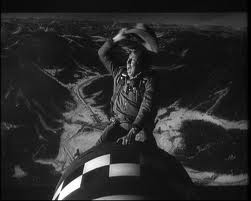
This weekend Pittsburgh Filmmakers and Pittsburgh’s local nuclear disarmament organization Remembering Hiroshima 2010, along w/ other events, are showing 3 films for an Atomic Weekend just down the street from me at the Melwood Screening Room. I’m gonna try to attend a few of the events, but def. Kurosawa’s I Live in Fear, a film I’ve been meaning to see for awhile. I had no idea this organization existed in the burgh, and I am very happy to see that it does and that it appears to be quite busy and active w/in the community. Please show your support. (And of course they’re also showing Dr. Strangelove.)
Can the Hyperarchive Make Our Choices for Us?
Well, according to chief executive of Google, Eric Schmidt, we at least want it to. Read William Gibson’s interesting op-ed piece on Schmidt’s statement and some of its implications here. Most of what he is talking about is old hat to most, but I esp. like the fact that he more-or-less says that google is a super-organism, and an Artificial Intelligence, even if it in no way resembles what we imagined AI to be. Furthermore, it means the archive is alive! It’s alive! Are we all royally screwed? or is the hyperarchive just going to have a really hard time choosing where it itself is going to eat dinner. Let’s hope so (so many choices. . .).
ENGLIT 0570: American Liteary Traditions
Today marks the beginning of a new school year, and it is one I am very much looking forward to, as I’ve designed the course I’m teaching, “American Literary Traditions,” subtitled, “The American Disaster: 21st C. Perspectives,” specifically around many of the avenues I’m exploring in a dissertation-type way right now. As such, I assume I will occasionally be posting on the progress of this course over the next year, and thought I’d provide the reading list for the fall semester:
Maurice Blanchot, The Writing of the Disaster, 2nd ed., trans. Ann Smock (Lincoln: University of Nebraska Press, 1995 [1986]).
Ralph Ellison, Invisible Man (New York: Vintage, 1953).
Herman Melville, Moby-Dick (Norton Critical Edition), 2nd Ed., eds. Hershel Parker & Harrison Hayford (New York: W.W. Norton & Co., 2002).
The Shock Doctrine (Matt Whitecross, Michael Winterbottom & Naomi Klein, 2009).
David Foster Wallace, Infinite Jest (New York: Back Bay Books, 1996).
Slavoj Žižek, Welcome to the Desert of the Real (New York: Verso, 2002).
It is an ambitious, and slightly idiosyncratic class, but I hope it proves challenging, thought-provoking, and fun for both my students and I. We’re watching a documentary adaptation of Naomi Klein’s The Shock Doctrine this first week, followed by reading Zizek’s book on 9/11 and Maurice Blanchot the following weeks, that’s before we even get to the three massive novels. I can’t wait to see how it all goes down.
Prelude to Cataclysm (An Addendum): What ELSE Happens When Bartleby Inhabits the World of Warcraft
A few months ago I posted a lengthy entry on a small socio-political experiment I performed in the turgid world of MMORPGs, “Prelude to Cataclysm: What Happens When Bartleby Inhabits the World of Warcraft.” Needless to say, this writing marked a kind of terminus in my experience of Azeroth. I have been more-or-less entirely absent from WoW since then, but for whatever reason last night I got a burr in my nose and re-visited Thescrivener.[1] As before, I did nothing but hit the number 8, uttering “I would prefer not to.” (There were also a few variations of this general statement. What they might have been will become apparent.) The evening turned out to be disturbing, upsetting, vile, and depressing.
To put it as simply as possible: the political exigencies of a fictional character created by one of the most impressive American writers of the 19th C., when actually explored, turn out to have been perhaps over-stated by some of the very impressive thinkers of the late 20th C. (Again, see above link.)
To put it even more simply: when Bartleby inhabits the World of Warcraft she gets raped. Repeatedly.
Last night I made Thescrivener sit in the AH doorway, uttering “I would prefer not to” on occasion, and quite quickly another character came along and began dancing right on top of her. This would have been funny/fairly innocuous, if not for the fact that a) he was basically rubbing his crotch in her face, simulating fellatio, and b) that this character’s actions were picked up by some less savory folk. (He disappeared, and I regret, esp. considering what happened afterward, not paying more attention to who he was initially.) Taking a cue from this man, one Eroza,[2] a female toon (but clearly a male player), proceeded to rub her crotch in my face on and off for well over an hour. Following this, a whole group of players (see n.2 below), for a really obscenely extended period of time, took turns, well (there’s no easier/less-blunt way to put this), fucking Thescrivener’s face.
The following is some of the dialogue from these unsavory folks:
“I think she’s a keeper.”
“She’s not much of a talker. . . she’ll be too busy w/ this.” (“This” should of course be obvious.)
“Yes, not polite to talk w/ your mouth full.”
“kk.” (Slang for okay.)
“Who’s next?”[3]
I am in no way claiming I was raped, nor do I feel like I was raped, but Thescrivener was repeatedly. And statements like, “I would prefer not to be raped,” and “I would prefer not to give you fellatio,” were not only ignored but laughed at.
Sure, these acts were vile, obscene, wrong, disturbing, and ultimately depressing. And of course who could expect anything more from people playing WoW, probably teenagers getting their rocks off. But it does reveal something quite profound about “humanity,” I feel. Namely, that rape and other violations are assuredly a possible outcome of a Bartlebian stance. The fact that I was able to maintain the purity of this stance—i.e. I said/did nothing other than expressing my preference not to do what I was being forced to do—leads, quite logically, to horror. (One can easily extend this in all sorts of hyperbolic ways.) And though this is assuredly something I considered initially, I was blinded by the politico-theoretical questions posed by the Bartlebian stance to see how Thescrivener could actually be treated in “reality.” In other words, w/o many people mobilizing to enact Bartleby, a lone Bartleby will be submitted to tortures of whatever imaginable kind, simply b/c people can. The question then may very well be, how is Bartleby simply not a perfect object for unadulterated sadism?
And this is a question I’m frankly too unnerved to answer, as I woke up this morning profoundly doubting humanity capable of much else beyond rapacious horror. Kurtz was right. When you confront the hard kernel of the Real, there is nothing else to say then simply acknowledge it w/ the phrase: “The horror. The horror.”
Don’t get me wrong, I realize WoW is virtual, a simulation, and that one of its attractions is that people can enact all sorts of fantasmatic desires they can’t in “real” life (like killing hordes of goblins/trolls/zombies/etc.). But at the end of the day, there are still humans on the other side of the screen doing things to other humans. The simple fact that these acts have no consequences (legal or otherwise) should in no manner lessen the brutality of the experience. If anything, it should make it worse. For if we take the famous Assassin at his word, “nothing is true, everything is permitted,” then WoW is the hyper-extension of this truth. It doesn’t, however, mean that we should take the Assassin at his word. If Azeroth is a world where “nothing is true, everything is permitted,” then I truly wish there were far more Bartlebys there.
[1] Seriously, if you don’t know what I’m talking about, read the first post. Link above in the first sentence.
[2] I have no desire to really research the perpetrators of what could be called nothing less than a heinous crime if it occurred in a(nother) World, but I did find these comments by Eroza online. The other toons involved, if anyone cares (and I urge you to, if at all possible), were the following members of the Galakrond community: Arcangle, Gabrius, Edanna, Galistin (esp. bad), Gonthorean, Malgant, Orhide, and Pathagarus. Most of them were b/t lvls 60-70.
[3] Thescrivener was also turned into a bunny rabbit for a period of time, and the violation continued. Why it was necessary to make an already passive creature into an even more passive object for the purposes of degradation were, it seems to me, unnecessary. But then how necessary is any of this anyway?
A (Little) Bit of DFW Archival Nonsense
(Note: for many the following may not come as news whatsoever, as the important events occurred in 2004 and 2009 respectively. For the rest, enjoy.)
Just read Jay Murray Siskind’s review of Boswell’s Understanding DFW and DFW’s Oblivion, “An Undeniably Controversial and Perhaps Even Repulsive Talent,” from a 2004 issue of Modernism/modernity. And the thing is, it took me all of, oh, four seconds to realize that this review was “written” by the same Jay Murray Siskind who so famously described the Most Photographed Barn in America in Don DeLillo’s White Noise. What is so incredible about this very small “hoax,” is that it took almost 5 years–and many serious citations of the review by graduate students, mind you–for anyone to notice it, namely Mark Sample over at Sample Reality. (Also read about it here and here and here.) Even more surprising w/r/t this “hoax” is the clear fact that Hal Incandenza is referenced as an author in the first footnote! For anyone working on DFW to not notice this, nor, perhaps even more criminally, to not read footnotes in an article on DFW (!), well. . . .
Sample and others are clear to point out that this “Littlest Literary Hoax” suggests some fairly dark things about academic publishing and scholarship–i.e. did anyone actually read the article in the first place (or does anyone even read literary scholarship much at all, for that matter); that more people have responded in the electronic realm (i.e. no published self-account in Modernism/modernity); and that a whole army of grads and undergrads referenced the article w/o any awareness whatsoever of White Noise (seriously, isn’t White Noise, like, as close to required pomo reading as it gets [w/ the exception, say, of Beloved]? Like Cont. Am. Lit.’s version of Relativity for Physicists?). But, then again, I wonder how many people, like myself, quickly caught the hoax, laughed a bit to themselves, found it clever, and immediately suggestive of a whole host of interesting pomo/popomo(/not to mention mo) debates that DFW is so clearly involved in, and then simply moved on, for it was essentially nothing more than a (fairly good and funny) book review–these various (fictional) readers not feeling the need, unlike my current self, to comment much further on it in any other forum.
Either way, though, the archival implications of this are fairly interesting, if for no other reason than DFW’s clear affinity for DeLillo; my own sense is that the very explosive archival nature of DFW’s work almost calls forth or demands that Hal Incandenza enter into the real world of ideas through a footnote to some obscure and (clearly) overlooked academic article. Hyperachivization indeed. (Also, Incandenza’s title is telling: How I Conquered Analysis: Ten Ways to Dupe Your Therapist [Elisingborg: Yorick Press, 1998], or perhaps a better title would be: Ten Ways to Dupe Literary Scholars Who Clearly Haven’t Read Enough (of What They’re Supposed to be Getting Paid to Read) and Didn’t Even Get the Hamlet! References in the Footnote.)
Anyway, just thought I’d (re-)share. And now, (back) to the archive, and step on it!
 The Hyperarchival Parallax