Newsweek (of all publications. . . ) has just made available many pages from the David Foster Wallace Archive at the University of Texas available. Check out a bunch of stuff that didn’t make the cut for the final draft of Infinite Jest here.
Barth on the Novel
Whether historically the novel expires or persists as a major art form seems immaterial to me; if enough writers and critics feel apocalyptical about it, their feeling becomes a considerable cultural fact, like the feeling that Western civilization, or the world, is going to end rather soon. If you took a bunch of people out into the desert and the world didn’t end, you’d come home shamefaced, I imagine; but the persistence of an art form doesn’t invalidate work created in the apocalyptic ambience.
John Barth, “The Literature of Exhaustion”
Skyline and Adorno
(Note: The following may sound hyperbolic. It isn’t.)
I had the great misfortune to go see Skyline (The Brother’s Strause, 2010) last night, or perhaps I made the great blunder, for I went voluntarily (to the death of Western culture as we know it). I’d love to detail in every single way that it was bad—for basically, it has achieved that near-impossible feat of being an aesthetic product with absolutely no critical response possible to it—but to do so would require a dissertation in-and-of-itself. But b/c it was bad in so many, many ways, a few examples are perhaps necessary. Like, for instance, it was a disaster movie that was basically set in an apartment. So we had to care about how the characters interacted and stuff. And I didn’t. At all. In no way were sympathy, empathy, or detached irony evoked in me. It was like watching a happy meal get older (i.e. nothing happens) in terms of temporal-narrative arc. Skyline makes 2012 look like an absolute masterpiece—which maybe now to think of it, it is (see, this is the kind thinking this movie causes; see me on 2012 here and here). It was so bad I had to apologize to myself that I saw it, and indeed anyone who was unfortunate enough to be in the theater w/ me.[1] It made me wonder why I thought Spiderman 2, 3, and Once Upon a Time in Mexico were all so bad that I had to get up and walk out of the theater during them b/c Skyline was so bad I didn’t leave, it was like watching a train wreck in hyper-slo-mo.[2] So anyway, definitely the worst SF/disaster/alien/apocalypse/brain eating/brain replacing/apartment melodrama of the 2010s so far.
But this is the kicker, Skyline functions in such a way that we are invited to read the following in a different fashion:
Only by subordinating all branches of intellectual production equally to the single purpose of imposing on the senses of human beings, from the time they leave the factory in the evening to the time they clock on in the morning, the imprint of the work routine which they must sustain throughout the day, does this culture mockingly fulfill the notion of a unified culture which the philosophers of the individual personality held out against mass culture.[3]
Alright, yes, Skyline as an aesthetic product treats itself as nothing more than a vehicle for $, and the experience of watching it feels like being at a particularly nasty low-level type job (say dishwashing or sewage maintenance), where you don’t have any choice but to barrel on through, but, and this is the kicker: Skyline achieves the impossible dream of making any critique of this type of intellectual/aesthetic labor impossible within its space, b/c it has made the film so impossibly unreadable, so critically unavailable to any detached engagement, as to turn the notion of art=labor into formal/aesthetic principle. There is nothing, quite literally nothing in the film around which a coherent critical reading could grasp at something to talk about, let alone something interesting to talk about. There aren’t even that many cool explosions or special effects, which is why you go see such a film in the first place! It is like pure labor in that it doesn’t muck up the well w/ all that sublimity or beauty, a perfect moment of clarity at our total reification and the completeness w/ which the culture industry has absorbed everything. Perfect panoptic control. Here is an empty object, something we can’t even fill up w/ our own anxieties or sublimated affect, b/c its like a sucking black hole of thought and imagination, a kind of reverse-emergence (maybe it shows “demergent” properties? anyone?); it is the goddamn void at the center of being.
And this is all to say that I was writing something else and I came across this quote from Adorno, and wasn’t sure whether to use it in there or not, but surely it was an excuse to put it on here. Sklyine is some kinda hyper-Adornoian nightmare. The kind that shivers under the blankets of the actors in Endgame, the ash falling outside their windows. The kind that makes me scared that I just go see films like this so I have an excuse to write about them, and then realize, why yes I do, but I don’t even have anything to say about this other than it confounds any attempt to say anything about it w/ its profound horribleness. Well. We’ve perhaps reached the end of something.
I mean, can we ever even take aliens seriously again after this? Or eating brains for that matter? These have been two beloved b-movie tropes for decades now, and Skyline might have single-handedly sounded their death-knell. Are we only to have werewolves and vampires to look forward to? No alien destruction from the sky? No zombies slurring out a barely audible, “braaaaaaaaaaaaaaaaiiiiiiiiiiiiiiiiiiiiinnnnnnnnnnnnnnnssssssssssssss!” Hell, we can’t even take Donald Faison of Scrubs fame seriously anymore, b/c his acting on that show, in comparison, is like Lifetime Emmy Achievement Award-caliber.
And the worst part? It’s not even good as pure labor. B/c no work is done. It doesn’t make us want to buy anything. It doesn’t make us want to work more. Nor abuse substances. Nor even watch more movies and television. It doesn’t make me feel like an individual w/ hopes, dreams, aspersions, commitments, responsibilities, etc. It makes me want to sleep (perhaps). But even then. It enacts a kind of zen nothingness at the heart of capitalist entertainment, an urge to simply sit and stare endlessly. (Weird, this has been a recent theme for me, I wonder why?) Sklyine is a kind of utopian non-space outside of the dominating logic of labor. And yet it is no less controlling b/c of that.
It achieves perfect aesthetic banality. And it is freaking evil. No one should have ever been permitted to make this film, let alone show it to anybody. If art can be dangerous, deadly even, Skyline is. In short, if an “Anti-Entertainment” perhaps exists in the pages of Infinite Jest, a virus to infect the effects of “The Entertainment,” nullifying our enjoyment of anything whatsoever, it is Skyline.
[1] More entertaining than Skyline?: The throngs of teenaged girls and boys lined up to be the first in line to see Harry Potter nearly 10 hours before it premiered. They at least, like, had capes and shit.
[2] Oh yeah, and of course there was this particularly zany shot of the character’ running in slow motion, before a weird tentacle thing came and snatched the woman into a sort of womb-stomach-like thing, and then extracted its brain, and replaced its own w/ the new brain—i.e. brains are, like, batteries. (Yes, you heard right: the aliens in this movie are motivated by eating brains, a kind of über-zombie-apocalypse. Oh wait, oops, I just made this movie sound more interesting simply by using the English language in a coherent fashion—i.e. none of the character’s knew how to enunciate their dialogue—for that I apologize, for even the brain eating was stupid.)
[3] Theodor Adorno & Max Horkheimer, The Dialectic of Enlightenment: Philosophical Fragments, ed. Gunzelin Schmid NOerr, trans. Edmund Jephcott (Stanford: Stanford University Press, 2002), 104.
Foucault
The twentieth century will undoubtedly have discovered the related categories of exhaustion, excess, the limit, and transgression—the strange and unyielding form of these irrevocable movements which consume and consummate us.
—Michel Foucault, “Preface to Transgression”
Shaviro on Art
“What we really want, when we think that we love a work of art, is for it to overwhelm us, trample us, and crush us into bits. We hate and resent creators, above all, because they see right through us: they understand our secret lust for annihilation, and they offer to fulfill it.” Steven Shaviro, Connected
Oh, Apocalypse Youtubes. . . (Eve of Destruction)
A Brief Note on a Minor Nuclear Plot Point in The Event
Two Mondays ago (NBC’s replacement for the original Law and Order [kidding]) The Event proposed as one of its plot points that whatever extraterrestrial or extra-dimensional people the US government had been holding captive since WWII were actually responsible for the atomic bomb, the Manhattan Project, and such. The Event is an interesting show so far, and perhaps lives up to its advertisement as what offspring 24 and Lost would have if they decided to copulate (neither show was on NBC, btw). But to be frank, the idea that nuclear technology wasn’t possible w/o the intervention of some advanced species, that we were “given” nukes to bolster some people’s (i.e. the “aliens’”) attempt to overcome their own state of being unheimlich, is tiresomely crazy. Yes, I tend to like concepts like Stargate or Battlestar Galactica that propose humans are not actually indigenous to Earth (or whatever), and yes, I appreciate alternate histories of all sorts, but to take away from humans their greatest accomplishment ever—the ability to destroy themselves in their entirety—is going too far.
An alternate history like this—that the US government, Oppenheimer, and all the rest—were not actually responsible for nuclear technology appears to me like a particularly insidious form of delusional revisionism. Not only does history easily refute this narrative point in The Event—if we allow it, the show makes the entire 20th-C. following it a colossal joke. Which it isn’t. SF has mined the depths of “what ifs” (take Philip K. Dick’s Man in the High Castle, for example), but it rarely makes us completely un-responsible. To suggest that human history is a whim of some advanced species is to suggest that nothing we do has any consequence whatsoever. And to do this is to completely degrade the very cultural artifact we ourselves are watching w/ pleasure (or at least b/c it isn’t as shitty as our day-to-day lives). In other words, a show that desperately wants our viewership, a show that is staking a claim on a now not-so-populated ground (read: there ain’t much SF on network TV no more), is suggesting that the very human history it is attempting to explore is not of our making, is a show desperately desiring to be cancelled after one season.
So You Want to Get a PhD in the Humanities?
This has been far too ubiquitous on a specific social networking site, and is really just far too spot on for me to not post here. Getting a PhD in the humanities may not be apocalyptic, but it sure feels like it.
Of Course Aliens Were Keeping Us Safe From Mutually Assured Destruction.
In a recent CNN report, 7 US Air Force personnel came forward and claimed to have seen UFOs hovering over nuclear missile sites, and in some cases shut down some of the systems in the missiles. Read this amazing absurdity here. Basically, this reveals what I knew all along: that the US and USSR could never have actually destroyed each other, b/c our benevolent alien overlords would have prevented it. No way the Cold War and the threat of MAD (Mutually Assured Destruction), and the various political and historical realities prevented this nuclear conflagration; it was the aliens!
Pittsburgh and Nuclear Disarmament
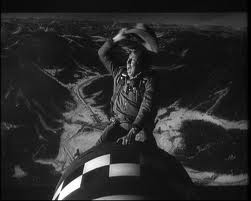
This weekend Pittsburgh Filmmakers and Pittsburgh’s local nuclear disarmament organization Remembering Hiroshima 2010, along w/ other events, are showing 3 films for an Atomic Weekend just down the street from me at the Melwood Screening Room. I’m gonna try to attend a few of the events, but def. Kurosawa’s I Live in Fear, a film I’ve been meaning to see for awhile. I had no idea this organization existed in the burgh, and I am very happy to see that it does and that it appears to be quite busy and active w/in the community. Please show your support. (And of course they’re also showing Dr. Strangelove.)
 The Hyperarchival Parallax