The most recent issue of Hot Metal Bridge, Pitt’s graduate-run literary journal, just went live. HMB is currently being edited by my good friend Jennifer Howard.

The most recent issue of Hot Metal Bridge, Pitt’s graduate-run literary journal, just went live. HMB is currently being edited by my good friend Jennifer Howard.
Kim Stanley Robinson, a master of imagining different geoengineering and terraforming projects in his novels, talks about the future in a short but poignant essay, “Earth: Under Repair, Forever.”
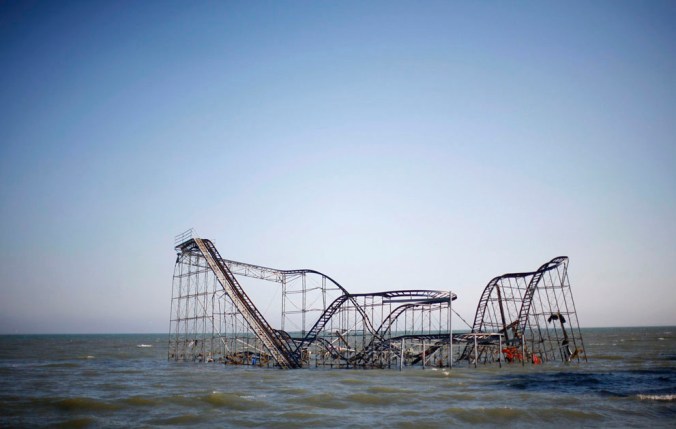
(The above is from The Atlantic‘s pretty astounding “2012: The Year in Photos.”)
Heather Havrilesky has an article published today on Vulture titled, “Why TV Apocalypses Are Really Wish-Fulfillment Fables.” There is some (psychoanalytic) ground being retread here, but I can’t help but smile at the following statements: “Cormac McCarthy’s The Road at first appears bereft of wishful thinking — that is, until you recognize that solitude and scorched horizons are this author’s ideal tromping ground”; and, referring to NBCs Revolution: “This is the apocalypse with a full-time stylist, on heavy antibiotics.”
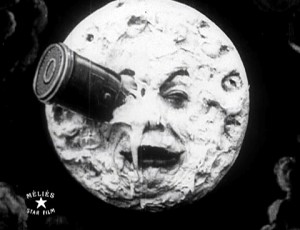
It was reported on Monday that “[i]n a secret project recently discovered, the United States planned to blow up the moon with a nuclear bomb in the 1950s as a display of the country’s strength during the Cold War space race.” Yes. The US was legitimately planning on blowing up the moon. The. Moon. Take that moon.
James Atlas wrote a piece, “Is this the End?” in Sunday’s New York Times discussing narrative eschatology with regard to Sandy and rising oceans and the sustainability of NYC: “Last month’s ‘weather event’ should have taught us that. . . in 50 or 100 or 200 years, there’s a good chance that New York City will sink beneath the sea.”
(In his I think monthly column “Easy Chair”) Thomas Frank has an article on “the 2012 canon of doom” in December’s issue of Harper’s, titled (cleverly . . .) “Appetite for Destruction.”
I’m currently discussing DFW’s “E Unibus Pluram: Television and U.S. Fiction”[1] with my freshman English class, and so of course it was quite appropriate that Christy Wampole just wrote an opinion piece in Saturday’s New York Times, “How to Live Without Irony.”
To address this issue, the Wikimedia Foundation is collaborating with JSTOR, a service of the not-for-profit organization ITHAKA, to provide 100 of the most active Wikipedia editors with free access to the complete archive collections on JSTOR, including more than 1,600 academic journals, primary source documents and other works. The authors who will receive accounts have collectively written more than 100,000 Wikipedia articles to date. Access to JSTOR, which is one of the most popular sources on English Wikipedia, will allow these editors to further fill in the gaps in the sum of all human knowledge.
And The New Yorker has a piece by Gary Marcus on “Ray Kurzweil’s Dubious New Theory of Mind.”
[1] There are two things to note about this link: 1) it links to a .pdf of the original Review of Contemporary Fiction piece from 1993, so is (perhaps) slightly different than its final appearance in A Supposedly Fun Thing I’ll Never Do Again (1997), and 2) it is dedicated to “M.M. Karr” (Mary Karr), which takes on all sorts of different significances in the wake of Max’s biography of DFW.
On his blog, Charles Stross, author of such works as Accelerando (2005), the wonderful novella “Palimpsest” in the collection Wireless (2009), and Glasshouse (2006), among others, thinks about what the world will be like in 2512. Interesting (and harrowing) stuff.
Thanks to R. for drawing my attention to Andrew Martin’s article, “Hurricane Sandy and the Disaster Preparedness Economy,” in Saturday’s New York Times that details yet another example of what Naomi Klein calls “disaster capitalism” (though this is admittedly a bit different than, say, Iraq or Chile . . .) in her 2007 book The Shock Doctrine. An excerpt:
It’s all part of what you might call the Mad Max Economy, a multibillion-dollar-a-year collection of industries that thrive when things get really, really bad. Weather radios, kerosene heaters, D batteries, candles, industrial fans for drying soggy homes — all are scarce and coveted in the gloomy aftermath of Hurricane Sandy and her ilk.
It didn’t start with the last few hurricanes, either. Modern Mad Max capitalism has been around a while, decades even, growing out of something like old-fashioned self-reliance, political beliefs and post-Apocalyptic visions. The cold war may have been the start, when schoolchildren dove under desks and ordinary citizens dug bomb shelters out back. But economic fears, as well as worries about climate change and an unreliable electronic grid have all fed it.
My good friend Salvatore Pane (or whatever you are calling yourself these days mr. pane) just got a writeup/interview in The Huffington Post by Teddy Wayne for his new/first novel, Last Call in the City of Bridges. Check it.
n+1, in honor of Sandy (so they say), just reposted this essay-review by Chad Harbach of Matthew Sharpe’s Jamestown (2007) and a host of other post-catastrophe lit, “The End, The End, The End.” Like Robert Charles Wilson’s recent Julian Comstock: A Story of 22nd Century America (2009), the catastrophic novels Harbach discusses lie on the other side of global oil-depletion: “Now we’ve burned half the available oil, or close to it, and burning it (along with so much coal) has altered the earth’s equilibrium. Our future, like our past, may be virtually free of oil, and global culture, and many of the social safeguards we enjoy. Thus the novel of future catastrophe threatens to become a version of the historical novel.” Harbach also has an old review of DFW’s Oblivion for n+1.
 The Hyperarchival Parallax