So it looks like my first speculation about when this novel was going to be set has turned out to be true: the 1990s and/or 2000s, thereby completing his epic of the 20th c. The New York Times reports that Thomas Pynchon’s novel, Bleeding Edge will be out Sept. 17, and is “set in 2001, [and] takes place in ‘the lull between the collapse of the dot-com boom and the terrible events of September 11.’” Wow. 2001 seems close enough for me to feel like my speculation was accurate. Who would’ve thunk that maybe the best 9.11.01 novel might be Pynchon’s . . . .
The Apocalypse Archive: American Literature and the Nuclear Bomb
I have completed the first draft of my dissertation. Hopefully no more apocalypse for awhile. Not now.
Nukes and Zombies
The title probably says it all. This is a report on Stanford doctoral student, Angela Becerra Vidergar, and her work.
Today in Cyborgicity
The Huffington Post has two stories today on our posthuman present. The first is on “Google Glass” (Vernor Vinge‘s Rainbows End, here we come), glasses that give reality a much more user-friendly overlay (also notice the GPS in the video). The second is Cyberdyne’s (seriously) Hybird Assistive Exoskeleton. It is weird to live in the future.
New Findings in Cosmic Eschatology
Irene Klotz writes about Joseph Lykeen’s report on how the discovery of the Higgs boson has made calculations about the future of the universe quite bleak indeed (even if the time scale is so massive as to be completely inaccessible to our anthropic notions / experiences of time):
“This calculation tells you that many tens of billions of years from now, there’ll be a catastrophe,” Lykken said. “A little bubble of what you might think of as an ‘alternative’ universe will appear somewhere and then it will expand out and destroy us,” Lykken said, adding that the event will unfold at the speed of light.
[. . .]
The calculation requires knowing the mass of the Higgs to within one percent, as well as the precise mass of other related subatomic particles. “You change any of these parameters to the Standard Model (of particle physics) by a tiny bit and you get a different end of the universe,” Lyyken said.
And George Dvorsky also reports on this at io9.

Meteor Strike in Russia
North Korea Nuclear Test
As is being reported all over today, “North Korea has drawn widespread condemnation after conducting a nuclear test in defiance of international bans – a development signaled by an earthquake detected in the country and later confirmed by the regime.” This is N. Korea’s third nuclear test; the others occurred in 2006 and 2009. The Guardian Quotes Dr. Leonid Petrov as saying, “‘The world is now a much more dangerous place.'” Indeed.
And Wired discusses how N. Korea’s weapons are getting bigger based on seismic readings.
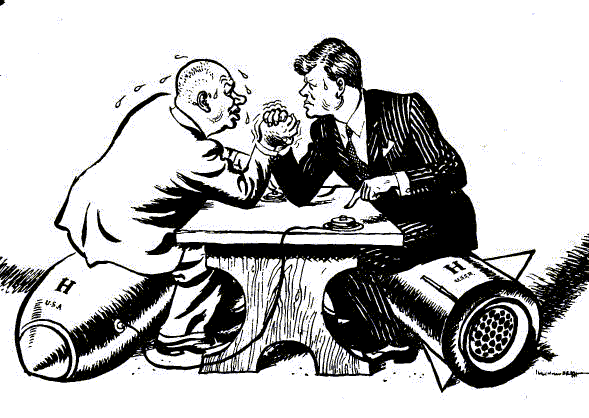
The Real Cuban Missile Crisis
Benjamin Schwartz over at The Atlantic writes that “everything you know about the Cuban Missile Crisis is Wrong,” in “The Real Cuban Missile Crisis.”
Data Mining the Literary Hyperarchive and Some Other Links
Ted Underwood, a professor of 18th and 19th century literature at the University of Illinois, Urbana-Champaign, has an interesting post on text mining and what is being called “distant reading,” “We Don’t Already Know the Broad Outlines of Literary History.” His blog is The Stone and the Shell: Historical Questions Raised by a Quantitative Approach to Language.
Some notes on the storm hitting the Northeast.
And io9‘s George Dvorsky reports on Lee Smolin’s theory of Cosmological Natural Selection, the idea that: “gives a kind of raison d’etre to our universe and all the objects flying through it. If true, it would mean that our universe is nothing more than a black hole generator, or a means to produce as many baby universes as possible.”
Forthcoming: The Silence of Fallout: Nuclear Criticism in a Post-Cold War World
I just sent along my corrected proofs for a chapter, titled “Apocalypse Networks: Representing the Nuclear Archive,” which will appear in The Silence of Fallout: Nuclear Criticism in a Post-Cold War World, to be published this spring by Cambridge Scholars Publishing, and edited by Michael J. Blouin, Morgan Shipley, and Jack Taylor. You can check out a description of the book here. And the book is available for pre-order on Amazon, Barnes & Noble, and many other booksellers. I am quite excited for this collection, which will include contributions from a number of notable scholars and nuclear critics, including Paul K. Saint-Amour, Daniel Cordle, and John Canaday.
 The Hyperarchival Parallax