The Concourse has a great map of the ways that Hollywood films have depicted the destruction of various locales in the US.

The Concourse has a great map of the ways that Hollywood films have depicted the destruction of various locales in the US.
Science
The first evidence for cosmic inflation–i.e., the Big Bang–was discovered this week.
Megan Garber at The Atlantic, “What It’s Like to be Right About the Big Bang?”
The search for Flight MH370 is revealing one thing: the ocean is filled with garbage.
Kim Stanley Robinson alert: Paul Rosenfeld, “Would You Take a One-Way Ticket to Mars?”
And as part of his forthcoming 3 million page novel, Breeze Avenue (2015), Richard Grossman has buried a crystal ball deep inside of Princeton Mountain in Colorado. The ball, “made of synthetic sapphire, which is almost as indestructible as diamond,” has the Ten Commandments inscribed on it in Hebrew, and in “20 million years, as a result of natural forces carefully calculated by the geologists, the Torah Ball will emerge from its eroded resting place and bear the Ten Commandments down the mountain.” Hyperarchivalists of the deep future rejoice!
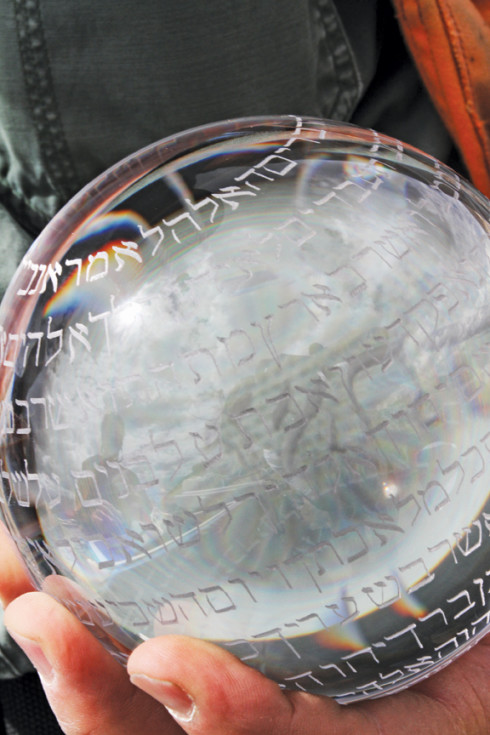
Richard Grossman, The Torah Ball (Synthetic Sapphire, Princeton Mountain, 20 Million Years of Erosion, 2011).
In “NASA-Funded Study: Industrial Civilization Headed for ‘Irreversible Collapse’?” Nafeez Ahmed reports for The Guardian on a recent study produced by the National Socio-Environmental Synthesis Center that “highlight[s] the prospect that global industrial civilisation could collapse in coming decades due to unsustainable resource exploitation and increasingly unequal wealth distribution.” The most striking thing about the report to me is its interdisciplinarity, mixing bleeding edge environmental science, historical perspective, economics, Marxist cultural analysis, etc.: “Elite wealth monopolies mean that they are buffered from the most ‘detrimental effects of the environmental collapse until much later than the Commoners,’ allowing them to ‘continue “business as usual” despite the impending catastrophe.’ The same mechanism, they argue, could explain how ‘historical collapses were allowed to occur by elites who appear to be oblivious to the catastrophic trajectory (most clearly apparent in the Roman and Mayan cases).'” We’re doomed.
Surveillance, consent, networks, numbers, the hyperarchival condition of the contemporary: Natasha Lennard writes “Of Being Numerous” for The New Inquiry.
This doesn’t seem like reading at all: the new “speed reading app.”
Rebecca Stoner in The Daily Sophist: “What’s Love Got to Do with Anything? DFW Biographer D.T. Max Speaks on Campus.”
“A Game is Being Beaten” by Leigh Alexander at The New Inquiry: “The trend in video game design is to comment on violence by asking players to perform violence. But could there be pleasure in performing consent?”
“How Benjamin Kunkel Went from Novelist to Marxist Public Intellectual” by David Wallace-Wells at Vulture.
“Between Two Ferns: The Selling of the President, 2014.”
A very interesting forthcoming issue of Critical Inquiry.
A(nother) soundtrack for the apocalypse. Track 1 seems especially doomy. (Thanks Michael.)
My good friend Ryan Pierson on The Lego Movie: “On the Nonessential Beauty of Legos.”
And because I saw it yesterday and enjoyed it (though I am a bit confounded by this fact), another: Andrew O’hehir for Salon: “The Lego Movie: Plastic Blocks Fight for Freedom!”
German philosophers play Monopoly. (I wonder what would happen if they got a game of Risk [The Game of Ruining Friendships] going.)
And sad news in hyperarchival realism. Google is redoing its Street View for many places in Pittsburgh, and thus Ben Kinsley and Robin Hewlett’s wonderful Street With a View is going away. (Right now it goes from a marching band in the rain to a deserted, sunny street. Uncanny.) Ah, the transitory internet–perhaps it isn’t an archive at all, for really, how do we archive the present in the present. . . .
A short film on Street With a View:
I am quite pleased to announce that, for the first time in quite a while, I will be reading some of my poems at Assemble in Pittsburgh, PA on Thursday, 27 March 2014. The reading has been put on by the Hour After Happy Hour Writing Workshop & Journal. Weenta Girmay, Tyson Himes, Jessica McNally, Jason Peck, and one of my former students, Amy Hayes, will also be reading. I am quite looking forward to sharing some of my recent writing with an audience. It has been far too long.
With the incursion of Russia into the Ukraine, a lot of stuff is going on.
Peter Baker in The New York Times, “Pressure Rising as Obama Works to Rein in Russia.”
“Ukraine, Putin, and the West” at n+1.
Peter Beinart for The Atlantic: “The Ukraine: Is This How the War on Terror Ends?”
Dominic Tierney for The Atlantic: “Putin’s Improv Act.”
David Rhode for The Atlantic: “Crimea: The Greatest Challenge to Geopolitics Since the Cold War.”
“Kerry Condemns Russia’s ‘Incredible Act of Aggression’ in the Ukraine.”
And a critique of The New York Times‘ coverage of Kerry.
Nuclear
“Aim Points in the US Nuclear Arsenal.”
Hans M. Kristensen, Director of the Nuclear Information Project, has authored an article for the Federation of American Scientists, “Obama and the Nuclear War Plan.”
Other
Noam Chomsky, “America’s Apocalyptic Imperial Strategy.”
Noam Chomsky, “The Death of American Universities.”
boundary 2‘s latest entry into its Great American Author Series, “A Political Companion to Walt Whitman” by Kerry Larson.
Ezra Klein, “The Real Reason Nobody Reads Academics.”
Things are happening very quickly in the Ukraine. David Remnick reports on the most recent events for The New Yorker in “Putin Goes to War.” He writes:
Vladimir Putin, the Russian President and autocrat, had a plan for the winter of 2014: to reassert his country’s power a generation after the collapse of the Soviet Union. He thought that he would achieve this by building an Olympic wonderland on the Black Sea for fifty-one billion dollars and putting on a dazzling television show. It turns out that he will finish the season in a more ruthless fashion, by invading a peninsula on the Black Sea and putting on quite a different show—a demonstration war that could splinter a sovereign country and turn very bloody, very quickly.
In other news, Luke O’Neil has a piece in Esquire: “The Year We Broke the Internet: An Explanation, an Apology, a Plea.”
From my old neck of the woods, “Say Goodbye to Phoenix–And the American West.”
And a blast from the past. A video for The Faint‘s new single, “Help in the Head,” from their forthcoming album Doom Abuse. I cannot help but see this video as a paranoid reflection on the total surveillance of contemporaneity.
The Chronicle of Higher Education has a discussion of Elaine Scarry‘s new book, Thermonuclear Monarchy: Choosing Between Democracy and Doom (2014). Nathan Schneider has written an extensive review of Thermonuclear Monarchy, “A Literary Scholar’s Voice in the Wilderness: Elaine Scarry Fights American Complacency About Nuclear Arms.” Scarry is also the author of the monumentally important, The Body in Pain: The Making and Unmaking of the World (1987).
“Melting Ice Makes the Arctic A Much Worse Heat-Magnet than Scientists Feared.”
January was actually one of the warmest months on record.
And more disastrous weather to come.
Davis and Michaels explaining why they’re striking at The Chronicle of Higher Education.
“Noam Chomsky: Zombies are the New Indians and Slave in White America’s Collective Nightmare.”
“David Foster Wallace, Mathematician.”
Samuel Cohen on Wallace, “Future Tense.”
My friend David Letzler reviews Thomas Pynchon’s Bleeding Edge (2013).
On Dead Poets Society (1989) and the humanities.
“Feminism, Depravity, and Power in House of Cards.” I just finished watching the fairly incredible second season last night.
Nicholas K. Geranios has has reported for the AP that “Whistle-blower Donna Busche, who raised safety concerns at the nation’s most polluted nuclear weapons production site, was fired Tuesday from her job at the Hanford Nuclear Reservation.” I feel like there’s been quite of bit of this kind of thing lately.
More Doomy
Brad Plummer has an interview with author of The Sixth Extinction Event, Elizabeth Kolbert (who was also on The Daily Show the other night) at The Washington Post.
“The NSA and Climate Change: What We Know So Far,” by Joshua Eaton.
“How Iowa Flattened Literature,” or rather, the CIA and the Writer’s Workshop.
NASA is going to turn the moon into computronium, ur, I mean give licenses to mine it.
Less Doomy
David Foster Wallace’s letter to his editor.
Dragonlance should be the next fantasy movie franchise. I agree, esp. if it means they make the Legends series into films.
A new anthology of post-apocalyptic fiction, Wastelands 2, edited by John Joseph Adams.
A pretty scathing review of Matthew Barney’s River of Fundament (2014) that actually makes me want to see it more.
And a book I had an essay appear in last year, The Silence of Fallout: Nuclear Criticism in a Post-Cold War World, was just selected as one of Zer0 Books‘ best books of 2013.
 The Hyperarchival Parallax