Special Issues of CounterText on Ranjan Ghosh and J. Hillis Miller’s Thinking Literature across Continents

I have written an essay, “Reading Now and Again:  Hyperarchivalism and Democracy in Ranjan Ghosh and J. Hillis Miller’s Thinking Literature across Continents,” which will appear in the spring issue of CounterText: A Journal for the Study of the Post-Literary, the second of two special issues devoted to Thinking Literature across Continents (Duke UP, 2016). I’ll provide more information about this essay at a later date.

In the meantime, the first issue of CounterText addressing Ghosh and Miller‘s book (vol. 3, no. 3) is now available. Additionally, a conversation between Marjorie Perloff, Charles Bernstein, and the two authors opening the special issue is available from behind the journal’s paywall.


“Thinking Literature Across . . .,” special issue, CounterText, table of contents:

Marjorie Perloff, J. Hillis Miller, Charles Bernstein. and Ranjan Ghosh, “The CounterText Conversation: Thinking Literature. . . .”

Maria Margaroni, “Dialogics, Diacritics, Diasporics: Ranjan Ghosh, J. Hillis Miller, and the Becoming-Now of Theory.”

Georges Van Den Abbeele, “Literary Intransigence: Between J. Hillis Miller and Ranjan Ghosh.”

Claire Colebrook, “Crossing Continents.”

Steven Yao, “How Many Ways of Thinking Literature across Continents?”

Pramod K. Nayar, “Literature/Ethics/Reading.”

Susana Onega, “Thinking English Literature and Criticism under the Transmodern Paradigm.”

Lene M. Johannessen, “Poetics of Peril.”

Adrian Grima and Ivan Callus, “Irreverent and Inventive Mamo.”

Juann Mamo, Nanna Venut’s Children in America: Two Chapters from the First English Translation,” trans. Albert Gatt.

Ivan Callus, “Literature, Journalism, and the Countertextual: Daphne Caruana Galizia, 1964–2017.”

Mario Aquilina, review of Essayism and the Return of the Essay, by Brian Dillon.

“Toward a Theory of the Megatext” in Scale in Literature and Culture

The first essay from my new project on unreadably large texts, “Toward a Theory of the Megatext: Speculative Criticism and Richard Grossman’s ‘Breeze Avenue Working Paper,'” has been published in Scale in Literature and Culture (Palgrave Macmillan, 2017), edited by Michael Tavel Clarke and David Wittenberg. The book includes essays by Bruno Latour and Mark McGurl. You can find the entire collection here through Springer Link if you have institutional access, or individual essays via the links below. The book is also available on Amazon. I’m happy to send along a copy of my essay to anyone who is interested (festb[at]hartwick[dot]edu).

Table of Contents for Scale in Literature and Culture

Michael Tavel Clarke and David Wittenberg, Introduction.

Scale: History and Conception

Zach Horton“Composing a Cosmic View: Three Alternatives for Thinking Scale in the Anthropocene.”

Derek Woods, “Epistemic Things in Charles and Ray Eames’s Powers of Ten.

Bruno Latour, “Anti-Zoom.”

Scale in Culture

Mark McGurl, “Making It Big: Picturing the Radio Age in King Kong.

Joan Lubin, “The Stature of Man: Population Bomb on Spaceship Earth.”

Aikaterini Antonopoulou, “Large-Scale Fakes: Living in Architectural Reproductions.”

Scale in Literature

Melody Jue, “From the Goddess Ganga to a Teacup: On Amitav Ghosh’s Novel The Hungry Tide.

Oded Nir, “World Literature as a Problem of Scale.”

Bradley J. Fest, “Toward a Theory of the Megatext: Speculative Criticism and Richard Grossman’s ‘Breeze Avenue Working Paper.'”

Jeffrey Severs, “Cutting Consciousness Down to Size: David Foster Wallace, Exformation, and the Scale of Encyclopedic Fiction.”

Mark Z. Danielewski on Facebook Live and “The Time of Megatexts”

Note: it appears that Danielewski had to postpone the Facebook Live event due to technical difficulties. I’ll be posting again when it has been rescheduled.

Mark Z. Danielewski will be appearing on Facebook Live to talk with the members of The Familiar (Volume 1-5) Book Club about his remarkable novel, The Familiar (2015-). He has distributed my recent conference paper, “The Time of Megatexts: Dark Accumulation and Mark Z. Danielewski’s The Familiar,” in advance. I invite you to read my essay and join in what should be an interesting conversation.

Pre-order Scale in Literature and Culture and Reading Inside Out: Interviews and Conversations, by J. Hillis Miller

Two new books are available for pre-order in which I have contributions.

Scale in Literature and Culture Cover

Scale in Literature and Culture, edited by Michael Tavel Clarke and David Wittenberg, and including essays by Bruno Latour and Mark McGurl, can now be ordered from Palgrave Macmillan. My contribution is the first part of my new project on megatexts: “Toward a Theory of the Megatext: Speculative Criticism and Richard Grossman’s ‘Breeze Avenue Working Paper.'”

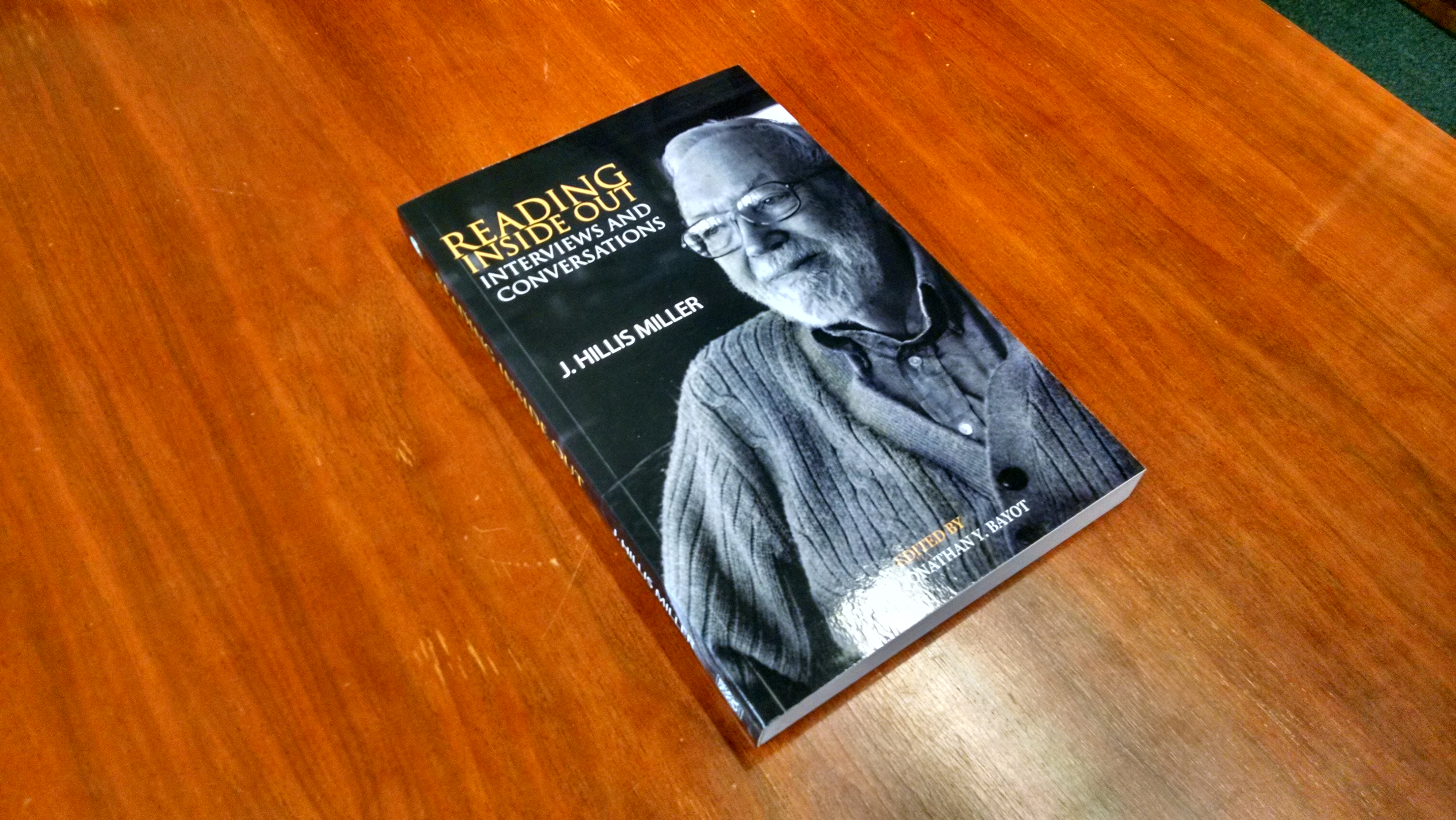
J Hillis Miller CoverJ. Hillis Miller’s Reading Inside Out: Interviews and Conversations, edited by David Jonathan Y. Bayot, is forthcoming from Sussex Academic Press and reprints my interview with Professor Miller from 2014, “Isn’t It a Beautiful Day?,” originally published in boundary 2.

Both books are also available on Amazon (here and here). (As both are also potentially prohibitively expensive, please do not hesitate to contact me requesting the essay or interview.)

The Shape of Things

The Shape of Things, my second book of poetry, is now available and shipping from Salò Press. Order it here if you’re in the UK and here if you are anywhere else. I am very proud of this book.

Bradley J. Fest’s second volume of poetry, The Shape of Things, continues his project of poetic assemblage. Written in an age of ubiquitous algorithmic surveillance and increasingly catastrophic climate change, these poems both describe the shape of things in the overdeveloped world and endeavor to challenge the widespread feeling that the imagination has been foreclosed in the twenty-first century. An ambivalent hyperarchive, the collection draws influence from a number of seemingly incompatible lyric registers, including the language of contemporary theory. The Shape of Things culminates in an eponymous long poem that asks if a poiesis of “network being” is possible and suggests that there might be some other way to dance to the sounds of our present.


If Whitman and Adorno had a knife fight on the ruins of the floor of the New York Stock Exchange, The Shape of Things would be the perfect voice over. Which is to say, though it’s not a pretty scene, there’s pleasure and beauty to be found in the action and music of the syntax and in following the wild movements of this poet’s mind. Truly original, dazzlingly smart and game for anything, Fest writes of lives and desires torn apart by the neoliberal security state. Jolting between paranoiac rage and orgasmic bliss, between all- out negation and Wordsworthian swoon, these poems describe the awful implications of a contemporary moment in which “we have made ourselves a gallows of a house.”

–Sten Carlson, author of Fur & After

To call The Shape of Things “post-apocalyptic” would be a mistake: its poignant present tense anxiety unfolds in the apocalypse now. Ataris and hunter-gatherers lean together over the edge of time, commingling in harrowing yet pleasurable ways. But this is no book of “detached mirth.” Hear in Fest’s singing the quiet pathos of humans and machines out of time. While Fest’s human creatures have lulled themselves into submission—”There may be something (virtually) / on fire. More likely our expectations are being met . . .”—his work nudges middle class late capitalist culture awake into the disturbing awareness that “a prolonged adolescence is the shape of things.”

–Robin Clark, author of Lines the Quarry