Hartwick College, where I am currently assistant professor of English, has issued a press release in which I am quoted as saying various things about my new book, The Shape of Things (Salò, 2017).
Publications
The Shape of Things
The Shape of Things, my second book of poetry, is now available and shipping from Salò Press. Order it here if you’re in the UK and here if you are anywhere else. I am very proud of this book.
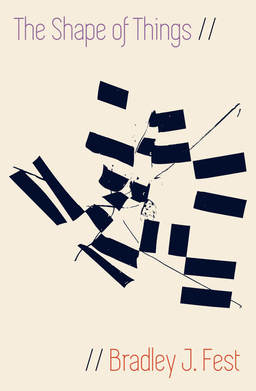 Bradley J. Fest’s second volume of poetry, The Shape of Things, continues his project of poetic assemblage. Written in an age of ubiquitous algorithmic surveillance and increasingly catastrophic climate change, these poems both describe the shape of things in the overdeveloped world and endeavor to challenge the widespread feeling that the imagination has been foreclosed in the twenty-first century. An ambivalent hyperarchive, the collection draws influence from a number of seemingly incompatible lyric registers, including the language of contemporary theory. The Shape of Things culminates in an eponymous long poem that asks if a poiesis of “network being” is possible and suggests that there might be some other way to dance to the sounds of our present.
If Whitman and Adorno had a knife fight on the ruins of the floor of the New York Stock Exchange, The Shape of Things would be the perfect voice over. Which is to say, though it’s not a pretty scene, there’s pleasure and beauty to be found in the action and music of the syntax and in following the wild movements of this poet’s mind. Truly original, dazzlingly smart and game for anything, Fest writes of lives and desires torn apart by the neoliberal security state. Jolting between paranoiac rage and orgasmic bliss, between all- out negation and Wordsworthian swoon, these poems describe the awful implications of a contemporary moment in which “we have made ourselves a gallows of a house.”
–Sten Carlson, author of Fur & After
To call The Shape of Things “post-apocalyptic” would be a mistake: its poignant present tense anxiety unfolds in the apocalypse now. Ataris and hunter-gatherers lean together over the edge of time, commingling in harrowing yet pleasurable ways. But this is no book of “detached mirth.” Hear in Fest’s singing the quiet pathos of humans and machines out of time. While Fest’s human creatures have lulled themselves into submission—”There may be something (virtually) / on fire. More likely our expectations are being met . . .”—his work nudges middle class late capitalist culture awake into the disturbing awareness that “a prolonged adolescence is the shape of things.”
–Robin Clark, author of Lines the Quarry
The Shape of Things Available for Pre-Order
 My second volume of poetry, The Shape of Things, is now available for pre-order from Salò Press. It will begin shipping September 1, 2017.
New Position at Hartwick College
 I am delighted to announce that I have accepted the position of Assistant Professor of English at Hartwick College in Oneonta, New York, where I will be teaching creative writing, poetry, and twentieth- and twenty-first-century United States literature and culture. I will be joining Hartwick’s English Department this fall and will be teaching three classes: Introduction to Creative Writing (ENGL 213), Reading Modern Poetry (ENGL 250), and Creative Writing: Poetry (ENGL 312). I am really excited about this new chapter in my life and career. Thanks to all those–too numerous to name–who have supported me along the way; your indefatigable encouragement has meant so much.
“2015.13,” “2015.16,” “2015.25,” and “2015.27” in Grain
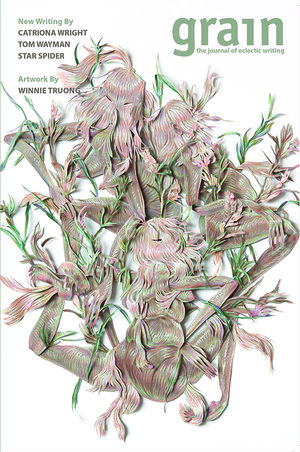
Four more sonnets from my ongoing sequence were just published in vol. 44, no. 3, of Grain: The Journal of Eclectic Writing. The issue is titled “Relativity of Zen,” is edited by Adam Pottle, and can be purchased here.
“Toward a Theory of the Megatext” Forthcoming in Scale in Literature and Culture
“Toward a Theory of the Megatext: Speculative Criticism and Richard Grossman’s ‘Breeze Avenue Working Paper,'” the first essay from a new project on what I have been calling megatexts, will appear in Scale in Literature and Culture, edited by Michael Tavel Clarke and David Wittenberg. The collection of essays will be published by Palgrave Macmillan and will hopefully come out later this year. More information to come.
The Shape of Things, Forthcoming from Salò Press
I am happy to announce that my second volume of poetry, The Shape of Things, will be published this summer by Salò Press. More details to come.
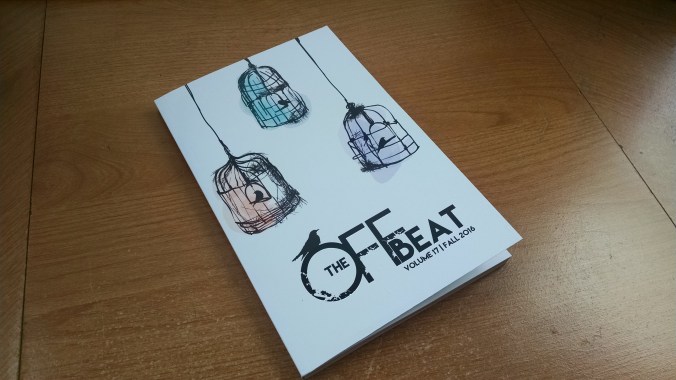
“2015.17” in The Offbeat
“2015.17,” a poem from my ongoing sonnet sequence, just appeared in volume 17 of The Offbeat.
“Mobile Games, SimCity BuildIt, and Neoliberalism” at First Person Scholar
On today of all days, I have a short essay, “Mobile Games, SimCity BuildIt, and Neoliberalism,” up at First Person Scholar.

“Metaproceduralism: The Stanley Parable and the Legacies of Postmodern Metafiction” in Wide Screen
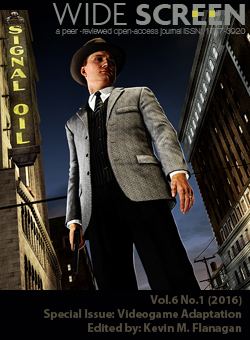
I am pleased to announce that another essay on videogames, “Metaproceduralism: The Stanley Parable and the Legacies of Postmodern Metafiction,” just appeared in Wide Screen. The essay is part of a special issue on videogame adaptation, edited by Kevin M. Flanagan, and includes articles by Jedd Hakimi, Cameron Kunzelman, Kyle Meikle, Bobby Schweizer, and Kalervo Sinervo. It’s also open access, so anyone can read it.
Abstract: Most critics of contemporary literature have reached a consensus that what was once called “postmodernism” is over and that its signature modes—metafiction and irony—are on the wane. This is not the case, however, with videogames. In recent years, a number of self-reflexive games have appeared, exemplified by Davey Wreden’s The Stanley Parable(2013), an ironic game about games. When self-awareness migrates form print to screen, however, something happens. If metafiction can be characterized by how it draws attention to its materiality—the artificiality of language and the construction involved in acts of representation—The Stanley Parable draws attention to the digital, procedural materiality of videogames. Following the work of Alexander R. Galloway and Ian Bogost, I argue that the self-reflexivity of The Stanley Parable is best understood in terms of action and procedure, as metaproceduralism. This essay explores the legacies of United States metafiction in videogames, suggesting that though postmodernism might be over, its lessons are important to remember for confronting the complex digital realities of the twenty-first century. If irony may be ebbing in fiction, it has found a vital and necessary home in videogames and we underestimate its power to challenge the informatic, algorithmic logic of cultural production in the digital age to our detriment.
 The Hyperarchival Parallax