The West Antarctic Ice Sheet Collapse and Other Portents of Doom

Climate Change

The New York Times on the collapse of the West Antarctic Ice Sheet.

Paul Krugman, “Points of No Return.”

Eyder Peralta, “New Report Finds Climate Change Already Having Broad Impact.”

Gerry Canavan on “Dystopia, Anti-Utopia, and the End of the World.”

Peter Frase, “Adjusting to the Apocalypse.”

A very interesting piece at Jacobin reflecting on an analogy between abolitionists and environmentalists: Matt Karp, “A Second Civil War.”

Roger Peet, “A Radical Approach to the Climate Crisis.”

Martin Lukacs, “New, Privatized African City Heralds Climate Apartheid.”

Julie Beck on John Oliver’s “Statistically Representative Climate Change Debate.”

Saskia Sassen, “Countdown to Oblivion: The Real Reason We Can’t Stop Global Warming.”

Mike Wall, “To Combat Climate Change, Humanity Must Act Now, NASA Chief Says.”

Brad Plumer, “Five Horrifying Maps of America’s Massive Drought.”

And “Picture This: U.S. Cities Under 12 Feet of Sea Level Rise.” An example:

The Back Bay in Boston under 12 Feet of Sea Level Rise

The Back Bay in Boston under 12 Feet of Sea Level Rise

But don’t fret, “This Couple is Making Roads Out of Solar Panels, and They Actually Work.”

And Michelle Nijhuis, “How to Laugh at Climate Change.”
Continue reading

Poetry, Metal, Irony, and Other Links

Converge

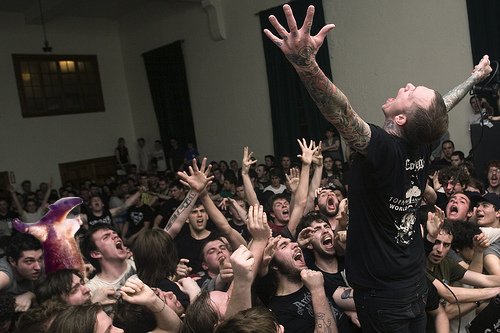
Michael Robbins has a great piece in this months Harper’s, “Destroy Your Safe and Happy Lives: A Poet’s Guide to Metal,” which, in the space of six pages, is able to reference John Milton, Rainer Maria Rilke, Black Sabbath, and Converge. I did not know that could be done. (Even R., who tends to abhor whenever anything loud and screamy even gets near our home’s turntable, enjoyed this piece.) Highlights of the short essay include: quoting a number of lines from William Blake’s “Proverbs of Hell” and commenting, “sounds pretty metal to me”; describing a Converge show where they “took over that space like a bellowing wooly rhino crashing into a Pleistocene clearing. . . . It’s war music” (a pretty accurate description); and some reflections on metal and capital: “Sometimes I wonder what metal would sound like after capitalism, or whether we would even need metal then. I wonder the same about poetry.”

More DFW stuff. Peter Finocchiaro, “What David Foster Wallace Got Wrong About Irony: Our Culture Doesn’t Have Nearly Enough of It,” which, strangely enough, is actually an interview with Jonathan Lear about irony (rather than an article specifically about DFW’s sense of irony). In my revised version of an essay that will appear in David Foster Wallace and “The Long Thing” (forthcoming July 2014), I make some similar points about the need for irony at the present time. That said, Lear seems to have a better handle on Wallace’s specific take on irony from the television essay than Finocchiaro, emphasizing that DFW was both a gifted ironist himself and that, in “E Unibus Pluram,” he is critiquing institutionalized irony, which I think all us post-ironists or new sincerity people would do well to heed, along with Lear’s acknowledgment that irony can actually be a from of earnestness: “There’s a very famous quote from Kierkegaard — or, I don’t know how famous it is, but it’s one of my favorites — where he said, it’s ‘only assistant professors’ who think irony can’t be a form of earnestness. Basically his claim is that irony when properly understood is a very high form of sincerity and earnestness, not its opposite. As he put it, it’s a real misunderstanding of what irony is to think it’s the opposite of earnestness toward commitment.” I feel the earnestness or “sincerity” of irony as it plays out in DFW’s work and thinking has been something that has been overlooked to the detriment of both our understanding of DFW and irony more generally.

Alex C. Madrigal and Adrienne LaFrance, “Net Neutrality: A Guide to (and History of) a Contested Idea.”

Dexter Filkins writes a letter from Iraq in The New Yorker, “What We Left Behind.”

And from the University of Pittsburgh’s great graduate student film blog, Kevin Flanagan on “Introduction to Applied Airport Studies.”

End of the Semester Links Spring 2014

It’s been a busy end of the semester and I haven’t been able to post anything for a bit. So, now that I have a bit of time before the semester wraps up, here’s a bunch of stuff that has been happening the last few weeks. My apologies if I’m a bit late on some of these things.

Nuclear and Disaster

Laura Miller reviews Craig Nelson’s The Age of Radiance: The Epic Rise and the Dramatic Fall of the Atomic Age.

John Metcalfe, “What Famous Old Paintings Can Tell Us About Climate Change.”

Only .02% of published research rejects global warming.

Adam Weinstein, “Arrest Climate Change Deniers.”

Continue reading

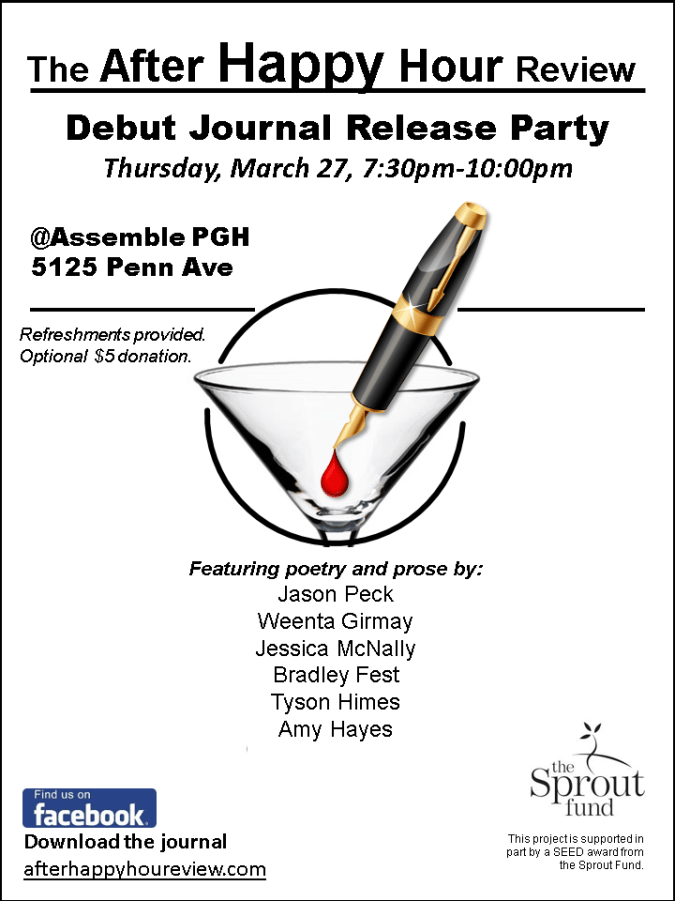
Reading at Assemble March 27

I am quite pleased to announce that, for the first time in quite a while, I will be reading some of my poems at Assemble in Pittsburgh, PA on Thursday, 27 March 2014. The reading has been put on by the Hour After Happy Hour Writing Workshop & Journal. Weenta Girmay, Tyson Himes, Jessica McNally, Jason Peck, and one of my former students, Amy Hayes, will also be reading. I am quite looking forward to sharing some of my recent writing with an audience. It has been far too long.

Fallout: New Vegas

[While going through some old poetry today, I discovered this little ditty. I couldn’t resist posting it.]

I am sick of the postapocalypse. Here we are,

eating human flesh on the Strip in casinos burned

by atomic fire about to devour some successful

rancher’s son while masked a la Eyes Wide Shut.


We’re supposed to converse w/ what seems like

an AI[1] but we’ve gotten curiously sidetracked,

this awkward looking young woman and I

as we’ve traversed the terrible wastes doing,

well, whatever it was to do that came along.


We’ve passed through this night waiting

for someone to sneak into a guard tower in

an old airport control tower.[2] In real time.


Here we are, perched on a hotel in Vegas,

a high enough vantage point to see the bombs

go off in the desert. Here we are, burying mountains

of nuclear phlegm beneath plaques bearing the universal

hieroglyphic for, well, death. The postapocalyptic


has infected us. We breathe its miasma and blow it

out our eyes in radiant spectacles of retro-horror

nuclear nostalgia from an alternative twenty-first century


in which some mysterious stranger rolled into town

w/ “a big iron on his hip”[3] and we were her, blowing

ghouls away. We’re all patiently waiting for the MMO.


[1] Nudge, nudge . . . Bioshock (Quincey, MA: Irrational Games, 2007).

[2] The future can only look like the past.

[3] Marty Robins, “Big Iron,” Gunfighter Ballads and Trail Songs (New York: Columbia Records, 1959).