I just found this little gem today from a 1965 TV documentary, The Decision to Drop the Bomb, featuring J. Robert Oppenheimer.
Nuclear
Chernobyl Photos
The Atlantic has some fairly arresting and haunting photos of an abandoned hospital in Chernobyl.
Nuclear Football
Greg Mitchell at The Nation reports on a (really a fairly bizarre) football game played in the ruins of Nagasaki on 1 January 1946, in “Football at Ground Zero: The Atom Bomb, Nagasaki, New Year’s Day, 1946”:
One of the most bizarre episodes in the entire occupation of Japan took [. . .] on January 1, 1946, in Nagasaki.
Back in the States, the Rose Bowl and other major college football bowl games, with the Great War over, were played as usual on New Year’s Day. To mark the day in Japan, and raise morale (at least for the Americans), two Marine divisions faced off in the so-called Atom Bowl, played on a killing field in Nagasaki that had been cleared of debris. It had been “carved out of dust and rubble,” as one wire service report put it.
(This really sounds like something straight outta Don DeLillo‘s End Zone [1972]).
Also, as Stuart Isett’s photography website points out, the Richland High School football team,
[i]n the fall of 1945, after an atomic bomb was dropped on Nagasaki [. . .] changed the team’s mascot to a mushroom cloud and called themselves the “Bombers.” The plutonium that was in that bomb was manufactured by workers at nearby Hanford Nuclear Site as part of the Manhattan Project. [. . .] During the Cold War, the Hanford project was expanded to include nine nuclear reactors and five massive plutonium processing complexes, which produced plutonium for most of the 60,000 weapons in the U.S. nuclear arsenal. The weapons production reactors were decommissioned at the end of the Cold War, but the manufacturing process left behind 53 million U.S. gallons of high-level radioactive waste that remains at the site. Hanford is the most contaminated nuclear site in the United States and is the focus of the nation’s largest environmental cleanup, providing thousands of jobs to residents in nearby towns such as Richland.
And, because we’re on the subject of “nuclear football,” I thought I’d include an image of the actual nuclear football: the satchel/black box/briefcase carried around near the President of the United States, the contents of which are capable of launching a nuclear attack.

Happy New Year!
“The Inverted Nuke in the Garden: Archival Emergence and Anti-Eschatology in David Foster Wallace’s Infinite Jest”
The fall 2012 issue of boundary 2 is now available online. It contains my article, “The Inverted Nuke in the Garden: Archival Emergence and Anti-Eschatology in David Foster Wallace’s Infinite Jest.” (Requires university access.) Here’s a link to the abstract.

How Did We Ever Survive the Twentieth Century?
Quite the fail safe. io9 reports that “according to recently declassified documents made available by the U.S. National Security Archive, the United States had a contingency plan in effect where, in the event that the President went missing or was killed during an attack on the country, the military was instructed to launch an automatic and simultaneous ‘full nuclear response’ against both the Soviet Union and China. And it wasn’t until 1968 that the government under Lyndon Johnson repealed the directive.”
And, in other news, “Scientists Plan to Test to See if the Entire Universe is a Simulation.”
Nuke the Moon! (For Real)
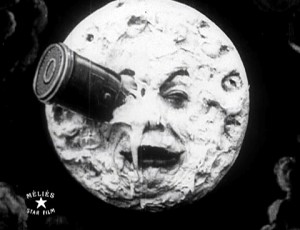
It was reported on Monday that “[i]n a secret project recently discovered, the United States planned to blow up the moon with a nuclear bomb in the 1950s as a display of the country’s strength during the Cold War space race.” Yes. The US was legitimately planning on blowing up the moon. The. Moon. Take that moon.
The End (Repeat)
n+1, in honor of Sandy (so they say), just reposted this essay-review by Chad Harbach of Matthew Sharpe’s Jamestown (2007) and a host of other post-catastrophe lit, “The End, The End, The End.” Like Robert Charles Wilson’s recent Julian Comstock: A Story of 22nd Century America (2009), the catastrophic novels Harbach discusses lie on the other side of global oil-depletion: “Now we’ve burned half the available oil, or close to it, and burning it (along with so much coal) has altered the earth’s equilibrium. Our future, like our past, may be virtually free of oil, and global culture, and many of the social safeguards we enjoy. Thus the novel of future catastrophe threatens to become a version of the historical novel.” Harbach also has an old review of DFW’s Oblivion for n+1.
Unsettling at Best
Yesterday Thom Shanker and Rick Gladstone reported in The New York Times that “Iran Fired on Military Drone in First Such Attack, U.S. Says.” This occurred five days before the election, and was only talked about by the Defense Department after news organizations had broken the story. Shanker and Gladstone write: “the failure to disclose a hostile encounter with Iran’s military at a time of increased international tensions over the disputed Iranian nuclear program — and five days before the American presidential election — raises questions for the Obama administration. Had the Iranian attack been disclosed before Election Day, it is likely to have been viewed in a political context — interpreted either as sign of the administration’s weakness or, conversely, as an opportunity for President Obama to demonstrate leadership.” Nuclear worries don’t cease just b/c the election is over. . . .
Oh How Things Have Changed in the Second Nuclear Age
Unsurprisingly, last night’s final Presidential Debate on foreign policy seemed to show Romney concerned w/ only one thing: not letting Iran produce a nuclear weapon (and how many nuclear weapons Pakistan already has). This makes how nuclear policy was discussed in 1984 and 1988 all the more striking in contrast. Heck, thought I’d post the whole weird thing below. (Also, I think Mark Shields’s observation that neither candidate mentioned, Idk, Europe, or India, or Africa, or really anywhere else . . . must give one pause.)
In More Contemporary Nuclear News (and Other Stuff)
Helene Cooper and Mark Landler reported in The New York Times yesterday that, “The United States and Iran have agreed in principle for the first time to one-on-one negotiations over Iran’s nuclear program, according to Obama administration officials, setting the stage for what could be a last-ditch diplomatic effort to avert a military strike on Iran.” Pretty interesting, esp. coming right before the debate, and that “Iranian officials have insisted that the talks wait until after the presidential election [. . .] telling their American counterparts that they want to know with whom they would be negotiating.” Yet another chink of armor for President Obama’s foreign policy CV? A cynical move for tomorrow night’s debate? Very, very interesting.
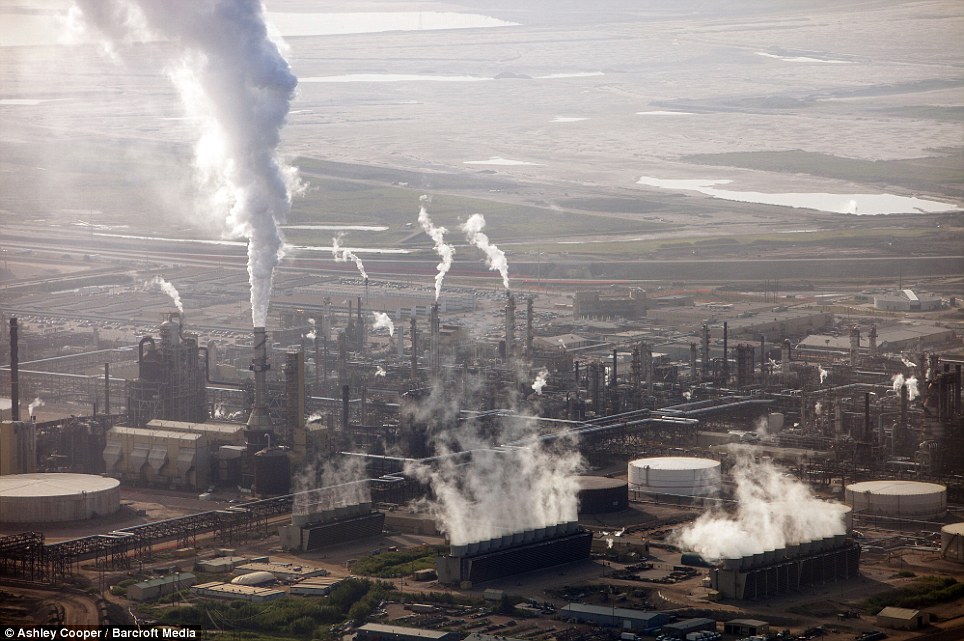
A truly horrifying group of images from the strip mining of Canada’s Tar Sands. A sample:
And a whole class being taught on David Foster Wallace at the John Adams Institute in Amsterdam. (Also, thought I’d relink to this class on DFW taught by Kathleen Fitzpatrick at Pomona College in the Spring of 2009.)
 The Hyperarchival Parallax