I am honored to have received this year’s Schachterle Prize from The Society for Literature, Science, and the Arts for my essay, “The Inverted Nuke in the Garden: Anti-Eschatology and Archival Emergence in David Foster Wallace’s Infinite Jest,” which appeared in the Fall 2012 issue of boundary 2. This year’s conference was nothing short of incredible, and it remains one of the most vibrant, stimulating, and humbling conferences I have attended. I will probably post my own paper from the conference in a few days.
Nuclear
SLSA 2013
I’m headed off to this year’s Society for Literature, Science, and the Arts Conference at Notre Dame this weekend. I will be presenting my paper, “Infinite Oppenheimer’s and Postnatural Metahistory: Jonathan Hickman’s The Manhattan Projects” Sunday Morning at 9:30. I posted an abstract of the paper previously, and I will probably post the entire paper this coming week. Looking forward to a fun conference.
NY Times Reviews Eric Schlosser’s Command and Control
Eric Schlosser’s new book about the many near misses with nuclear explosions that occurred throughout the Cold War, Command and Control: Nuclear Weapons, the Damascus Accident, and the Illusion of Safety, has received an interesting review in The New York Times. Walter Russell Mead treats it at length in “Atomic Gaffes.”
Labor Day Links
Lois Weiner has a very interesting piece in Jacobin, “This Labor Day, Thank a Teacher,” on how teacher’s unions are revitalizing the labor movement.
And there may be a bigger surveillance system then PRISM, as reported on in The New York Times by Scott Shane and Colin Moynihan in “Drug Agents Use Vast Phone Trove, Eclipsing the N.S.A.’s.”
Fukushima Over Two Years Later
In “Fukushima: Vast Amounts of Radioactive Water Creeping Towards Sea,” Mari Yamaguchi has reported for Talking Points Memo that “deep beneath Fukushima’s crippled nuclear power station a massive underground reservoir of contaminated water that began spilling from the plant’s reactors after the 2011 earthquake and tsunami has been creeping slowly toward the sea. Now, 2 1/2 years later, experts fear it is about to reach the Pacific and greatly worsen what is fast becoming a new crisis at Fukushima: the inability to contain vast quantities of radioactive water.”
More Archives, More Bombs
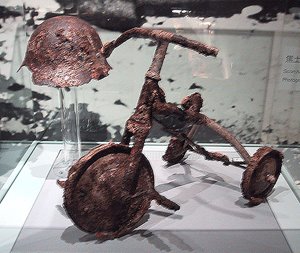
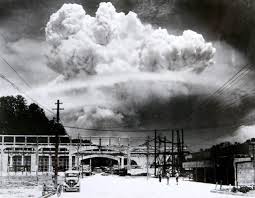
So, I guess Google has created some sort of mega-meta-archive, the “Google Cultural Institute,” an archive of stuff that is in museums (i.e. archives), and when I go to the front page, the two featured archives are the “Hiroshima Peace Museum” and the “Nagasaki Atomic Bomb Museum.” Sometimes this is just too easy. Nukes and archives. Bombs and museums. Hyperarchival realism.
The National Security State and Dystopian Narcissism
Today’s sentencing of Bradley Manning to 35 years in prison has provoked considerable outrage. Birgitta Jónsdóttir addresses this nicely in her piece for The Guardian, “Bradley Manning’s Sentence: 35 Years for Exposing the Truth.”
And Rob Goodman has a very compelling piece on “dystopian narcissism” for The Chronicle of Higher Education titled, “The Comforts of the Apocalypse.” Dystopian narcissism is the selfish belief that your time, your civilization, your world is somehow unique in its proximity to the end times, to the disaster, to the apocalypse. As Goodman writes: “We’re virtually guaranteed to witness the end of nothing except our lives, and the present, far from fulfilling anything, is mainly distinguished by being the one piece of time with us in it.” I’ve been saying this for years. (Though perhaps the Doomsday Argument would disagree, as perhaps would Nick Bostrom [here and here and here and here] .)
The Zombification of Academia and Blowing Up the Sun
Serena Golden has an interview at The Chronicle of Higher Education with the authors of Zombies in the Academy: Living Death of Higher Education, Andrew Whelan, Ruth Walker, and Christopher Moore. She writes:
The book’s contributors find zombies lurking around every corner: students concerned solely with getting through and making the grade; faculty members deadened by the corporatization of the university and the erosion of traditional faculty jobs; systems and processes within the university that have long since outlived their original purpose but that endlessly perpetuate themselves. What does it mean, the editors wonder, if the zombie apocalypse has already taken place, and we are living — or undead — within it?
And in the latest in eschatology from the scientific front, Alexander Bolonkin and Joseph Friedlander have published a paper, “Explosion of the Sun,” which details how you could blow up the sun. A link to the abstract here and a link to the full paper here. Here is the abstract of the paper, which really needs to be quoted in full:
The Sun contains ~74% hydrogen by weight. The isotope hydrogen-1 (99.985% of hydrogen in nature) is a usable fuel for fusion thermonuclear reactions. This reaction runs slowly within the Sun because its temperature is low (relative to the needs of nuclear reactions). If we create higher temperature and density in a limited region of the solar interior, we may be able to produce self-supporting detonation thermonuclear reactions that spread to the full solar volume. This is analogous to the triggering mechanisms in a thermonuclear bomb. Conditions within the bomb can be optimized in a small area to initiate ignition, then spread to a larger area, allowing producing a hydrogen bomb of any power. In the case of the Sun certain targeting practices may greatly increase the chances of an artificial explosion of the Sun. This explosion would annihilate the Earth and the Solar System, as we know them today. The reader naturally asks: Why even contemplate such a horrible scenario? It is necessary because as thermonuclear and space technology spreads to even the least powerful nations in the centuries ahead, a dying dictator having thermonuclear missile weapons can pro[duce] (with some considerable mobilization of his military/industrial complex) an artificial explosion of the Sun and take into his grave the whole of humanity. It might take tens of thousands of people to make and launch the hardware, but only a very few need know the final targeting data of what might be otherwise a weapon purely thought of (within the dictator’s defense industry) as being built for peaceful, deterrent use. Those concerned about Man’s future must know about this possibility and create some protective system—or ascertain on theoretical grounds that it is entirely impossi[ble]. Humanity has fears, justified to greater or lesser degrees, about asteroids, warming of Earthly climate, extinctions, etc. which have very small probability. But all these would leave survivors—nobody thinks that the terrible annihilation of the Solar System would leave a single person alive. That explosion appears possible at the present time. In this paper is derived the “AB-Criterion” which shows conditions wherein the artificial explosion of Sun is possible. The author urges detailed investigation and proving or disproving of this rather horrifying possibility, so that it may be dismissed from mind—or defended against.[1]
The keywords for the paper also need to be quoted: Artificial Explosion of Sun; Annihilation of Solar System; Criterion of Nuclear Detonation; Nuclear Detonation Wave; Detonate Sun; Artificial Supernova.[2]
Didn’t we already think of such silly things like blowing up heavenly bodies? This is absurd.
Fukushima, Apple, The Manhattan Project, and The Anthropocene
A bunch of interesting stories today:
“Water Leaks on the Fukushima Plant Could Contaminate Entire Pacific Ocean.”
The Faces of Project Y: the security badges for those working on the Manhattan Project.
And in further news from the Orwellian security state: “Apple has patented a piece of technology which would allow government and police to block transmission of information, including video and photographs, from any public gathering or venue they deem ‘sensitive,’ and ‘protected from externalities.'”
The Atlantic has amazing time-lapse satellite images showing the massive changes to the human-built world. An archive of disaster.
And from The Chronicle of Higher Education: “The National Institutes of Health announced on Wednesday that it had reached an agreement to give the family of Henrietta Lacks, an African-American woman who died of cervical cancer in 1951, some control over researchers’ access to the genomic data of cells derived from her tumor, according to The Wall Street Journal.”
Nuclear Activism
To return to one of the main threads of this blog–all things nuclear–which has been going down slightly different paths over the past month, I give you the following excerpt from Devon Fredericksen’s interview with Terry Tempest Williams, activist and author of When Women Were Birds (2013), among many other books:
I believe the first time I found my voice was when I crossed the line at the Nevada Test Site in 1988. It was one year after my mother died. It was one year before my grandmother would die, and I found myself the matriarch of my family at thirty. With the death of my mother, grandmothers, and aunts—nine women in my family have all had mastectomies, seven are dead—you reach a point when you think, “What do I have to lose?” and you become fearless. When I crossed that line at the Nevada Test Site as an act of protest because the United States government was still testing nuclear bombs in the desert—it was a gesture on behalf of the Clan of the One-Breasted Women—my mother, my grandmothers, my aunts. And I didn’t do it alone. I was with hundreds of other women who had suffered losses in Utah as a result of atomic testing, as a result of our nuclear legacy in the West. I crossed that line with Jesuit priests, with Shoshone elders, with native people who had also lost lives because of the radiation fallout in the Shivwits’ lands.
 The Hyperarchival Parallax