Hyperarchival Realism, Surveillance, and the Control Society

Christine Jun for Dazed Digital has posted an  A-Z list of some incredible contemporary art that engages with technologies of surveillance in “The dA-Zed Guide to Surveillance: Drones in the Sky, Whistleblowers in Jail: How Art is Responding to Big Brother’s Watch.” Of especial note is Robin Hewlett and Ben Kinsley‘s Street with a View, which was done a number of years ago while both were pursuing Master’s of Fine Arts degrees at Carnegie Mellon University, just down the street from me. I have met Ben a few times and had the opportunity to talk with him about this project while he was working on it. A pic (and a link to the Street with a View at Google maps):
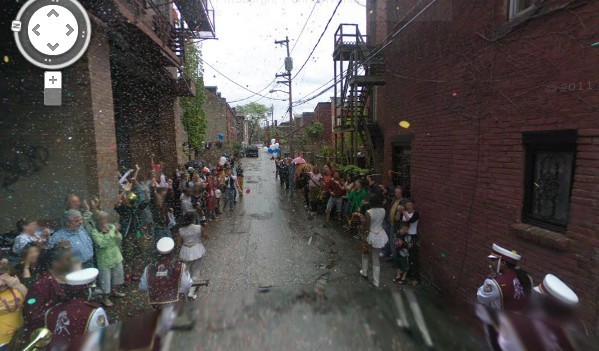
Street with a View

I especially appreciate Hewlett and Kinsely’s hyperarchivally realist work here for integrating the archival processes of contemporaneity, the all-surveilling  eye of Google and their maps, the social and local residents of the area, and what in the end is pretty high-concept performance art. Simply wonderful. (And that they somehow got Google to come out and take part, all the better. I also probably should have posted something about Street with a View years ago, but I’m glad being pointed toward Dazed Digital‘s A-Z list reminded me of how excellent this happening was.)

The National Security State and Dystopian Narcissism

Today’s sentencing of Bradley Manning to 35 years in prison has provoked considerable outrage. Birgitta Jónsdóttir addresses this nicely in her piece for The Guardian, “Bradley Manning’s Sentence: 35 Years for Exposing the Truth.”

And Rob Goodman has a very compelling piece on “dystopian narcissism” for The Chronicle of Higher Education titled, “The Comforts of the Apocalypse.” Dystopian narcissism is the selfish belief that your time, your civilization, your world is somehow unique in its proximity to the end times, to the disaster, to the apocalypse. As Goodman writes: “We’re virtually guaranteed to witness the end of nothing except our lives, and the present, far from fulfilling anything, is mainly distinguished by being the one piece of time with us in it.” I’ve been saying this for years. (Though perhaps the Doomsday Argument would disagree, as perhaps would Nick Bostrom [here and here and here and here] .)

Fukushima, Apple, The Manhattan Project, and The Anthropocene

A bunch of interesting stories today:

“Water Leaks on the Fukushima Plant Could Contaminate Entire Pacific Ocean.”

The Faces of Project Y: the security badges for those working on the Manhattan Project.

And in further news from the Orwellian security state: “Apple has patented a piece of technology which would allow government and police to block transmission of information, including video and photographs, from any public gathering or venue they deem ‘sensitive,’ and ‘protected from externalities.'”

The Atlantic has amazing time-lapse satellite images showing the massive changes to the human-built world. An archive of disaster.

A conversation with Leigh Phillips, Gwyneth Jones, Marge Piercy, Ken MacLeod and Kim Stanley Robinson.

And from The Chronicle of Higher Education: “The National Institutes of Health announced on Wednesday that it had reached an agreement to give the family of Henrietta Lacks, an African-American woman who died of cervical cancer in 1951, some control over researchers’ access to the genomic data of cells derived from her tumor, according to The Wall Street Journal.”

Historical Leaks and Contemporary Cover Ups

Two interesting stories:

An NPR story on Daniel Ellsberg, “the military analyst who in 1971 leaked the top-secret Pentagon Papers detailing the history of U.S. policy in Vietnam.”

And for Reuters, John Shiffman and Kristina Cooke write, “U.S. Directs Agents to Cover Up Program Used to Investigate Americans”: “A secretive U.S. Drug Enforcement Administration unit is funneling information from intelligence intercepts, wiretaps, informants and a massive database of telephone records to authorities across the nation to help them launch criminal investigations of Americans.”