A student from my New Literature class last spring, “US Fiction in the Wake of Postmodernism,” just sent me this picture of a giant advertisement for the French translation of Jonathan Franzen’s Freedom.

A student from my New Literature class last spring, “US Fiction in the Wake of Postmodernism,” just sent me this picture of a giant advertisement for the French translation of Jonathan Franzen’s Freedom.
My Freshman Composition course just wrapped up a lively discussion of DFW’s “Authority and American Usage” (originally published in Harper’s as “Tense Present”), and though I think I probably wanna do some different stuff w/ it next time . . . here’s a lovely excerpt:
The insecurities that drive [Politically Correct English], [Academic English], and vocab-tape ads are far from groundless, though. These are tense linguistic times. Blame it on Heisenbergian uncertainty or postmodern relativism or Image Over Substance or the ubiquity of advertising or PR or the rise of Identity Politics or whatever you will–we live in an era of terrible preoccupation with presentation and interpretation, one in which the relations between who someone is and what he believes and how he “expresses himself” [DFW’s fn.: (Notice the idiom’s syntax–it’s never “expresses his beliefs” or “expresses his ideas.”)] have been thrown into big-time flux. In rhetorical terms, certain long-held distinctions between the Ethical Appeal, Logical Appeal ( = an argument’s plausibility or soundness, from logos), and Pathetic Appeal ( = an argument’s emotional impact, from pathos) have now pretty much collapsed–or rather the different sorts of Appeals now affect and are affected by one another in ways that make it nearly impossible to advance an argument on “reason” alone. (David Foster Wallace, “Authority and American Usage,” in Consider the Lobster and Other Essays [New York: Little, Brown and Company, 2006], 116, my emphases.)
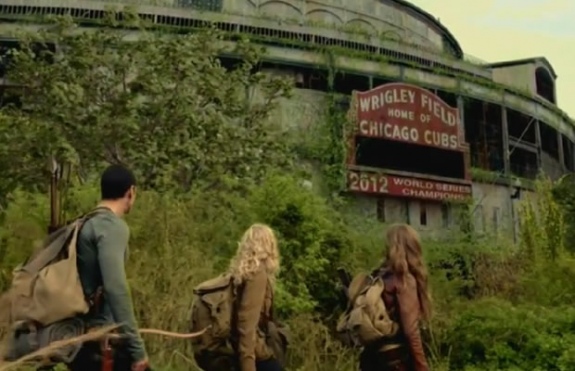
No. As George Dvorsky over at io9 reports in “Could Someone Really Destroy the Whole Internet,” the very things that make the Internet possible make it resistant to total destruction. Phew. (That is, unless you’re in this terrible looking new show. I watched the pilot, and its one of those: we stuck it in a post-apocalyptic future, but honestly, we will not have a single plot point that wouldn’t work just fine in another, less apocalyptic universe. But this way we get to have Wrigley Field covered in vines. And seriously, when I google, “revolution,” this is the first thing that comes up? We’re done for.)
I was working on something today and recalled this 2007 article from The New Yorker, Alec Wilkinson’s “Remember This?” where he talks about Gordon Bell and Microsoft’s MyLifeBits project to record and document one’s entire life. Hyperarchivalism indeed.
. . . is making a fool of himself. Though I’ll admit D.T. Max’s Every Love Story is Ghost Story left me slightly disappointed (actually, I could probably criticize much of it, like on a sentence level, but I won’t), it is still a welcome addition to our understanding of DFW’s life and work, and it surely doesn’t make me want to submit this kind of twitter fiasco Ellis is involved in: “Reading D.T. Max’s bio I continue to find David Foster Wallace the most tedious, overrated, tortured, pretentious writer of my generation…” It is precisely this kind of vitriolic internet rambling, of the upset nerd commenting on well, whatever, that is beginning to define the critical atmosphere of today. If Matthew Arnold was around today, and answered the question of what the function of internet criticism is at the present time, I don’t think things like Culture and Anarchy (1869), or much of anything else, would have been written; he would’ve been too despondent. Further, to me the atmosphere of constant, instant, widespread, poorly-thought-out, and loud criticism from hardly qualified and anonymous people with nothing better to do that dominates “comments”-discourse today, this culture of easy and quick dismissal (of anything), practically requires of us the most generous, considered criticism we can muster. Ellis’s words don’t make me want to read his significant oeuvre any less generously (though I do think DFW has a point in “Fictional Futures and the Conspicuously Young,” a salvo he launched against Ellis in 1987, so yes, he got the first shots in quite a while ago). In fact, for those of us who are seriously in the business of criticism, this kind of thing only re-emphasizes the need for us to be as generous, thoughtful, and, well, kind as we can. It is much easier to say what is “bad” about a work of art–really, any art, how easy is it to call, say, Jackson Pollock’s paintings bad b/c my “five year old could have painted that”–and it is esp. easy to say what is “bad” about a dead artist. It is much more difficult to figure out what is worthwhile in a work, particularly something that does not immediately strike one as worthy of one’s attention. And even more difficult is actually trying to figure out what kind of aesthetic work something is trying to do, what the poem, novel, painting is trying to say, what meaning it is constructing, etc. I have to imagine Ellis’s own work would benefit from seriously considering DFW and, if he were still around, vice versa. But, for now, being loud and mean surely gets oneself a minute of attention, “but a minute was all it was. After nature had drawn just a few more breaths the planet froze and the clever animals had to die.”[1]
[1] Friedrich Nietzsche, “On Truth and Lying in a Non-Moral Sense,” in The Birth of Tragedy and Other Writings, Trans. & ed. Ronald Speirs. Ed. Raymond Geuss (New York: Cambridge University Press, 1999), 141.
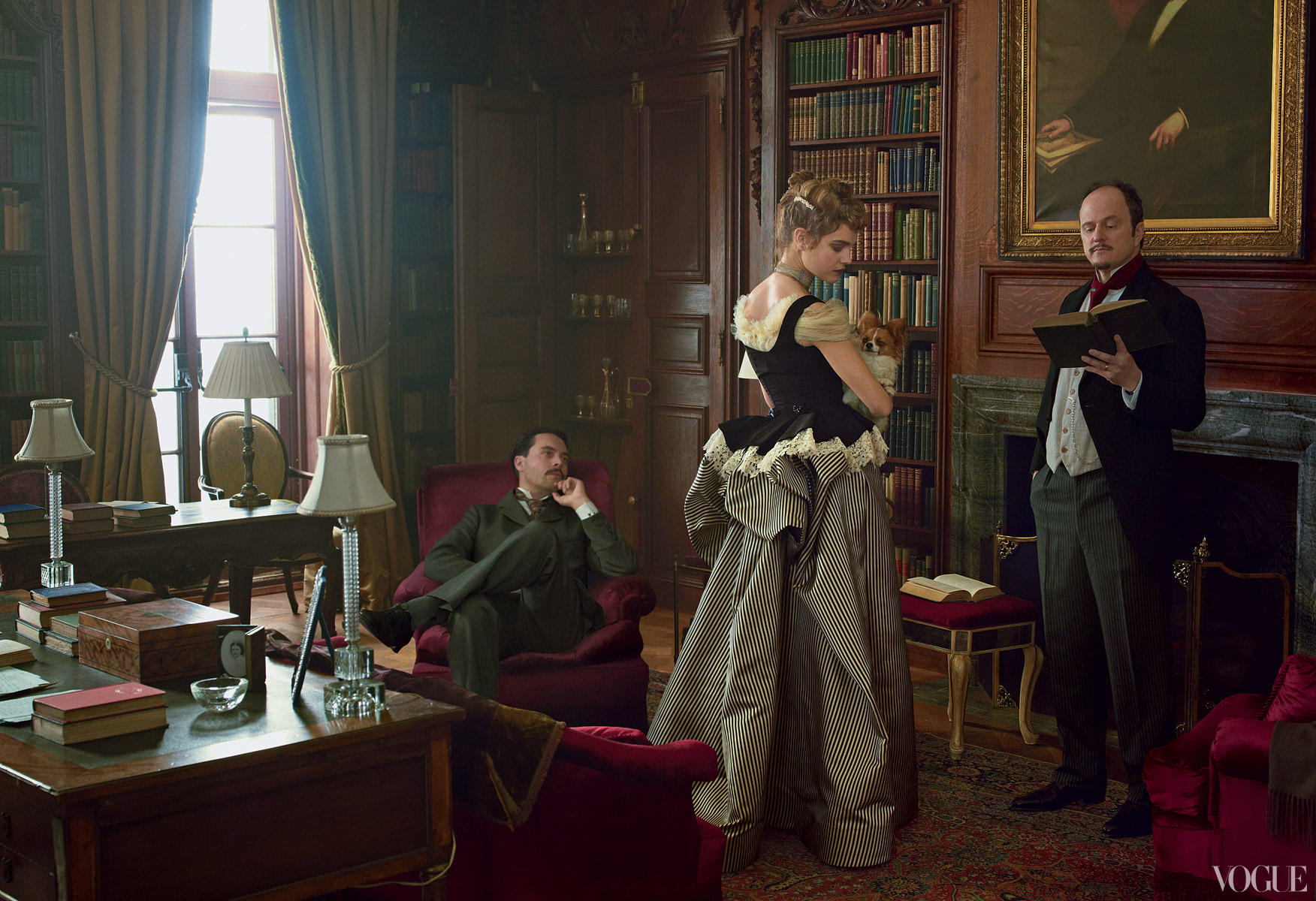
R. just pointed me toward this Vogue photo shoot where photographer Annie Leibovitz recreates scenes from Edith Wharton’s life. These photos are incredibly lush, and feature Jefferey Eugenides playing Henry James. There’s also something weirdly archivally unsettling about all this that I can’t quite put my finger on.
I need to listen to this Internet Evolution Radio interview w/ Cory Doctorow and Charles Stross.
“I’ll stay out of politics. It’s too upsetting.” –DFW (2003)
An 83 minute interview w/ DFW on German TV:
The whole thing is linked at Open Culture.
William Beutler just informed me about a really interesting project he has recently begun. Infinite Boston is a tumblr blog that will present photographs from approximately 50 locations around Boston that are referred to in DFW’s Infinite Jest. Now, if someone could do that for Tucson . . . (where I grew up and went to school. . .). A couple samples:


Are you living in a hyperarchive?: a French supercomputer has modeled the entire observable universe.

 The Hyperarchival Parallax