Eric Schlosser’s new book about the many near misses with nuclear explosions that occurred throughout the Cold War, Command and Control: Nuclear Weapons, the Damascus Accident, and the Illusion of Safety, has received an interesting review in The New York Times. Walter Russell Mead treats it at length in “Atomic Gaffes.”
Hyperarchival Realism
More Bleeding Edge Reviews and The Crisis in the Humanities
This month’s issue of Harper’s Magazine has a lengthy and interesting review of Thomas Pynchon’s Bleeding Edge by Joshua Cohen (article link requires subscription), and an interesting take on the crisis in the humanities (something this blog has posted frequently on this last summer) in Thomas Frank’s monthly column, “Easy Chair,” titled, “Course Corrections.” Frank nicely summarizes many of the issues facing humanists and the humanities today, and ends with a fairly bold call: “The world doesn’t need another self-hypnotizing report on why universities exist. What it needs is for universities to stop ruining the lives of their students [financially]. Don’t propagandize for your institutions, professors: Change them. Grab the levers of power and pull.” (On a semi-related note I’m happy to report that my own current department looks like it is doing just that.)
Carolyn Kellogg Reviews Bleeding Edge for the LA Times
My friend Carolyn Kellogg has a review of Bleeding Edge in the Los Angeles Times, “Thomas Pynchon Meets 9/11 in Bleeding Edge.”
Really Quite Weird Bleeding Edge Promotional Video
John Williams for The New York Times has reported on a promotional video released by Penguin Press for Thomas Pynchon’s forthcoming Bleeding Edge (2013).
The New York Times Reviews Bleeding Edge
Here is a link to Michiko Kakutani’s review of Thomas Pynchon’s Bleeding Edge (2013) from The New York Times. Bleeding Edge comes out next Tuesday. (Here’s to hoping Amazon gets me my pre-ordered copy a day or two early.)
Patrick Jagoda’s “Gamification and Other Forms of Play”
boundary 2 has made the entirety of Patrick Jagoda‘s recently published essay, “Gamification and Other Forms of Play,” freely available online. This is an excellent article, and I was actually already planning on providing it to the students of my current Narrative and Technology class. For anyone interested in video games, and the emerging scholarship and conversation about them, this should be mandatory reading.
Labor Day Links
Lois Weiner has a very interesting piece in Jacobin, “This Labor Day, Thank a Teacher,” on how teacher’s unions are revitalizing the labor movement.
And there may be a bigger surveillance system then PRISM, as reported on in The New York Times by Scott Shane and Colin Moynihan in “Drug Agents Use Vast Phone Trove, Eclipsing the N.S.A.’s.”
Post-Apocalyptic Archive
Hyperarchival Realism, Surveillance, and the Control Society
Christine Jun for Dazed Digital has posted an A-Z list of some incredible contemporary art that engages with technologies of surveillance in “The dA-Zed Guide to Surveillance: Drones in the Sky, Whistleblowers in Jail: How Art is Responding to Big Brother’s Watch.” Of especial note is Robin Hewlett and Ben Kinsley‘s Street with a View, which was done a number of years ago while both were pursuing Master’s of Fine Arts degrees at Carnegie Mellon University, just down the street from me. I have met Ben a few times and had the opportunity to talk with him about this project while he was working on it. A pic (and a link to the Street with a View at Google maps):
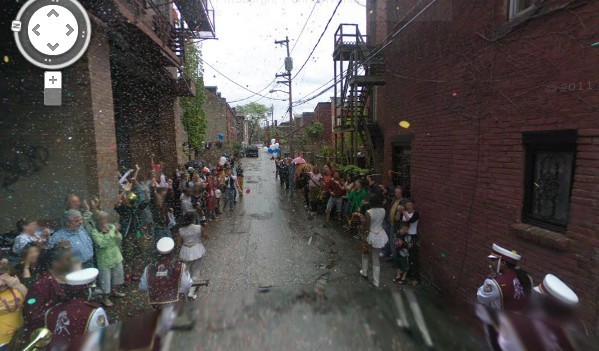
I especially appreciate Hewlett and Kinsely’s hyperarchivally realist work here for integrating the archival processes of contemporaneity, the all-surveilling eye of Google and their maps, the social and local residents of the area, and what in the end is pretty high-concept performance art. Simply wonderful. (And that they somehow got Google to come out and take part, all the better. I also probably should have posted something about Street with a View years ago, but I’m glad being pointed toward Dazed Digital‘s A-Z list reminded me of how excellent this happening was.)
More Archives, More Bombs
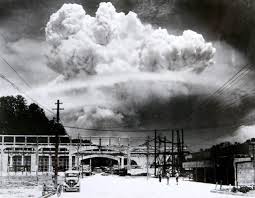
So, I guess Google has created some sort of mega-meta-archive, the “Google Cultural Institute,” an archive of stuff that is in museums (i.e. archives), and when I go to the front page, the two featured archives are the “Hiroshima Peace Museum” and the “Nagasaki Atomic Bomb Museum.” Sometimes this is just too easy. Nukes and archives. Bombs and museums. Hyperarchival realism.

 The Hyperarchival Parallax