Summer and Fall 2024 Links

I was so busy this fall I fell behind on pretty much everything, so I’m making up for it with a big two-season link post, roughly mid-May until the end of 2024.


Nuclear and Environmental

The Editorial Board of The New York Times, “The President’s Arsenal.”

Elizabeth Kolbert, “When the Arctic Melts” and “Why Hurricane Milton Is a Sign of the New Abnormal.”

Damian Carrington, “Earth’s ‘Vital Signs’ Show Humanity’s Future in Balance, Say Climate Experts” and “‘No Sign’ of Promised Fossil Fuel Transition as Emissions Hit New High.”

Patrick Greenfield, “Trees and Land Absorbed Almost no CO2 Last Year. Is Nature’s Carbon Sink Failing?”

Kathleen Kingsbury, W.J. Hennigan, and Spencer Cohen, “The Last Survivors [of Hiroshima] Speak. It’s Time to Listen.”

Megan Specia and Lynsey Chutel, “Nobel Updates: Peace Prize Is Awarded to Japanese Group of Atomic Bomb Survivors.”

Christopher Kempf, “Disaster Triumphant.”

David E. Sanger, “Biden Approved Secret Nuclear Strategy Refocusing on Chinese Threat.”

William Langewiesche, “The Secret Pentagon War Game That ​Offers a Stark​ Warning for Our Times.”

W. J. Hennigan, “The Price.”

Damian Carrington, “Hopeless and Broken: Why the World’s Top Climate Scientists Are in Despair.”
Continue reading

The 2024–25 Babcock Lecture: Anna Kornbluh, “Historical Fictions, Heist Flicks, and other Climate Genres for a Burning World”

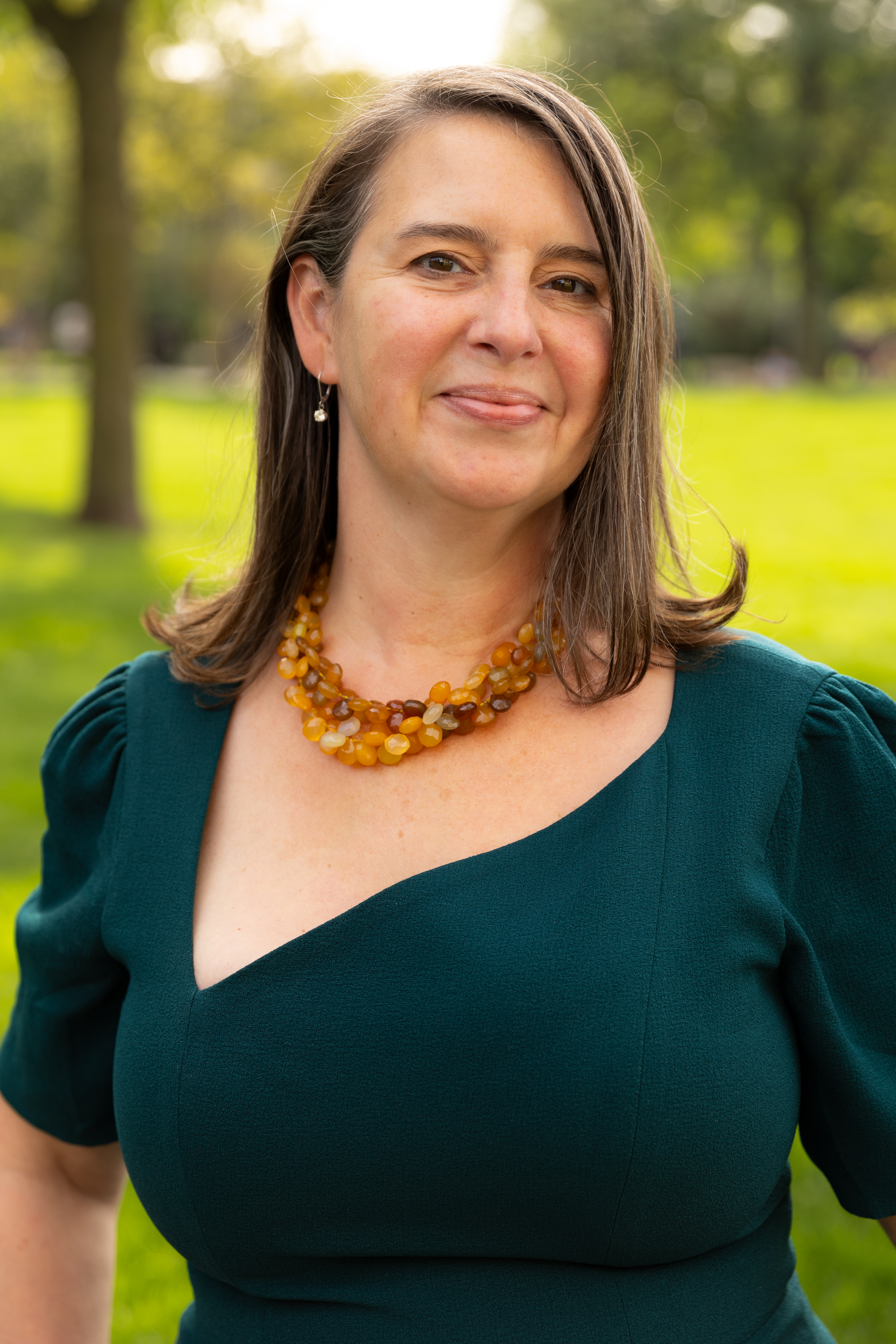
Kornbluh, Anna--HeadshotI am delighted to yet again announce that on Thursday, October 17 at 7:00 p.m. in Anderson Theater at Hartwick College, distinguished critic Anna Kornbluh will be delivering the 2024–25 Babcock Lecture at Hartwick College, which will be titled: “Historical Fictions, Heist Flicks, and other Climate Genres for a Burning World.” Kornbluh’s lecture will be followed by a reading by eminent poet and feminist critic Rachel Blau DuPlessis and is part of the Oneonta Literary Festival.


Historical Fictions, Heist Flicks, and other Climate Genres for a Burning World

In the urgent emergency of climate crisis, is there any time for art? This talk considers some of the pressures on literature and culture at present, exploring the prevailing ways that artists, authors, and critics are conceiving artistic ties to the environment, and proposing some alternative ties with the help of popular genres like historical fiction and heist films.


Anna Kornbluh
 is professor of English and a member of the United Faculty bargaining team at the University of Illinois, Chicago, where her research and teaching focus on the novel, film, and critical theory. She is the author of Realizing Capital: Financial and Psychic Economies in Victorian Realist Form (Fordham University Press, 2014), Marxist Film Theory and “Fight Club” (Bloomsbury, 2019), The Order of Forms: Realism, Formalism, and Social Space, and Immediacy, or, The Style of Too Late Capitalism, which was recently published by Verso. She has edited special issues for b2o: an online journalCriticismMediations, and Syndicate, and is a frequent guest on The American Vandal and other podcasts. She is the founder of the V21 Collective and InterCcECT (Inter Chicago Circle for Experimental Critical Theory) and is the Director of Graduate Studies at UIC.

2013–2017: Sonnets

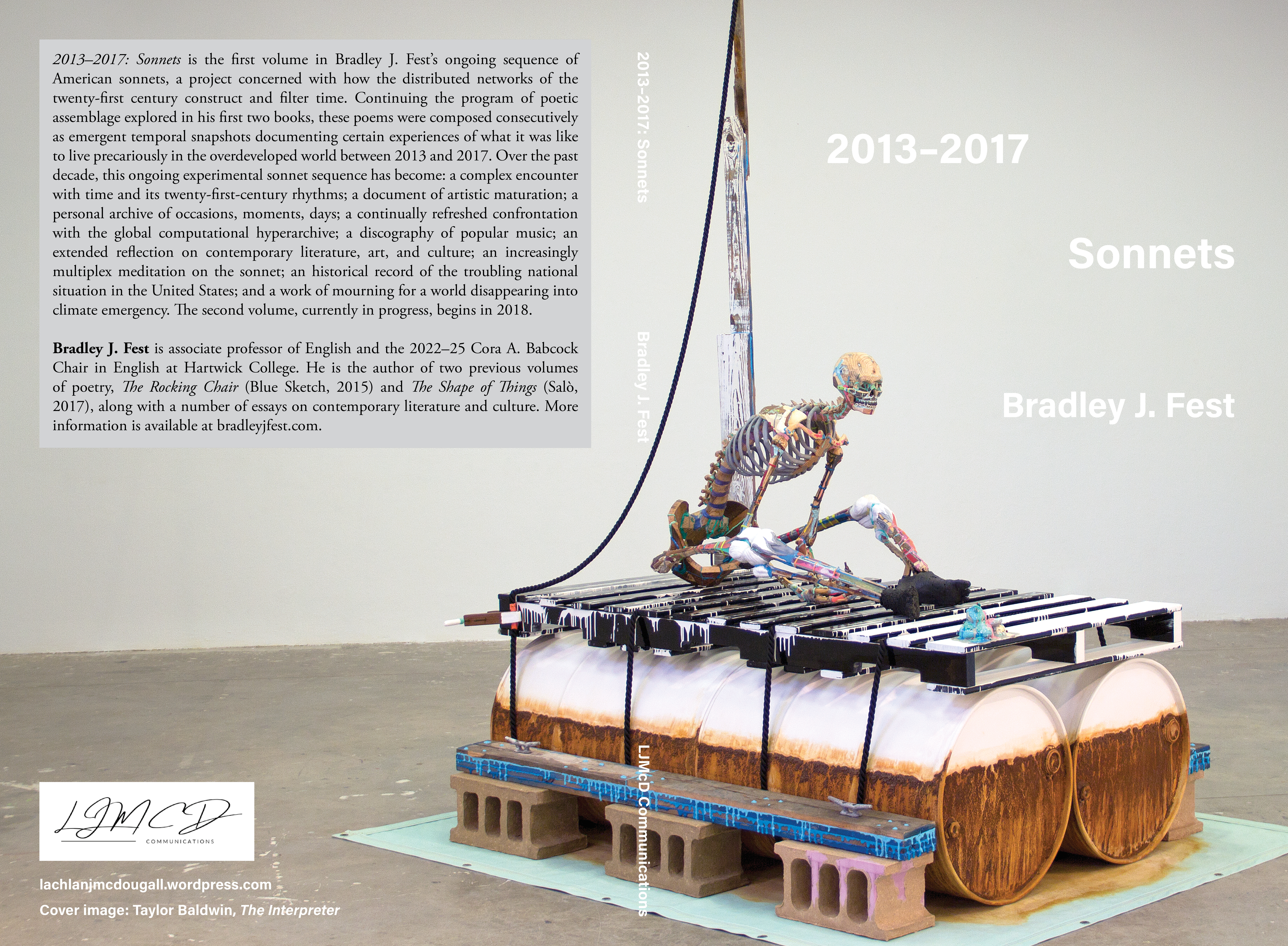
Now available! 2013–2017: Sonnets, my third book of poetry and the first volume of my American Sonnet sequence, has been published by LJMcD Communications. It can be ordered through Amazon

Fest, Bradley J--Cover for 2013-2017--cover

2013–2017: Sonnets is the first volume in Bradley J. Fest’s ongoing sequence of American sonnets, a project concerned with how the distributed networks of the twenty-first century construct and filter time. Continuing the program of poetic assemblage explored in his first two books, these poems were composed consecutively as emergent temporal snapshots documenting certain experiences of what it was like to live precariously in the overdeveloped world between 2013 and 2017. Over the past decade, this ongoing experimental sonnet sequence has become: a complex encounter with time and its twenty-first-century rhythms; a document of artistic maturation; a personal archive of occasions, moments, days; a continually refreshed confrontation with the global computational hyperarchive; a discography of popular music; an extended reflection on contemporary literature, art, and culture; an increasingly multiplex meditation on the sonnet; an historical record of the troubling national situation in the United States; and a work of mourning for a world disappearing into climate emergency. The second volume, currently in progress, begins in 2018.

Eternal thanks to Lachlan J. McDougall for bringing 2013–2017 into the world and to Taylor Baldwin for the cover image.

Fest, Bradley J--Cover for 2013-2017--spread

Spring 2024 Links

Nuclear and Environmental

W. J. Hennigan, “The US Has Received a Rare Invitation from China. There Is Only One Right Answer.”

Kathleen Kingsbury and W. J. Hennigan, “At the Brink: A Series about the Threat of Nuclear Weapons in an Unstable World.”

Anton Troianovski, “Putin Says West Risks Nuclear Conflict if It Intervenes More in Ukraine.”

David E. Sanger, “Biden’s Armageddon Moment: When Nuclear Detonation Seemed Possible in Ukraine.”

Catie Edmondson, “Senate Approves Expansion of Fund for Nuclear Waste Exposure Victims.”

Anton Troianovski, “Russia to Hold Drills on Tactical Nuclear Weapons in New Tensions with West.”

Noah Smith, “Americans Are Still Not Worried Enough about the Risk of World War.”

Emily Faux, “Deserted Myths and Nuclear Realities: Revisiting the Symbolism of Nuclear Weapons in Contemporary Popular Culture through Oppenheimer.”

Paul Thompson, “Become Death: On Christopher Nolan’s Oppenheimer.”

Motoko Rich and Kiuko Notoya, “Oppenheimer Opens in Nuclear-Scarred Japan, Eight Months After US Premiere.”

Ariel Kaminer, Oppenheimer, My Uncle, and the Secrets America Still Doesn’t Like to Tell.”

Jimmy So, “Killerheimer: American Betrayal in Martin Scorsese and Christopher Nolan.”

Anna Kornbluh, “We Didn’t Start the Fire: Death Drive against Ecocide.”

Bill McKibben, “‘D Is for Despair’ Didn’t Sound so Good: A Conversation between Bill McKibben and Elizabeth Kolbert.”

Continue reading

Oneonta Literary Festival, October 17–21, 2024 and the 2024–25 Babcock Lecture.

onenta-new-york-Main-Sunset_f

In collaboration with SUNY Oneonta’s Department of English, the Community Arts Network of Oneonta (CANO), the Huntington Library, and Oneonta High School, my colleague Tessa Yang and I are co-organizing the Oneonta Literary Festival, which will take place October 17–21, 2024 at various places in and around Oneonta.

For our part, Hartwick College is bringing in Anna Kornbluh to deliver the 2024–25 Babcock Lecture, “Historical Fictions, Heist Flicks, and other Climate Genres for a Burning World,” as part of the festival, along with Rachel Blau DuPlessis, Ross Gay, and Willy Palomo. For more information, please visit the Oneonta Literary festival website at www.hartwick.edu/literaryfestival. (The festival also takes place throughout the year [more info about year-long events here].)

At Hartwick College, the festival is supported by the Arts and Humanities Division, the Babcock Chair in English, the Department of Literature, Media, and Writing, a grant from the National Endowment for the Humanities, the Office of Academic Affairs, and the Visiting Writers Series.

Summer and Fall 2023 Links

The links have really gotten away from me. This summer, I was prioritizing finishing up a chapter for Too Big to Read, and this fall the semester just hammered me; I basically haven’t had a single free moment. So, better late than never, huh? Over six months of links. Enjoy.


Nuclear and Environmental

Apocalyptica, a new journal.

Jeff VanderMeer, “Florida’s Environmental Failures Are a Warning for the Rest of the US.”

Lydia Millet, “Biden’s Green Energy Money Is Sugar on a Poison Pill.”

Tina Cordova, “What Oppenheimer Doesn’t Tell You about the Trinity Test.”

Brad Plumer and Elena Shao, “Heat Records Are Broken Around the Globe as Earth Warms, Fast.”

Alexis Pauline Gumbs, “Heat Is Not a Metaphor.”

David Gelles, “Climate Disasters Daily? Welcome to the ‘New Normal.’”

Tom Engelhardt, “Humanity Has Created Too Many Ways of Destroying Itself.”

Kim Tingley, “‘Forever Chemicals’ Are Everywhere. What Are They Doing to Us?”

Azby Brown, “Just Like That, Tons of Radioactive Waste Is Heading for the Ocean.”

Raymond Zhong, “Something Was Messing With Earth’s Axis. The Answer Has to Do With Us.”

Damian Carrington, “Canadian Lake Chosen to Represent Start of Anthropocene.”

Ralph Vartabedian, “A Poisonous Cold War Legacy That Defies a Solution.”

The Washington Post, “Where Dangerous Heat Is Surging.”

Michael Levenson, “Heat Wave and Blackout Would Send Half of Phoenix to ER, Study Says.”

Jessica Hurley, “The Irradiated Body as Postcolonial Lost Edge.”

Hoyt Long and Aarthi Vadde, “We Want Our Catastrophe TV.”

Continue reading

“Something Worth Leaving in Shards: An Interview with Rachel Blau DuPlessis” in boundary 2

boundary 2, vol 50, no 2, cover image I am honored to say that my interview with the great poet and critic Rachel Blau DuPlessis, “Something Worth Leaving in Shards: An Interview with Rachel Blau DuPlessis,” has just been published in the most recent issue of boundary 2. (This link should provide access for three months.) I am deeply grateful to DuPlessis for corresponding with me during the summer of 2020. In lockdown with no childcare, corresponding with DuPlessis via email to conduct this interview (when I had a spare moment or two to do so) played a large part in keeping me sane during that difficult time. A huge thanks also to Racheal and Aviva, who were right there every day along with me while this interview was being conducted.

Here’s an abstract of the interview:

This interview with poet, essayist, literary critic, and collagist Rachel Blau DuPlessis was conducted via email correspondence between June 11 and August 29, 2020. Author of over a dozen volumes of poetry and half a dozen books in modernist studies, poetics, and feminist criticism, DuPlessis reflects broadly on her career in this interview. She discusses the ongoing role of feminism in her writing and thought, the forms of the fold and the fragment, the relationship between her poetry and criticism, her work in and on the long poem, and her post‐Drafts poetry, including her (at the time) most recent book, Late Work (2020). The interview concludes with a conversation about the relationship between poetry and theorizing practices and a meditation on writing during a global pandemic.

For my writing on DuPlessis: “‘Is an Archive Enough?’: Megatextual Debris in the Work of Rachel Blau DuPlessis.”

And for previous interviews: “Isn’t It a Beautiful Day? An Interview with J. Hillis Miller” and “An Interview with Jonathan Arac.”

Fall 2022 Links

12.-JROME-7P9A8927-copy-1024x683

Nuclear and Environmental

Max Bearak, Raymond Zhong, and Ihsanullah Tipu Mehsud, “Deadly Floods Devastate an Already Fragile Pakistan.”

Katie Rogers and David E. Sanger, “Biden Calls the ‘Prospect of Armageddon’ the Highest since the Cuban Missile Crisis.”

David Wallace-Wells, “The World Took a Bold, Toothless Step Forward on Climate Justice” and “Beyond Catastrophe: A New Climate Reality Is Coming into View.”

Somini Sengupta, “‘A Reason to Act Faster’: World Leaders Meet on Climate Amid Other Crises.”

Max Bearak, “Climate Pledges Are Falling Short, and a Chaotic Future Looks More Like Reality.”

Brad Plumer, Max Bearak, Lisa Friedman, and Jenny Gross, “UN Climate Talks End with a Deal to Pay Poor Nations for Damage.”

Catrin Einhorn, “Researchers Report a Staggering Decline in Wildlife. Here’s How to Understand It.”

Continue reading

MLA 2023: Twenty-First-Century Forms

For this year’s Modern Language Association Convention, to be held January 5–8, 2023 in San Francisco, California, I organized and will be speaking on a roundtable on Twenty-First-Century Forms, along with Daniel Burns, Zoe Bursztajn-Illingworth, Kathryn Harlan-Gran, Kevin Pyon, and Elizabeth Sotelo. I have included the information about the panel and, below that, full abstracts from each speaker.

197. Twenty-First-Century Forms

Friday, January 6, 2023, 8:30–9:45 a.m. (PST)

If one might argue that the novel and lyric poem have become residual forms, what literary forms are emerging in contemporaneity? Panelists explore emergent literary forms of the twenty-first century and their relationship with, instantiation in, or remediation by other (digital) media: film, documentary, social media, publishing platforms, transmedia, autotheory, and other hybrid narrative and poetic forms.

Speakers
Dan Burns (Elon University)
Bradley J. Fest (Hartwick College)
Zoe Bursztajn-Illingworth (The University of Texas at Austin)
Kathryn Harlan-Gran (Cornell University)
Kevin Pyon (Pennsylvania State University, Harrisburg)
Elizabeth Sotelo (University of Oregon)

Presiding
Bradley Fest (Hartwick College)

Continue reading

Links in the Time of Coronavirus, Vol. 24: February 16–March 15, 2022

Ukraine (Ordered by Date of Appearance)

Alexander Gabuev, “On Why Vladimir Putin and His Entourage Want War.”

Edward Wong, Julian E. Barnes, and Anton Troianovski, “US Says Russia Has a List of Ukrainians to Kill or Detain after an Invasion.”

Anton Troianovski, “Moscow Orders Troops to Ukraine’s Separatist Regions after Putin Recognizes Their Independence.”

“Ukrainian Officials Report Missile Attacks in Kyiv.”

Mike McIntire and Michael Forsythe, “Putin Faces Sanctions, but His Assets Remain an Enigma.”

Peter Baker, “Biden and Putin, Children of the Cold War, Face Off in New Conflict.”

Emma Ashford, “It’s Official: The Post-Cold War Era Is Over.”

Manveen Rana, “Volodymyr Zelensky Survives Three Assassination Attempts in Days.”

Michael Schwirtz, Andrew E. Kramer and Michael Levenson, “Russian Forces Pound Civilians, as Putin Likens Sanctions to a ‘Declaration of War.'”

Michael D. Shear, “Biden Bans Oil Imports from Russia, Calling It a ‘Blow to Putin’s War Machine.'”


Nuclear and Environmental

James M. Acton, “The Most Immediate Nuclear Danger in Ukraine Isn’t Chernobyl.”

David E. Sanger and William J. Broad, “Putin Declares a Nuclear Alert, and Biden Seeks De-Escalation.”

Continue reading