I just sent along my corrected proofs for a chapter, titled “Apocalypse Networks: Representing the Nuclear Archive,” which will appear in The Silence of Fallout: Nuclear Criticism in a Post-Cold War World, to be published this spring by Cambridge Scholars Publishing, and edited by Michael J. Blouin, Morgan Shipley, and Jack Taylor. You can check out a description of the book here. And the book is available for pre-order on Amazon, Barnes & Noble, and many other booksellers. I am quite excited for this collection, which will include contributions from a number of notable scholars and nuclear critics, including Paul K. Saint-Amour, Daniel Cordle, and John Canaday.
Eschatological Anxiety
The Flood This Time: Some 2012 Weather Links
2012, by all accounts, was the warmest year on record. Among many other responses to the disastrous 2012 (w/r/t weather) both The New Inquiry and Jacobin: A Magazine of Culture and Polemic have published some excellent pieces on climate change, disaster, and our contemporary sense of an ending. Among them are Alyssa Battistoni’s excellent, “The Flood Next Time: Life After Emergency” at Jacobin. The New Inquiry has devoted an entire issue to weather , including a nice editorial, and an essay from the incomparable Gerry Canavan, “Après Nous, le Déluge.” (This is all also coming in the wake of this nonsense.) These magazines, along w/ my good friend Alexander Provan’s Triple Canopy, also just had a very nice writeup in The Guardian. Enjoy.
Chernobyl Hospital
Timm Seuss has some striking photographs of Chernobyl’s hospital 26 years later over at The Atlantic. Seuss also looks like one of his major projects is photography of decay and ruin. His blog/website has some really compelling stuff, including journal entries and the accompanying photographs from his two days in Chernobyl.
Nuclear Football
Greg Mitchell at The Nation reports on a (really a fairly bizarre) football game played in the ruins of Nagasaki on 1 January 1946, in “Football at Ground Zero: The Atom Bomb, Nagasaki, New Year’s Day, 1946”:
One of the most bizarre episodes in the entire occupation of Japan took [. . .] on January 1, 1946, in Nagasaki.
Back in the States, the Rose Bowl and other major college football bowl games, with the Great War over, were played as usual on New Year’s Day. To mark the day in Japan, and raise morale (at least for the Americans), two Marine divisions faced off in the so-called Atom Bowl, played on a killing field in Nagasaki that had been cleared of debris. It had been “carved out of dust and rubble,” as one wire service report put it.
(This really sounds like something straight outta Don DeLillo‘s End Zone [1972]).
Also, as Stuart Isett’s photography website points out, the Richland High School football team,
[i]n the fall of 1945, after an atomic bomb was dropped on Nagasaki [. . .] changed the team’s mascot to a mushroom cloud and called themselves the “Bombers.” The plutonium that was in that bomb was manufactured by workers at nearby Hanford Nuclear Site as part of the Manhattan Project. [. . .] During the Cold War, the Hanford project was expanded to include nine nuclear reactors and five massive plutonium processing complexes, which produced plutonium for most of the 60,000 weapons in the U.S. nuclear arsenal. The weapons production reactors were decommissioned at the end of the Cold War, but the manufacturing process left behind 53 million U.S. gallons of high-level radioactive waste that remains at the site. Hanford is the most contaminated nuclear site in the United States and is the focus of the nation’s largest environmental cleanup, providing thousands of jobs to residents in nearby towns such as Richland.
And, because we’re on the subject of “nuclear football,” I thought I’d include an image of the actual nuclear football: the satchel/black box/briefcase carried around near the President of the United States, the contents of which are capable of launching a nuclear attack.

Happy New Year!
Apocalypse Forever
I just received (from R. for xmas) and am looking forward to reading Craig Child’s Apocalyptic Planet: Field Guide to the Everending Earth, which I imagine will fit nicely w/ this Wikipedia entry on the far future. The number of catastrophic things that have happened and will happen to the earth really dwarfs most anthropic notions of time, disaster, and crisis.
And on the other side of this spectrum, check out The Long Now Foundation.
“The Inverted Nuke in the Garden: Archival Emergence and Anti-Eschatology in David Foster Wallace’s Infinite Jest”
The fall 2012 issue of boundary 2 is now available online. It contains my article, “The Inverted Nuke in the Garden: Archival Emergence and Anti-Eschatology in David Foster Wallace’s Infinite Jest.” (Requires university access.) Here’s a link to the abstract.

Mayan Apocalypse Not Now
In honor of the end of the world that (yet again) failed to occur today (here’s assuming I’m not jumping the gun on this one), a few disaster-related stuff that is real.
Talking Points Memo reports on the link b/t the Newton, Connecticut shooting and doomsday preppers. (And oh yeah, even though I’ve failed to watch it yet, there’s a whole show on the National Geographic channel devoted to this type of doomsday prepping.)
In Guernica, Joel Kovel and Quincy Saul talk about ecosocialism in “Apocalypse and Revelation Are the Same Word.”
And Steven Shaviro has a new essay, “Melancholia, or The Romantic Anti-Sublime,” in the new (free) online journal Sequence.
Enjoy the continuation of the world.
Kim Stanley Robinson on Geoengineering
Kim Stanley Robinson, a master of imagining different geoengineering and terraforming projects in his novels, talks about the future in a short but poignant essay, “Earth: Under Repair, Forever.”
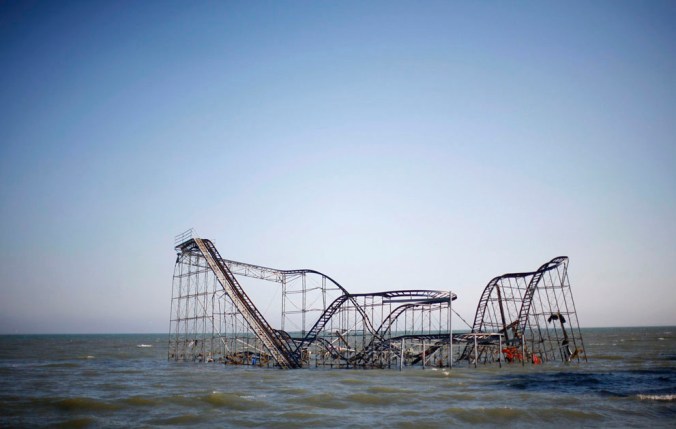
(The above is from The Atlantic‘s pretty astounding “2012: The Year in Photos.”)
Apocalypse as Fantasy
Heather Havrilesky has an article published today on Vulture titled, “Why TV Apocalypses Are Really Wish-Fulfillment Fables.” There is some (psychoanalytic) ground being retread here, but I can’t help but smile at the following statements: “Cormac McCarthy’s The Road at first appears bereft of wishful thinking — that is, until you recognize that solitude and scorched horizons are this author’s ideal tromping ground”; and, referring to NBCs Revolution: “This is the apocalypse with a full-time stylist, on heavy antibiotics.”
Nuke the Moon! (For Real)
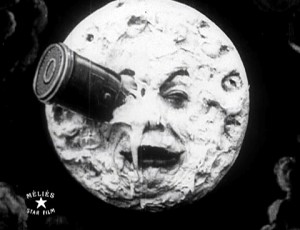
It was reported on Monday that “[i]n a secret project recently discovered, the United States planned to blow up the moon with a nuclear bomb in the 1950s as a display of the country’s strength during the Cold War space race.” Yes. The US was legitimately planning on blowing up the moon. The. Moon. Take that moon.
 The Hyperarchival Parallax