MLA 2026 Panels: “Aesthetics, Politics, and Ecological Overshoot” and “Comics as Physical Objects”

At this year’s Modern Language Association Convention in Toronto, Ontario, Canada (January 8-11, 2026), I will be speaking on a roundtable Aesthetics, Politics, and Ecological Overshoot, and panel, Comics as Physical Objects. I have included the information and tentative abstracts for each paper below.

52. Comics as Physical Objects

Thursday, January 8, 2026, 1:45-3:00 p.m.

Presiding: Edward Whitley (Lehigh U)

Presentations:
1. “A Queer Print History of Comics,” Margaret Galvan (U of Florida)
2. “The Comics Megatext: Floppies, Trades, Marvel Unlimited, Podcasts, and The X-Men,” Bradley Fest (Hartwick C)
3. “Multimedia and Digital Materialities: The Blue Age of (Web) Comics and Fostering Multimodal Literacy,” Devon Harvey (Queen’s U)
4. “Framing Matter: Materiality and the Medium of Comics,” Christina Kraenzle (York U)


The Comics Megatext: Floppies, Trades, Marvel Unlimited, Podcasts, and The X-Men

As Douglas Wolk recently pointed out in his book about reading all of Marvel Comics, “The twenty-seven thousand or so superhero comic books that Marvel Comics has published since 1961 are the longest continuous, self-contained work of fiction ever created.”[1] Though a bit smaller, the over six thousand comics that constitute The X-Men (1963–) also makes it one of the longest narratives ever written. Both are what I call in my current book project megatexts: a massively unreadable twenty-first century form created through collaboration and digital technology to achieve a scale beyond what a single author could do alone and that requires incredibly nontrivial effort on the part of readers to completely traverse. In this talk, I will explore the emergence of comics as a megatextual object in the twenty-first century. In the age of floppies and trades, comics megatexts were largely inaccessible in their totality. With the emergence of platforms such as Marvel Unlimited and paratextual forms like podcasts such as Jay and Miles X-Plain “The X-Men” (2014–), we can now read comics megatexts as megatexts. For all intents and purposes, then, the comics megatext has newly emerged as an accessible and thus coherent form that, like other megatexts, also importantly calls forth collective and creative reading and criticism. Approached in this way, The X-Men in particular offers us a continuously transforming megatextual object that is also a beacon for collaboratively exploring how to build alternative communities and ways of thinking and being for an infowhelming world.


[1] Douglas Wolk, All the Marvels: A Journey to the End of the Biggest Story Ever Told (New York: Penguin, 2021), 1.


602. Aesthetics, Politics, and Ecological Overshoot

Sunday, January 11, 2026, 10:15-11:30 a.m.

Presiding: John Maerhofer (Rutgers U, New Brunswick)

Speakers: Federico Correa Pose (U of Southern California)
Bradley Fest (Hartwick C)
Christopher Gortmaker (U of Chicago)
Brenda Odria Loayza (U of Toronto)
Pedro Gabriel Soares Daher (Maine C of Art and Design)

Megatextual Eco-Utopia: Jonathan Hickman’s X-Men and Mutant Poiesis

In 2019, in one of the more audacious reboots of a long-running megatextual franchise, Jonathan Hickman reimagined the now decades-long political aspirations of Marvel Comics’ X-Men (1963–) franchise in explicitly eco-utopian terms. Rather than continuing to pursue his decades-long dream of mutant and human peaceful coexistence, in House of X/Powers of X (2019) Professor X creates a separatist sovereign nation on the sentient living island Krakoa, an achieved utopia for all mutants. Notable even in its genre for its exploration of alternative presents and various futures, The X-Men franchise’s subsequent five-year pivot fleshes out the politics of a separatist utopia where no mutant dies and the dead are reborn. Despite the ecologically harmonious, sustainable technologies the mutant nation develops and despite their offer to share their miraculous, life-saving drugs and technology with the rest of the world, humans nonetheless turn toward the genocidal destruction of what appears the last, best hope for the continued flourishing for organic life on the planet. As such, Hickman’s eco-utopia emerges not from the dreams of the 1960s but from the despair of the present, a somewhat reactionary imaginary attempting to respond to the slow violence of climate change and the rise and resurgence of far-right, ecocidal extremism in the United States and around the world. Ultimately, however, the mutant survivors of Krakoa discover that their story was not one of separatist paradise gained but historical subjectivity achieved without the yoke of human bigotry and hatred, enabling them to build their world with others, crafting its institutions and practices, its culture and its politics—in short, mutant poiesis—the swift, violent destruction of which should serve as a warning for us in this moment of political destituency.


For previous essays of mine on megatexts and unreadable texts, see:

“Toward a Theory of the Megatext: Speculative Criticism and Richard Grossman’s ‘Breeze Avenue Working Paper.’”

“‘Is an Archive Enough?’: Megatextual Debris in the Work of Rachel Blau DuPlessis.”

“Reading Now and Again: Hyperarchivalism and Democracy in Ranjan Ghosh and J. Hillis Miller’s Thinking Literature across Continents.”

“Writing Briefly about Really Big Things.”

Summer and Fall 2024 Links

I was so busy this fall I fell behind on pretty much everything, so I’m making up for it with a big two-season link post, roughly mid-May until the end of 2024.


Nuclear and Environmental

The Editorial Board of The New York Times, “The President’s Arsenal.”

Elizabeth Kolbert, “When the Arctic Melts” and “Why Hurricane Milton Is a Sign of the New Abnormal.”

Damian Carrington, “Earth’s ‘Vital Signs’ Show Humanity’s Future in Balance, Say Climate Experts” and “‘No Sign’ of Promised Fossil Fuel Transition as Emissions Hit New High.”

Patrick Greenfield, “Trees and Land Absorbed Almost no CO2 Last Year. Is Nature’s Carbon Sink Failing?”

Kathleen Kingsbury, W.J. Hennigan, and Spencer Cohen, “The Last Survivors [of Hiroshima] Speak. It’s Time to Listen.”

Megan Specia and Lynsey Chutel, “Nobel Updates: Peace Prize Is Awarded to Japanese Group of Atomic Bomb Survivors.”

Christopher Kempf, “Disaster Triumphant.”

David E. Sanger, “Biden Approved Secret Nuclear Strategy Refocusing on Chinese Threat.”

William Langewiesche, “The Secret Pentagon War Game That ​Offers a Stark​ Warning for Our Times.”

W. J. Hennigan, “The Price.”

Damian Carrington, “Hopeless and Broken: Why the World’s Top Climate Scientists Are in Despair.”

Continue reading

Reading at CANO’s Writers Salon

I recently published a book, 2013–2017: Sonnets (LJMcD Communications, 2024), the first in an ongoing sonnet sequence. I have written the next book in the sequence, 2018–2024: Sonnets, and I’ve started the third, 2024–20XX: Sonnets, and I will be reading poems from these two most recent projects at 7:30 p.m. on Thursday, November 21, 2024 at the Community Arts Network of Oneonta (CANO)’s Writers Salon at the Wilber Mansion on 11 Ford Ave. I promise a poem about the election (writing it right now).

The 2024–25 Babcock Lecture: Anna Kornbluh, “Historical Fictions, Heist Flicks, and other Climate Genres for a Burning World”

Kornbluh, Anna--HeadshotI am delighted to yet again announce that on Thursday, October 17 at 7:00 p.m. in Anderson Theater at Hartwick College, distinguished critic Anna Kornbluh will be delivering the 2024–25 Babcock Lecture at Hartwick College, which will be titled: “Historical Fictions, Heist Flicks, and other Climate Genres for a Burning World.” Kornbluh’s lecture will be followed by a reading by eminent poet and feminist critic Rachel Blau DuPlessis and is part of the Oneonta Literary Festival.


Historical Fictions, Heist Flicks, and other Climate Genres for a Burning World

In the urgent emergency of climate crisis, is there any time for art? This talk considers some of the pressures on literature and culture at present, exploring the prevailing ways that artists, authors, and critics are conceiving artistic ties to the environment, and proposing some alternative ties with the help of popular genres like historical fiction and heist films.


Anna Kornbluh
 is professor of English and a member of the United Faculty bargaining team at the University of Illinois, Chicago, where her research and teaching focus on the novel, film, and critical theory. She is the author of Realizing Capital: Financial and Psychic Economies in Victorian Realist Form (Fordham University Press, 2014), Marxist Film Theory and “Fight Club” (Bloomsbury, 2019), The Order of Forms: Realism, Formalism, and Social Space, and Immediacy, or, The Style of Too Late Capitalism, which was recently published by Verso. She has edited special issues for b2o: an online journalCriticismMediations, and Syndicate, and is a frequent guest on The American Vandal and other podcasts. She is the founder of the V21 Collective and InterCcECT (Inter Chicago Circle for Experimental Critical Theory) and is the Director of Graduate Studies at UIC.

2013–2017: Sonnets

Now available! 2013–2017: Sonnets, my third book of poetry and the first volume of my American Sonnet sequence, has been published by LJMcD Communications. It can be ordered through Amazon

Fest, Bradley J--Cover for 2013-2017--cover

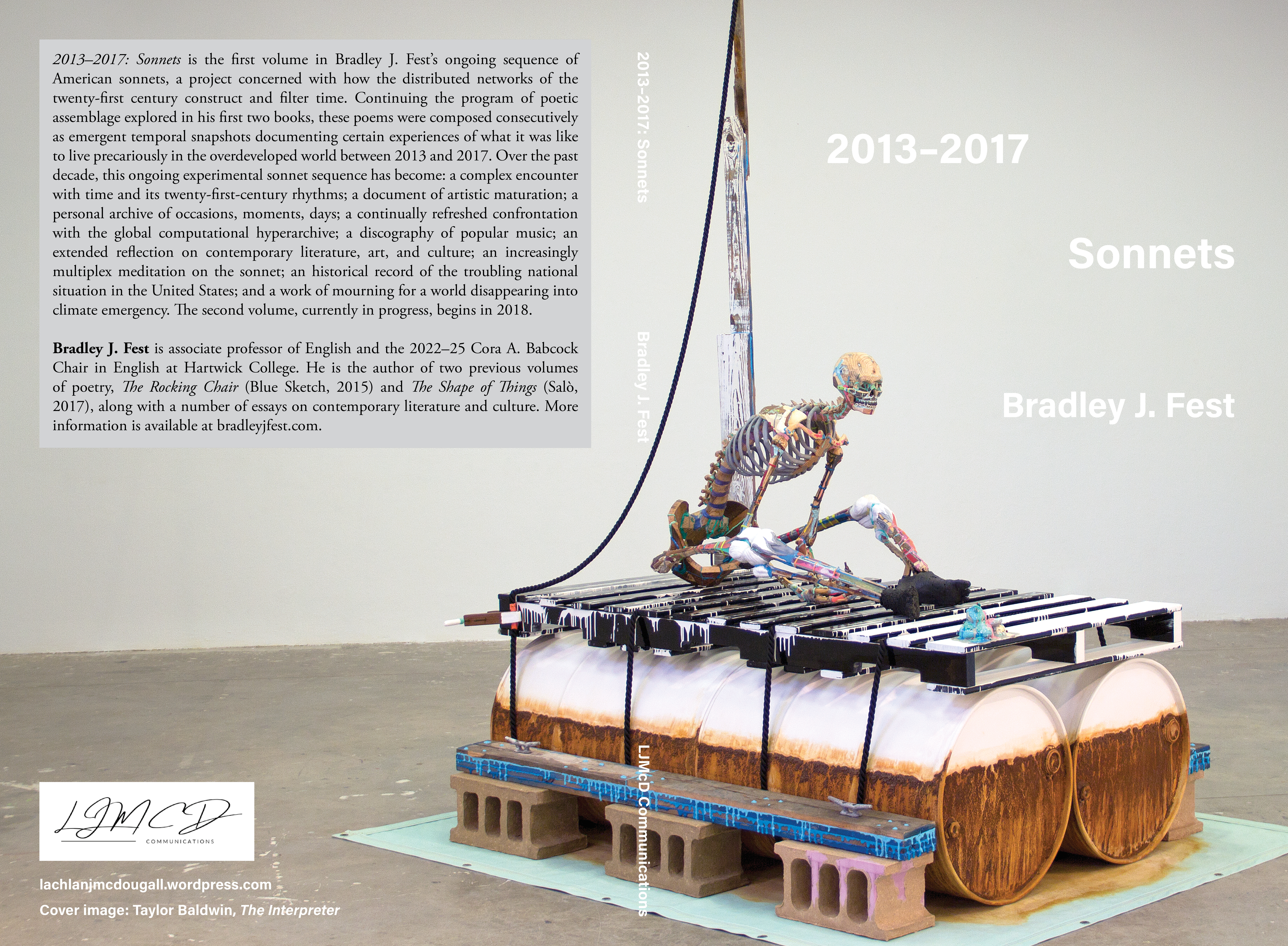
2013–2017: Sonnets is the first volume in Bradley J. Fest’s ongoing sequence of American sonnets, a project concerned with how the distributed networks of the twenty-first century construct and filter time. Continuing the program of poetic assemblage explored in his first two books, these poems were composed consecutively as emergent temporal snapshots documenting certain experiences of what it was like to live precariously in the overdeveloped world between 2013 and 2017. Over the past decade, this ongoing experimental sonnet sequence has become: a complex encounter with time and its twenty-first-century rhythms; a document of artistic maturation; a personal archive of occasions, moments, days; a continually refreshed confrontation with the global computational hyperarchive; a discography of popular music; an extended reflection on contemporary literature, art, and culture; an increasingly multiplex meditation on the sonnet; an historical record of the troubling national situation in the United States; and a work of mourning for a world disappearing into climate emergency. The second volume, currently in progress, begins in 2018.

Eternal thanks to Lachlan J. McDougall for bringing 2013–2017 into the world and to Taylor Baldwin for the cover image.

Fest, Bradley J--Cover for 2013-2017--spread

Spring 2024 Links

Nuclear and Environmental

W. J. Hennigan, “The US Has Received a Rare Invitation from China. There Is Only One Right Answer.”

Kathleen Kingsbury and W. J. Hennigan, “At the Brink: A Series about the Threat of Nuclear Weapons in an Unstable World.”

Anton Troianovski, “Putin Says West Risks Nuclear Conflict if It Intervenes More in Ukraine.”

David E. Sanger, “Biden’s Armageddon Moment: When Nuclear Detonation Seemed Possible in Ukraine.”

Catie Edmondson, “Senate Approves Expansion of Fund for Nuclear Waste Exposure Victims.”

Anton Troianovski, “Russia to Hold Drills on Tactical Nuclear Weapons in New Tensions with West.”

Noah Smith, “Americans Are Still Not Worried Enough about the Risk of World War.”

Emily Faux, “Deserted Myths and Nuclear Realities: Revisiting the Symbolism of Nuclear Weapons in Contemporary Popular Culture through Oppenheimer.”

Paul Thompson, “Become Death: On Christopher Nolan’s Oppenheimer.”

Motoko Rich and Kiuko Notoya, “Oppenheimer Opens in Nuclear-Scarred Japan, Eight Months After US Premiere.”

Ariel Kaminer, Oppenheimer, My Uncle, and the Secrets America Still Doesn’t Like to Tell.”

Jimmy So, “Killerheimer: American Betrayal in Martin Scorsese and Christopher Nolan.”

Anna Kornbluh, “We Didn’t Start the Fire: Death Drive against Ecocide.”

Bill McKibben, “‘D Is for Despair’ Didn’t Sound so Good: A Conversation between Bill McKibben and Elizabeth Kolbert.”

Continue reading

“2015.10,” “2015.23,” and “2016.10” Reprinted in What We Did during the Apocalypse: The Archive of “The Babel Tower Notice Board”

What We Did During the Apocalypse--The Babel Tower Notice Board_Page_001The Babel Tower Notice Board, a pandemic project that existed between August 2020 and December 2021 edited by Richard Capener, was just collected in What We Did during the Apocalypse: The Archive of “The Babel Tower Notice Board” (Hem Press, 2024). I was thrilled then and continue to be thrilled that three sonnets of mine, “2015.10,” “2015.23,” and “2016.10,” are part of that project. Thanks again to Capener for his amazing work on The Babel Tower Notice Board, for his monthly Babel Parish Newsletter–a welcome dispatch during those difficult months–and for his continued great work with Hem Press.

(And “2015.10,” “2015.23,” and “2016.10” will all be collected in my third book of poems, 2013–2017: Sonnets, forthcoming in July from LJMcD Communications.)

Summer and Fall 2023 Links

The links have really gotten away from me. This summer, I was prioritizing finishing up a chapter for Too Big to Read, and this fall the semester just hammered me; I basically haven’t had a single free moment. So, better late than never, huh? Over six months of links. Enjoy.


Nuclear and Environmental

Apocalyptica, a new journal.

Jeff VanderMeer, “Florida’s Environmental Failures Are a Warning for the Rest of the US.”

Lydia Millet, “Biden’s Green Energy Money Is Sugar on a Poison Pill.”

Tina Cordova, “What Oppenheimer Doesn’t Tell You about the Trinity Test.”

Brad Plumer and Elena Shao, “Heat Records Are Broken Around the Globe as Earth Warms, Fast.”

Alexis Pauline Gumbs, “Heat Is Not a Metaphor.”

David Gelles, “Climate Disasters Daily? Welcome to the ‘New Normal.’”

Tom Engelhardt, “Humanity Has Created Too Many Ways of Destroying Itself.”

Kim Tingley, “‘Forever Chemicals’ Are Everywhere. What Are They Doing to Us?”

Azby Brown, “Just Like That, Tons of Radioactive Waste Is Heading for the Ocean.”

Raymond Zhong, “Something Was Messing With Earth’s Axis. The Answer Has to Do With Us.”

Damian Carrington, “Canadian Lake Chosen to Represent Start of Anthropocene.”

Ralph Vartabedian, “A Poisonous Cold War Legacy That Defies a Solution.”

The Washington Post, “Where Dangerous Heat Is Surging.”

Michael Levenson, “Heat Wave and Blackout Would Send Half of Phoenix to ER, Study Says.”

Jessica Hurley, “The Irradiated Body as Postcolonial Lost Edge.”

Hoyt Long and Aarthi Vadde, “We Want Our Catastrophe TV.”

Continue reading

Spring 2023 Links

Nuclear and Environmental

Herman Kahn, On Thermonuclear War (1960).

Raymond Zhnog, “For Planet Earth, This Might Be the Start of a New Age.”

Nicholas Kristof, “Cheer Up! The World Is Better Off Than You Think.”

Rebecca Solnit, “What If Climate Change Meant Not Doom–But Abundance?”

Elizabeth Kolbert, “It’s Earth Day—and the News Isn’t Good.”

David Wallace-Wells, “Greta Thunberg: ‘The World Is Getting More Grim by the Day.'”

Mark O’Connell, “Our Way of Life Is Poisoning Us.”

Simon Schama, “Simon Schama on the Broken Relationship between Humans and Nature: ‘The Joke’s on Us. Things Are Amiss.'”

Continue reading

2013–2017: Sonnets Will Be Published by LJMcD Communications in July 2024

Fest, Bradley J--Cover for 2013-2017--600 resolution--coverI am absolutely thrilled to announce that 2013–2017: Sonnets, the first volume of my ongoing sonnet sequence, will be published by LJMcD Communications in July 2024. I’ll update this page with more information when I have it, but for now, here’s a description of the book:

2013–2017: Sonnets is the first volume in Bradley J. Fest’s ongoing sequence of American sonnets, a project concerned with how the distributed networks of the twenty-first century construct and filter time. Continuing the program of poetic assemblage explored in his first two books, these poems were composed consecutively as emergent temporal snapshots documenting certain experiences of what it was like to live precariously in the overdeveloped world between 2013 and 2017. Over the past decade, this ongoing experimental sonnet sequence has become: a complex encounter with time and its twenty-first-century rhythms; a document of artistic maturation; a personal archive of occasions, moments, days; a continually refreshed confrontation with the global computational hyperarchive; a discography of popular music; an extended reflection on contemporary literature, art, and culture; an increasingly multiplex meditation on the sonnet; an historical record of the troubling national situation in the United States; and a work of mourning for a world disappearing into climate emergency. The second volume, currently in progress, begins in 2018.

Also, thanks much to my very good friend Taylor Baldwin for the amazing cover image: The Interpreter (2010).