Spring Semester 2026: Syllabi and Teaching Without Computers


After a very productive and thoroughly refreshing sabbatical, I’m back at Hartwick College this spring teaching two courses (and two of my favorite to teach!). Here are the syllabi: ENGL 220 Introduction to Textual Analysis and ENGL 352 Critical Game Studies.

Most notably, after twenty years of teaching predominantly writing-intensive courses in which I assigned essays, poems, and stories to be composed outside of class, in response to the frustration the sheer amount of student work I have seen generated by artificial intelligence (AI) has caused me and the more general neofeudal edtechification of higher education, I made the decision this spring to make my courses (almost) completely analog in terms of assignments, materials, and expectations. Students write all their papers in class. Students are required to have print books, and I print out all PDFs for them to read and annotate. No one has a smart phone or a laptop anywhere in sight. It’s glorious, old school, amazingly analog. And it is working.[1]

I am calling this teaching without computers, and it has been revolutionary for my pedagogy and peace of mind, revitalizing the classroom as a space of human connection, energy, communication, thinking, and poiesis while also assuaging my own considerable frustrations with and despair about my job over the past few years, a job that at some point seemed destined to be little more than that of plagiarism detective. All my previous engagement with students’ ideas and their attempts to express those ideas were slowly and almost completely strained away over the past three-odd years with nothing left but policing, constantly on the lookout for evidence of now seemingly ubiquitous large-language model (LLM) use infecting and subverting the reading, writing, and thinking of our students, of an entire generation of young people, of, really, everyone, compromising our very humanity with its tepid, dumb slop. Though I am only six weeks into the semester, the transformation teaching without computers has wrought upon my classroom has been remarkable. My students have, to a large degree, embraced my new pedagogy, as I suspect it has given them back something that I perhaps only now realize had been lost in classrooms years before LLMs had emerged. I cannot recommend this (and other) kind(s) of AI-resistant pedagogy enough for other people teaching in the critical humanities. I am a convert. Fully. And I expect that, whatever comes next for me as a teacher, a big part of it will be proselytizing for the new good news: teaching and learning without computers.

For more resources on resisting AI in our teaching, see Anna Kornbluh, Eric Hayot, Krista Muratore, and Gina Stinnett’s Against AI.


[1] That said, there are still some digital elements in my classes. For example, obviously I still require that students play video games in ENGL 352 Critical Game Studies, and I do make available the online version of the Oxford English Dictionary and a thesaurus during in-class writing assignments. Of course, I also happily approve whatever digital accommodations students might need—they just need to ask (and regardless of whether or not they have any documented need for such accommodation).

“Postrock” in Always Crashing

I am beyond delighted to announce that my long poem, “Postrock,” which I composed between June 2021 and July 2022 and which was supported by the Cora A. Babcock Chair in English and a number of Faculty Research Grants, has (finally!) been published in Always Crashing. This is probably the piece of writing that I am the most proud of among everything I have ever published, and so I am just utterly thrilled to be able to bring it into the world. I am forever indebted to James Tadd Adcox and the other editors of Always Crashing for their ongoing support of my work.

“Postrock” is the concluding and last unpublished poem from an unpublished manuscript (also titled Postrock and seeking a publisher!) in which I endeavor to perform what I’m calling a weird phenomenology: seeing everyday objects anew by mediating their perception through lenses of poetic, environmental, and cultural influence. In particular, “Postrock” draws explicit inspiration from John Ashbery’s Three Poems (1972), is a sustained meditation on space, and, like all the poems from the manuscript, was composed while listening to postrock music. The poem is also in conversation with a large number of other texts, including books about space by Gaston Bachelard, Maurice Blanchot, Henri Lefebvre, and others, and it was composed using a variety of formal constraints, including being composed as an unbroken, nearly twenty-thousand-word paragraph.

The 2025–26 Visiting Writers Series at Hartwick College

With the departure of my amazing colleague Tessa Yang, and as I am on sabbatical this fall, no events will be held in the fall for the 2025–26 Visiting Writers Series at Hartwick College. The series will return in spring 2026 with the events below. Readings take place at 7:00 in the Eaton Lounge, Bresee Hall at Hartwick College in Oneonta, New York.


James Tadd Adcox will be reading, including from his newest book Denmark Variations (Hem Press, 2023), on Thursday, April 23, 2026.

For more information, visit the Visiting Writers Series webpage.

Summer and Fall 2024 Links

I was so busy this fall I fell behind on pretty much everything, so I’m making up for it with a big two-season link post, roughly mid-May until the end of 2024.


Nuclear and Environmental

The Editorial Board of The New York Times, “The President’s Arsenal.”

Elizabeth Kolbert, “When the Arctic Melts” and “Why Hurricane Milton Is a Sign of the New Abnormal.”

Damian Carrington, “Earth’s ‘Vital Signs’ Show Humanity’s Future in Balance, Say Climate Experts” and “‘No Sign’ of Promised Fossil Fuel Transition as Emissions Hit New High.”

Patrick Greenfield, “Trees and Land Absorbed Almost no CO2 Last Year. Is Nature’s Carbon Sink Failing?”

Kathleen Kingsbury, W.J. Hennigan, and Spencer Cohen, “The Last Survivors [of Hiroshima] Speak. It’s Time to Listen.”

Megan Specia and Lynsey Chutel, “Nobel Updates: Peace Prize Is Awarded to Japanese Group of Atomic Bomb Survivors.”

Christopher Kempf, “Disaster Triumphant.”

David E. Sanger, “Biden Approved Secret Nuclear Strategy Refocusing on Chinese Threat.”

William Langewiesche, “The Secret Pentagon War Game That ​Offers a Stark​ Warning for Our Times.”

W. J. Hennigan, “The Price.”

Damian Carrington, “Hopeless and Broken: Why the World’s Top Climate Scientists Are in Despair.”

Continue reading

The 2024–25 Visiting Writers Series at Hartwick College

In addition to this year’s Oneonta Literary Festival, at which Rachel Blau DuPlessis, Ross Gay, Anna Kornbluh, and many others will be speaking, the Hartwick College and the Department of Literature, Media, and Writing will present three readings in the 2024–25 Visiting Writers Series. Readings take place at 7:00 in the Eaton Lounge, Bresee Hall at Hartwick College in Oneonta, New York.


I will be reading on Wednesday, September 24, 2024 from my new book, 2013–2017: Sonnets (LJMcD Communications, 2024).

Libby Cudmore will be reading from her new book, Negative Girl (Datura, 2024), on Wednesday, November 13, 2024.

And Amish Trivedi will be reading, including from his newest book FuturePanic (Co•Im•Press, 2021), on Thursday, April 10, 2025.

For more information, visit the Visiting Writers Series webpage.

2013–2017: Sonnets

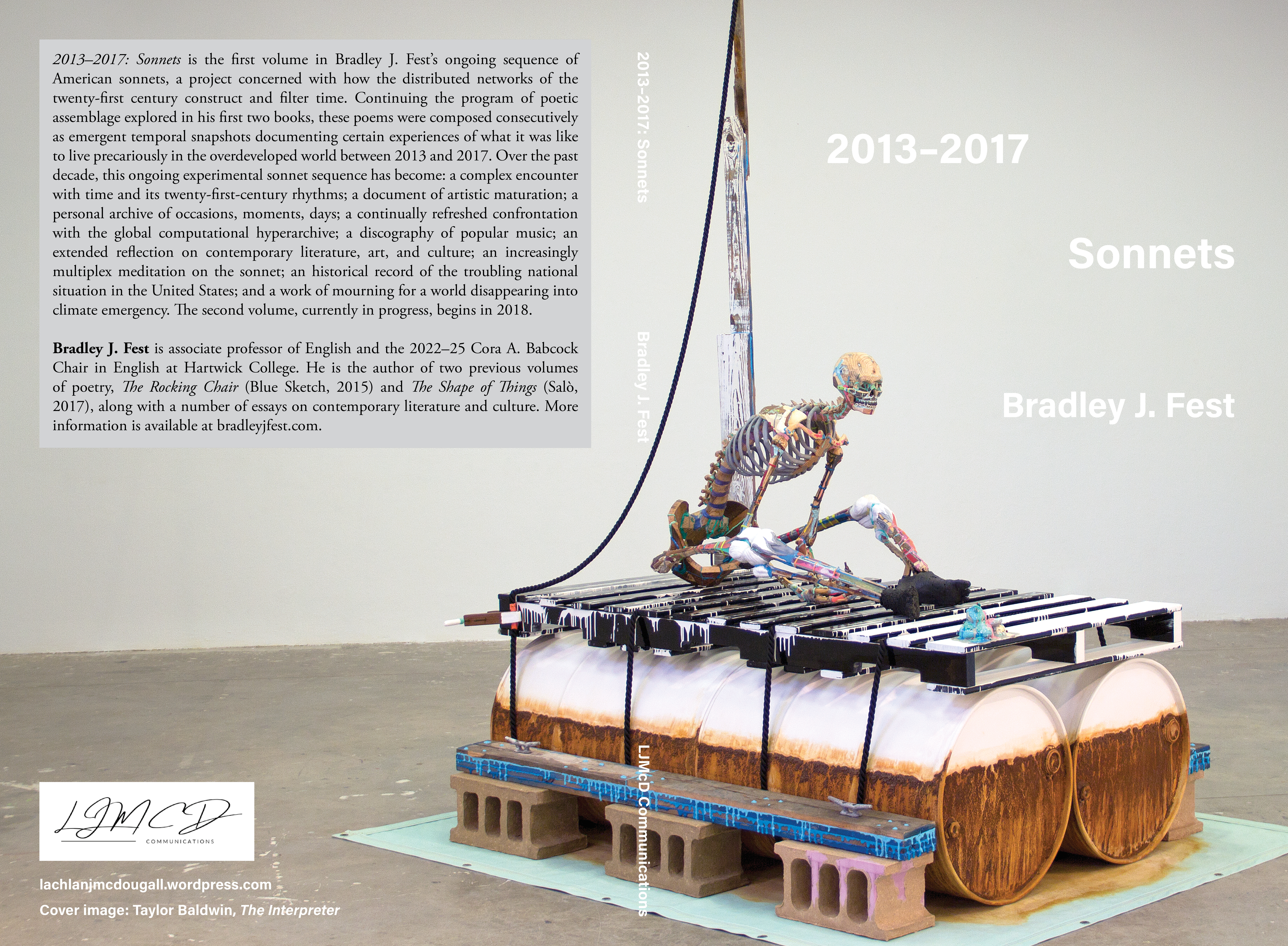
Now available! 2013–2017: Sonnets, my third book of poetry and the first volume of my American Sonnet sequence, has been published by LJMcD Communications. It can be ordered through Amazon

Fest, Bradley J--Cover for 2013-2017--cover

2013–2017: Sonnets is the first volume in Bradley J. Fest’s ongoing sequence of American sonnets, a project concerned with how the distributed networks of the twenty-first century construct and filter time. Continuing the program of poetic assemblage explored in his first two books, these poems were composed consecutively as emergent temporal snapshots documenting certain experiences of what it was like to live precariously in the overdeveloped world between 2013 and 2017. Over the past decade, this ongoing experimental sonnet sequence has become: a complex encounter with time and its twenty-first-century rhythms; a document of artistic maturation; a personal archive of occasions, moments, days; a continually refreshed confrontation with the global computational hyperarchive; a discography of popular music; an extended reflection on contemporary literature, art, and culture; an increasingly multiplex meditation on the sonnet; an historical record of the troubling national situation in the United States; and a work of mourning for a world disappearing into climate emergency. The second volume, currently in progress, begins in 2018.

Eternal thanks to Lachlan J. McDougall for bringing 2013–2017 into the world and to Taylor Baldwin for the cover image.

Fest, Bradley J--Cover for 2013-2017--spread

Oneonta Literary Festival, October 17–21, 2024 and the 2024–25 Babcock Lecture.

onenta-new-york-Main-Sunset_f

In collaboration with SUNY Oneonta’s Department of English, the Community Arts Network of Oneonta (CANO), the Huntington Library, and Oneonta High School, my colleague Tessa Yang and I are co-organizing the Oneonta Literary Festival, which will take place October 17–21, 2024 at various places in and around Oneonta.

For our part, Hartwick College is bringing in Anna Kornbluh to deliver the 2024–25 Babcock Lecture, “Historical Fictions, Heist Flicks, and other Climate Genres for a Burning World,” as part of the festival, along with Rachel Blau DuPlessis, Ross Gay, and Willy Palomo. For more information, please visit the Oneonta Literary festival website at www.hartwick.edu/literaryfestival. (The festival also takes place throughout the year [more info about year-long events here].)

At Hartwick College, the festival is supported by the Arts and Humanities Division, the Babcock Chair in English, the Department of Literature, Media, and Writing, a grant from the National Endowment for the Humanities, the Office of Academic Affairs, and the Visiting Writers Series.

The 2023–24 Visiting Writers Series at Hartwick College

This year, Hartwick College and the Department of Literature, Media, and Writing will present four readings in the 2023–24 Visiting Writers Series. Readings take place at 7:00 in the Eaton Lounge, Bresee Hall at Hartwick College in Oneonta, New York.


Novelist and essayist Shena McAuliffe will read on Wednesday, October 11, 2023 from her new book of short stories, We Are a Teeming Wilderness: Stories (Press 53, 2023).

Poet and emeritus Hartwick professor Robert Bensen will read from his new book, What Lightning Spoke: New and Selected Poems (Bright Hill, 2023), on Wednesday, November 8, 20223.

Yumei Kitasei will read from her new novel, The Deep Sky (Flatiron Books, 2023), on Monday, March 4, 2024.

And poet essayist Joshua Zelesnick will read from his forthcoming poetry collection, Insert Coin (Finishing Line Press, forthcoming 2025), on Thursday, April 11, 2024.

For more information, visit the Visiting Writers Series webpage.

Summer and Fall 2023 Links

The links have really gotten away from me. This summer, I was prioritizing finishing up a chapter for Too Big to Read, and this fall the semester just hammered me; I basically haven’t had a single free moment. So, better late than never, huh? Over six months of links. Enjoy.


Nuclear and Environmental

Apocalyptica, a new journal.

Jeff VanderMeer, “Florida’s Environmental Failures Are a Warning for the Rest of the US.”

Lydia Millet, “Biden’s Green Energy Money Is Sugar on a Poison Pill.”

Tina Cordova, “What Oppenheimer Doesn’t Tell You about the Trinity Test.”

Brad Plumer and Elena Shao, “Heat Records Are Broken Around the Globe as Earth Warms, Fast.”

Alexis Pauline Gumbs, “Heat Is Not a Metaphor.”

David Gelles, “Climate Disasters Daily? Welcome to the ‘New Normal.’”

Tom Engelhardt, “Humanity Has Created Too Many Ways of Destroying Itself.”

Kim Tingley, “‘Forever Chemicals’ Are Everywhere. What Are They Doing to Us?”

Azby Brown, “Just Like That, Tons of Radioactive Waste Is Heading for the Ocean.”

Raymond Zhong, “Something Was Messing With Earth’s Axis. The Answer Has to Do With Us.”

Damian Carrington, “Canadian Lake Chosen to Represent Start of Anthropocene.”

Ralph Vartabedian, “A Poisonous Cold War Legacy That Defies a Solution.”

The Washington Post, “Where Dangerous Heat Is Surging.”

Michael Levenson, “Heat Wave and Blackout Would Send Half of Phoenix to ER, Study Says.”

Jessica Hurley, “The Irradiated Body as Postcolonial Lost Edge.”

Hoyt Long and Aarthi Vadde, “We Want Our Catastrophe TV.”

Continue reading