Mitch Smith just wrote an article for Inside Higher Education about the suspension of graduate admissions in the German, religious studies, and classics departments at Pitt.
Archival Pedagogy
Freedom and the Bomb Threats at the University of Pittsburgh, Spring 2012

I have been teaching Jonathan Franzen’s Freedom (2010) for the past five weeks. During that time the University of Pittsburgh received 125+ (and counting) bomb threats,[1] with as many evacuations. That the conjunction of these things would lead a college literature course to ask more general questions of “freedom,” what it means to be free, what role institutions play, etc., is obvious. And we have had quite an interesting discussion of some of these issues. But, particularly within the context of Franzen’s novel, there are some deeper and more fundamental questions regarding freedom that these threats raise.
The terrorism the university is experiencing threatens basic academic freedoms. And not in the usual sense we ivory tower dwellers mean when discussing things like tenure or FERPA, but how something as simple as Mixmaster is powerful enough to threaten the very foundations of a major public institution. The effects such threats have on an urban campus like Pitt, with its attendant hospital buildings, adjacent universities and colleges, is considerable. And the threats are now beginning to spread outside the university.[2] When 34,000 students and attendant faculty are undergoing continual evacuations, to the point that attendance policies have been thrown out the window, the stress and anxiety in the urban/academic landscape is palpably evident.
And here we are, talking about Franzen’s novel, having a very interesting discussion online, and my students are afraid to come to class. The facebooks, with its multiple grad student/student/professor connections, has only exacerbated the situation. (Like, we all know more-or-less immediately that, in a completely unrelated incident, this happened the other day.[3]) And yet we are having class. And frankly, this has been one of the most interesting classes I have had the privilege of teaching, largely due to the fortitude of my students who are coming to class. I have made it clear to them that their attendance has ceased to be mandatory. Sure, not all of my students were there for the past two weeks, but many of them were.[4]
So it struck me last week, that since the questions of the course largely involved postmodern representation, with all the simulacra and simulation of White Noise (1985), the spectacle of 9/11 in the American imaginary, and various other writings of disaster, the form of these bomb threats and the affect they are producing deserves particular attention. Pitt is experiencing, quite simply, a simulation of terrorism, terrorism as simulation. The other night I was reading a particularly strong interpretation of the presence of aerial warfare in Virginia Woolf’s Mrs. Dalloway, and could not help but note how Paul K. Saint-Amour’s analysis of false air-raid alarms after World War I was particularly apt for the current situation:
The same assessments implied that the panic induced by false alarms was in some ways more disruptive than that caused by actual raids. Unlike the realized physical violence of a raid, a false alarm provides no catharsis for the sense of endangerment it produces; it mobilizes anxiety without providing it with a kinetic output. Thus the very falsity of the alarm emphasizes a condition of hideously prolonged expectation, a state of emergency that is both perennial, in having been detached from the arrival of violence in a singular event, and horribly deferred—the advance symptom of a disaster still to come.[5]
These bomb threats have effectively revealed that what was once an advance symptom of a disaster “to come,” has become the disaster in-and-of-itself. The state of exception, the feeling my students have of being constantly threatened, has become the norm. Campus life has adjusted, and already the bomb threats have become an old, perhaps tired point of conversation. The institution has already internalized the state of exception. Receiving 3 or so text messages daily from the university’s Emergency Notification Service is not only unsurprising,[6] but expected. And this is one aspect of what is so frightening about these bomb threats. They may never end.
Further, it was reported in both The Wall Street Journal and Forbes today that the FBI has seized the servers of activist group Riseup Networks in an effort to track the emails that are making up the bulk of the threats. Riseup provides an email service so that activists and whistleblowers can remain anonymous. Says the spokesperson for Riseup, Devin Theriot-Orr, “Our position is that anonymous speech is vital to a thriving democracy. Anonymous remailers are used by democracy activists, people in oppressive regimes and whistleblowers. There isn’t a way to run an anonymous remailer that allows good anonymous speech and not bad anonymous speech.” Theriot-Orr further added that, “[The FBI’s raid] is an attack on all forms of anonymous communications.”[7] That whoever is making these bomb threats is taking advantage of a system designed to protect freedom of speech is particularly disturbing.
Compounded with the fact that recent suspects included a transgender couple once associated with the satellite Johnstown campus, there is something disconcerting about the turn these threats are taking. At the time of this writing it is unclear why these threats are being made. No demands have been made public, and no ideological position has been taken by whoever is issuing these threats. Nonetheless, so far there is an undeniable political dimension to the (public) targets of the FBI’s investigation. And the fact that the FBI has seized the server of a group whose explicit goal is to protect speech, raises some very complex questions regarding security and privacy.
It has been difficult as an instructor to think through these questions vis-à-vis teaching Freedom. For Franzen’s novel complexly explores questions of, quite simply, freedom, and the difficulty of being “truly free.” As Lev Grossman writes in his article on Franzen for Time magazine,
For Franzen’s characters, too much freedom is an empty, dangerously entropic thing. After all, energy companies are free to ravage and poison the breeding grounds of the cerulean warbler. If Patty and Walter divorced, they would be free, but it’s a freedom they would do almost anything to avoid. At her lowest ebb, Patty reflects that she “had all day every day to figure out some decent and satisfying way to live, and yet all she ever seemed to get for all her choices and all her freedom was more miserable.” And no one is freer than a person with no moral beliefs. “One of the ways of surrendering freedom is to actually have convictions,” Franzen says. “And a way of further surrendering freedom is to spend quite a bit of time acting on those convictions.”[8]
The bomb threats have made clear that a certain level of security is necessary, and I for one, as someone who is both professionally frustrated by the constant disruption of these threats, and concerned for my student’s physical and psychological well-being,[9] want these threats to end. The question of what restrictions on freedom are necessary to achieve such a conclusion, however, when it seems quite apparent that no one has any idea who is behind the threats, and that we have gone far beyond the question of does-freedom-of-speech-protect-your-right-to-yell-fire-in-a-crowded-theater, makes the current situation a particularly problematic one. For the threat being experienced by the entire Pitt community, costing millions of dollars, potentially doing damage to Fall enrollments, and further exacerbating the financial situation of an institution already making large cuts due to decreased state funding, is, at this point, fundamentally discursive.
For my final lecture of the year yesterday, this is something I emphasized to my students. For, no matter what one may think of Freedom (warts and all [or my own take, which I am of course not as emphatic about at this point]), our reading of the novel in the context of both the larger questions of the course and the ongoing bomb threats has served to emphasize that risk projection is an incredibly powerful force in the postmodern imagination. And perhaps, despite Franzen’s own worries about the role of the Novel in the late-20th c., that reading literature forces us to ask questions about freedom, representation, and disaster, about the increasingly precarious position of public vs. private discourse, this hopefully foregrounds the vital role studying the humanities can play in attempting to comprehend and imagine an alternative to the terror Pitt has experienced for months. If I myself have learned anything from my students this semester, it is that there is something important about getting together, carrying on, and talking seriously about a novel that deals with serious issues, perhaps especially in adverse conditions. And if nothing else, I am incredibly in debt to my students for that.
[1] And, crazily, the bomb threats already have their own Wikipedia page. See link above.
[2] I do not think it improper to point out that these threats are beginning to resemble spam. . . .
[3] Further, thinking that my students would feel safer outside the frequently threatened Cathedral of Learning, they are now expressing fear about the openness of the park we are in, and the possibility of a shooting.
[4] To add another layer of mediation, not only do I find myself frequently searching “bomb threats at Pitt,” I also just got a text message (one of many), informing me that the Cathedral hasn’t blown up this time either, in so many words.
[5] Paul K. Saint-Amour, “Air War Prophecy and Interwar Modernism,” Comparative Literature Studies 42.2 (2005): 140.
[6] In fact, Pitt has recently started a video campaign played on monitors at various points on campus requesting that students not opt out of the ENS. Seriously though, receiving many text messages every day is quite annoying.
Also check out this vid from MSNBC.
[7] Qtd. in Andy Greenberg, “FBI Seizes Activists’ Anonymizing Server in the Probe of Pittsburgh’s Bomb Threats,” Forbes (19 April 2012), http://www.forbes.com/sites/andygreenberg/2012/04/19/fbi-seizes-activists-anonymizing-server-in-probe-of-pittsburghs-bomb-threats/.
[8] Lev Grossman, “Jonathan Franzen: The Wide Shot,” Time176. 8 (23 August 2010): 46, http://www.time.com/time/magazine/article/0,9171,2010185,00.html.
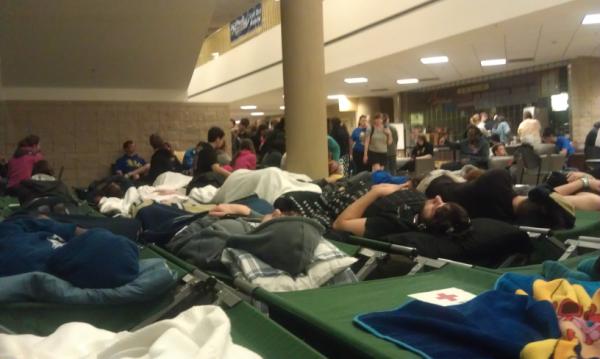
[9] One of the more despicable aspects of the threats has been the frequent and continual threats to student dormitories at late hours of the night or early morning. For instance, students have been forced to sleep on cots in the gymnasium during these threats.
ENGLIT 0365: Literature and the Contemporary
I will be teaching Literature and the Contemporary this summer during the second six week session at the University of Pittsburgh. This course examines contemporary cultural expression across a range of forms and media. It investigates the contemporary as both a complex reworking of past narratives and traditions, and as the production of the experimental and the new. In particular, this section of Literature and the Contemporary, subtitled “Human/Machine: Exploring the Posthuman Imagination,” will examine how intersections between human and machine, between the biological and the technological have been represented in a wide range of texts. Beginning with Mary Shelley’s Frankenstein, we will then read significant 20th and 21st century novels that approach questions of posthumanity in complex and often quite shocking ways:
Paolo Bacigalupi, The Windup Girl (San Francisco: Night Shade Books, 2010 [2009]).
J.G. Ballard, Crash (New York: Picador, 2001 [1973]).
Jennifer Egan, Look at Me (New York: Anchor Books, 2002 [2001]).
Thomas Pynchon, The Crying of Lot 49 (New York: Perennial, 2006 [1965]).
Mary Shelley, Frankenstein (Norton Critical Edition), 2nd ed., ed. J. Paul Hunter (New York: W.W. Norton & Co., 2012 [1818]).
Videodrome (David Cronenberg, 1983).
ENGLIT 0635: New Literature Class Blog
For a course in New Literature I’m teaching this upcoming semester, which I’ve subtitled “U.S. Fiction in the Wake of Postmodernism,” my students are keeping a course blog. Check it out here. Content will be arriving shortly. (And wow, just realized no posts for the whole month of Dec. Been a while since I’ve done that. . . ).
Some Links: On the “End” of Postmodernism, Quantum Theory, Apocalypse, and Destroyed Archives
Edward Docx (sounds like a pseudonym) just wrote a piece, “Postmodernism is Dead,” over at Prospect.
At Nature, Eugenie Samuel Reich reports on a major breakthrough in quantum physics. “But the new paper, by a trio of physicists led by Matthew Pusey at Imperial College London, presents a theorem showing that if a quantum wavefunction were purely a statistical tool, then even quantum states that are unconnected across space and time would be able to communicate with each other. As that seems very unlikely to be true, the researchers conclude that the wavefunction must be physically real after all.”
“Why are Apocalyptic Narratives So Popular?” Why, I don’t know. . . .
Occupy Wall Street Archival Destruction.
My colleague Adriana Ramirez is having her students blog for her class “Narrative and Technology: We Might Be Gadgets.” The class just got done playing World of Warcraft (Blizzard: 2004-2011), and I had the great privilege to deliver a guest lecture a few days ago. Check out the blog here.
America’s growing anti-intellectualism.
And a nice discussion of the archival “Etymology” and “Extracts” section of Moby-Dick (which I’m teaching right now).
New Literature: ENGLIT 0635
I just finished designing the course I’m going to be teaching in the Spring at Pitt, New Literature (ENGLIT 0635), which I’ve titled “U.S. Fiction in the Wake of Postmodernism,” and I am quite excited about it! One of the challenges for such a course (whose online course description is incredibly broad, literally any lit. from the past 25 years, not limited to region, country, genre, style, school, etc.), is figuring out what exactly is meant by “new” literature. Consequently, I’m beginning the course where I often end other courses–Don DeLillo’s White Noise–and am taking up very seriously the idea that the lit. we’re reading is, if not precisely “after” postmodernism (not post-postmodernism, a useless term), then at least positioned in its wake–i.e. the pomo is still around, but it has also left, or something. The class will start w/ grounding pomo in fairly “standard” ways, move through Southland Tales, through some “theory” as lit. (informed by DFWs old “Fictional Futures” essay) and end by seriously considering two U.S. novels that have gotten quite a bit of play as of late, Freedom and The Submission. New lit. indeed. Below is the major reading list, followed by the rest. . .
Don DeLillo, White Noise: Text and Criticism, ed. Mark Osteen (New York: Penguin, 1998 [1985]).
Jonathan Franzen, Freedom (New York: Picador, 2011 [2010]).
Richard Kelly & Brett Weldele, Southland Tales: The Prequel Saga (Anaheim: Graphitti Designs, 2007).
Amy Waldman, The Submission (New York: Farrar, Straus & Giroux, 2011).
David Foster Wallace, Girl with Curious Hair (New York: W.W. Norton & Co., 1989).
Slavoj Žižek, Welcome to the Desert of the Real (New York: Verso, 2002).
And the additional reading:
Jonathan Franzen, “Why Bother” in How to Be Alone: Essays (New York: Farrar, Straus & Giroux, 2002), 55-97.
Walter Benjamin, “The Work of Art in the Age of Mechanical Reproduction” in Illuminations, ed. Hannah Arendt, trans. Harry Zohn (New York: Schocken Books, 1968), 217-253.
Jean Baudrillard, “The Precession of Simulacra” in Simulacra and Simulation, trans. Sheila Faria Glaser (Ann Arbor: The University of Michigan Press, 1994), 1-42.
John Barth, “Lost in the Funhouse” in Lost in the Funhouse: Fiction for Print, Tape, Live Voice (New York: Anchor Books, 1988 [1968]), 72-97.
Fredric Jameson, “The Cultural Logic of Late Capitalism” in Postmodernism; or, the Cultural Logic of Late Capitalism (Durham: Duke University Press, 1991), 1-55.
David Foster Wallace, “E Unibus Pluram: Television and U.S. Fiction” in A Supposedly Fun Thing I’ll Never do Again (New York: Little, Brown & Co., 1996), 21-82.
David Foster Wallace, “Octet” in Brief Interviews with Hideous Men (New York: Little, Brown & Co., 1999), 131-160.
Steven Shaviro, “Southland Tales,” The Pinocchio Theory (weblog), http://www.shaviro.com/Blog/?p=611.
David Foster Wallace, “Fictional Futures and the Conspicuously Young,” The Review of Contemporary Fiction 8.3 (1988): 36-53, http://www.theknowe.net/dfwfiles/pdfs/ffacy.pdf.
Jacques Derrida, “No Apocalypse, Not Now (Full Speed Ahead, Seven Missiles, Seven Missives),” trans. Catherine Porter & Philip Lewis, in Psyche: Inventions of the Other, Vol. 1, ed. Peggy Kamuf & Elizabeth Rottenberg (Stanford: Stanford University Press, 2007), 387-410.
Fredric Jameson, “New Literary History and the End of the New,” New Literary History 39.3 (Summer 2008): 375-87.
Lev Grossman, “Jonathan Franzen: The Wide Shot,” Time 176.8 (Aug. 23, 2010): 42-8, http://www.time.com/ time/magazine/article /0,9171,2010185,00.html.
Michiko Kakutani, “A Family Full of Unhappiness, Hoping for Transcendence,” The New York Times (Aug. 15, 2010), C1, http://www.nytimes.com/2010/08/16/books/16book.html.
Sam Tanenhaus, “Peace and War,” The New York Times Book Review (Aug. 19, 2010), http://www.nytimes.com/ 2010/08/29/books/review/Tanenhaus-t.html?ref=books
B.R. Myers, “Smaller Than Life,” The Atlantic (Oct. 2010), http://www.theatlantic.com/magazine/archive/2010/ 10/smaller-than-life/8212/
American Literary Traditions
For the course I’m teaching this spring, American Literary Traditions, subtitled “The American Disaster: Network Subjectivities and Apocalyptic Topologies,” my students are keeping a course blog. Check it out here. There isn’t much content yet, but that will change shortly.
ENGLIT 0570: American Liteary Traditions
Today marks the beginning of a new school year, and it is one I am very much looking forward to, as I’ve designed the course I’m teaching, “American Literary Traditions,” subtitled, “The American Disaster: 21st C. Perspectives,” specifically around many of the avenues I’m exploring in a dissertation-type way right now. As such, I assume I will occasionally be posting on the progress of this course over the next year, and thought I’d provide the reading list for the fall semester:
Maurice Blanchot, The Writing of the Disaster, 2nd ed., trans. Ann Smock (Lincoln: University of Nebraska Press, 1995 [1986]).
Ralph Ellison, Invisible Man (New York: Vintage, 1953).
Herman Melville, Moby-Dick (Norton Critical Edition), 2nd Ed., eds. Hershel Parker & Harrison Hayford (New York: W.W. Norton & Co., 2002).
The Shock Doctrine (Matt Whitecross, Michael Winterbottom & Naomi Klein, 2009).
David Foster Wallace, Infinite Jest (New York: Back Bay Books, 1996).
Slavoj Žižek, Welcome to the Desert of the Real (New York: Verso, 2002).
It is an ambitious, and slightly idiosyncratic class, but I hope it proves challenging, thought-provoking, and fun for both my students and I. We’re watching a documentary adaptation of Naomi Klein’s The Shock Doctrine this first week, followed by reading Zizek’s book on 9/11 and Maurice Blanchot the following weeks, that’s before we even get to the three massive novels. I can’t wait to see how it all goes down.
Let there be a Postmodern Drip; or, How I Learned to Stop Worrying and Love Milton
[Note: my problem w/ footnotes still remains. Sorry.]
So I just accidentally caught a bit of PBS’ art:21. Not having ever really seen the show, I cannot comment at length other than to say I’m mildly surprised by a few things about it.
1) Its existence. That, despite the slashing of budgets around the country for publicly-supported arts—perhaps most notably in our public school system—PBS has devoted an impressive amount of time and funding to archiving the contemporary art scene (or at least an institutionalized take on it). 2) The speed of whatever (might still be said to) come(s) under the heading “avant-garde” in its ability to slink into the “mainstream” of public television. For instance, I only sat and watched long enough to get what the show was trying to do: interview artists, show their work, talk about their process, etc.—all in a more-or-less banal fashion—but was immediately struck by the “painter” and “sculptor” Jeff Koons sitting and talking to the camera while the shots of his work being created resembled factory floors with many laborers toiling to produce surplus value, and the owner (read: artist) was nowhere to be seen except talking to the camera. If this is the avant-garde, like a video I watched of the making of Judy Chicago’s The Dinner Party (1979) in a undergrad women’s studies class, at least we don’t have the myth of the lone, toiling, individual artist to contend w/ anymore—it is a collective, Stalinst endeavor, a 5-year Plan, if you will (. . .); and it is formally sanctioned by PBS (better than FOX I suppose). 3) Baudrillard was “right” (perhaps, at least in this regard) when he wrote:
“Therein lies all the duplicity of contemporary art: asserting nullity, insignificance, meaninglessness, striving for nullity when already null and void. Striving for emptiness when already empty. Claiming superficiality in superficial terms. Nullity, however, is a secret quality that cannot be claimed by just anyone. Insignificance—real insignificance, the victorious challenge to meaning, the shedding of sense, the art of the disappearance of meaning—is the rare quality of a few exceptional works that never strive for it. There is an initiatory form of Nothingness, or an initiatory form of Evil. And there are the inside traders, the counterfeiters of nullity, the snobs of nullity, of all those who prostitute Nothingness to value, who prostitute Evil for useful ends. The counterfeiters must not be allowed free reign. When Nothing surfaces in signs, when Nothingness emerges at the very heart of the sign system, that is the fundamental event of art. The poetic operation is to make Nothingness rise from the power of signs—not banality or indifference toward reality but radical illusion. Warhol is thus truly null [yay to living in pgh], in the sense that he reintroduces nothingness into the heart of the image [my emphases]. He turns nullity and insignificance into an event that he changes into a fatal strategy of the image” (“The Conspiracy of Art.” The Conspiracy of Art: Manifestos, Interviews, Essays. Trans. Ames Hodges. Ed. Sylvère Lotringer. New York: Semiotex(e). 2005 [1996]. 27-8).
4) The final spoken line of Mary Heilmann’s segment, which filmed her “finishing” a work: “let’s leave that postmodern drip.”
And this brings me to the point that has been on my mind all day: how is simply leaving a drip, an “accident,” a self-referential awareness of the artifice one is creating postmodern!? (Has Cervantes taught us nothing?) Heilmann, here at least, is intentionally inscribing postmodernism not into her painting itself, but into her filmic inscription of that painting, into the institutionalized, publicly accepted portrayal of her artistic process. This is not really to comment on her art at all (a visual practice that perhaps reached its peak in Mondrian—oops, that’s a comment in-and-of-itself. . .), but rather to suggest that this perhaps off-the cuff, highly edited comment is both obscene and untimely. Obscene b/c it attests to her own self-aware position as a filmic representative of 21st-c. art, in all the excessive surplus of her reification. Untimely, b/c I couldn’t help but to inscribe my own current teaching of Paradise Lost upon it—i.e. I am weirdly and perhaps desperately attempting to locate some sort of hip, postmodern take on Milton to “dazzle” my students w/, and am simply not finding it. Milton is an incredibly drippy poet, this is a given. But where is that postmodern drip!?
Rather, and I know this is quite an unexpected (except for the title) left turn, but it is precisely the traditional, canonical, and established take on the aporias of Milton’s text which are fascinating me right now, which are dictating my pedagogical approach to something I probably have no right to be teaching in the first place. For instance, over the past two classes, we talked about light, the Word, language, gender, freedom, predestination, Satan’s status, good vs. evil, authority/discipline/sovereignty vs. the individual, etc. etc. And it has been kinda gettin’ my rocks off. I don’t know what it is. Perhaps it’s the old dead white-guy in me (I’m one of those things, and approaching [the] (an)other[s]), but some of the most enjoyable things I’ve taught in the past couple years, of course w/ some notable exceptions, have been, for lack of a better term, canonical. Where does this come from?
Well, that is probably a pretty damn (stupid-)easy question, in oh-so-many ways, so let me rephrase it. Why do I, as someone who has for so long valued the new, the minor, the interstitial, the subversive, the alternative, the marginal (or was I just deluding myself before . . . !? [oh no; damn]), all of a sudden get this supreme satisfaction for engaging, teaching, and in some cases writing about, such a text? And not even in some sort of new or interesting way? but in the same-ole’ way my a-bit-more-than-slightly-overweight undergrad Miltonist did? (Seriously, take a look at his page. He literally looks exactly like what one would expect a corpulent Miltonist to look like.[1] And yet I’m realizing what an incredible debt I owe(d) him. So I apologize if this is a bit adolescent. Hell, one of the best things my students said today was that Paradise Lost was like a simplistic teenage drama, w/ Satan as the rebellious son.[2] Sheer gold.) Is it possible that PL has certain universal resonances that not only myself but my students can appreciate, understand, be frustrated by, and work w/? Or is this simply yet another case of the ability for PL to be, in short, Blakean?
Or is something entirely different going on?
Like, where’s the postmodern drip? If Stanley Fish’s Surprised by Sin is the major contemporary reinterpretation of PL (and of course, I’m drawing upon his introduction to the second edition of Is There a Text in This Class for the title of this piece. . .[3]), it would appear there is still an ample amount of work to be done w/r/t this question. And so of course it is here rather than somewhere else that perhaps even an inkling of what this work might consist of can be posited.
In other words, if PL is anything, it is a case of absolute archival over-accumulation, excess, abundance. It splits its seems. There is simply too much textual, historical, critical, and classical crap, which it holds gravitationally w/in its constellation, to dismiss its archival logic, its hyperarchivization. The manner in which it has presented itself to me and the manner I cannot but help to present it to my students is wholly reliant on the fact that it is a significant node w/in the archive, not least b/c it is something I have decided to take into close-account. Though the archive’s logic may be dictated by virtually anything but oneself, that is perhaps the entire point of PL: I’m Satan; I dictate my own goddamn archive. No law rules the freedom of my textual play. I cannot be subsumed systematically. My freedom spreads, and it is an archival spreading, not necessarily subject to any authority whatsoever. The Fall is a realization. Humanity enters historical time, archival time w/ man’s first transgress; holy crap it would’ve been boring otherwise. The very thing that makes possible the thinking, imagining, or writing of PL is the subject of itself. W/o the Fall: no archive, narrative, history, art:21. . . no postmodern drip. No Jayson Green screaming “I am Nietzsche!” And so for a brief moment, is it perhaps alright to, I don’t know, love Milton a bit? to be all Christ-y w/ him and break the law (in more ways than one, if you know what I mean)?
Walking home from the liquor store tonight, reading as usual (re: walking, not the liquor store), I was pointed to/reminded of a text I’d forgotten about w/r/t the Fall: chapter 3 of Žižek’s The Puppet and the Dwarf. Re-reading it tonight, thinking it would offer me that postmodern drip, the only thing that really stood out (as it often does in the case of that Slovenian) was a joke in a footnote:
(Before the footnote (i.e. in the text proper): “In a wonderful alternative history essay, ‘Pontius Pilate Spares Jesus,’ Josiah Ober entertains the hypothesis that Pilate did not yield to the pressure of the mob, and spared Christ, who survived, and thrived to a very great age as a successful preacher, supported by the Roman authorities against the Jewish establishment; his sect gradually became dominant, and also became the Roman state religion, albeit in its more Jewish version, without the Cross and Redemption by Christ’s death. The coincidence of Fall and Redemption makes this hypothesis strict sensu beside the point.”)
“This also makes meaningless the well-known Christian joke according to which, when, in John 8:1-11, Christ says to those who want to stone the woman taken in adultery, ‘Let him who is without sin among you be the first to throw a stone!,’ he is immediately hit by a stone, and then shouts back: ‘Mother! Didn’t I ask you to stay at home!’” (The Puppet and the Dwarf: The Perverse Core of Christianity. Cambridge: The MIT Press, 2003. 77, 181).
And perhaps therein lies the ultimate lesson of any take on PL. Subverting it ultimately, imagining that therein (and, by proxy, in Genesis too) Eve (and Adam) never eat that fruit, but remain in Eden forever, happy, genuflecting, praising God, and fucking/multiplying in the most holy of ways (read: w/o pain)—what would be the point of that? The reversal of the Fall, unlike the reversal of so many other things that we encounter in the phenomenal world, isn’t funny. There is no irony possible if Eve doesn’t eat the fruit. No laughter at all (Dionysian or otherwise). Unlike most jokes, which require some small amount of distortion from the “real,” the only thing that is funny about the Fall is the Fall itself rather than its inversion. There is no humor in an unfallen world. The Fall literally produces the possibility (and thus the instantiation) of laughter! And this is perhaps the real question of PL: what is happiness w/o laughter? What then is the more privileged human quality: freedom or laughter (and of course we get both in the Fall)? Happiness isn’t even an issue here—its question is ludicrous.[4] Freedom or laughter, or are they not synonymous?
I cannot help but to think here of Jubal Harshaw’s response to Mike from Mars’ question: “What is ‘Man?’” in Robert Heinlein’s Stranger in a Strange Land. Faced w/ the near impossible task of defining exactly what makes humans human, Harshaw responds to Mike that “Man is the animal who laughs.” “Because man is the animal that laughs at himself.” Ultimately for Harshaw, this ability to laugh resides in our ability to feel pain—we laugh ’cause it hurts. To watch Laurel and Hardy, the Three Stooges, Jim Carrey and laugh, is to laugh at the pain they are having inflicted upon themselves. And, at least for Heinlein (here), this is the most fundamental aspect of being human! In other words, Milton’s great ambition (perhaps not realized in something like Paradise Regained) may have been, in a very real way, to write the comedy of the West, the narrative which produced laughter (perhaps as a by-product of freedom or vice-versa). W/o the Fall, w/o transgression, pride, knowledge, etc. etc., there would be no laughter. And this is why I am so stricken w/ PL, b/c I want to end on a question akin to: “and is it possible to be human w/o laughter,” when in fact this is a very traditional/canonical/normative question to ask when faced w/ a text such as PL, and, indeed, one which has been asked in far more subtlety, detail, and complexity quite a while ago in Nietzsche. But I cannot refrain. Is perhaps the postmodern dripping I am so eagerly and desperately seeking not simply this: wtf does PL have to do w/ laughter? This: is there any the difference b/t Adam and Eve laughing gloriously at their fall and the final scene of Dr. Strangelove, w/ that dude waving his cowboy hat while straddling the bomb, laughing gloriously? And yet, still no postmodern dripping. . . .
[1] Btw, take a look at the image on his desktop—priceless. Esp. w/r/t myself and its archival resonance. In other words, my moms had a bunch of cheap art books in our massive library (which was of no interest to my young self b/c it was all—except for these art books and a few others—my pops’ English history before 1800 [if only I’d’ve known!]), and one of their covers was that image, one which weirdly assailed me at every point.
[2] i.e. “Fuck you Dad,” you don’t understand me! I’m moving out as soon as I’m 18!
[3] To say absolutely nothing of Kubrick, the apocalypse, or the bomb. . . .
[4] Like when someone responds to the question: “what do you want out of life,” w/ “I just want to be happy.” Yeesh.
 The Hyperarchival Parallax
