Notes from the Anthropocene: Insuring the Apocalypse and Other Links

Nuclear

More adventures in nuclear incompetence: Lily Hay Newman, “Air Force Security Failed a Takeover Drill at a Nuclear Silo.”


Climate Change, Catastrophe, and the Anthropocene

We’re doomed. “A Galaxy Far, Far Away . . . Will Hit Ours.”

Lindsay Abrams, “Researchers: The Collapse of Greenland’s Ice Sheet Could Be a Bigger Disaster Than We Thought.”

Ari Phillips, “In Landmark Class Action, Farmers Insurance Sues Local Government for Ignoring Climate Change.” Is that what we need? For the insurance companies to get involved?

Yes. McKenzie Funk, “Insuring the Apocalypse.”

Paul Krugman, “Cutting Back on Carbon.”

On the flooding in the Balkans.

Everything is the worst: Ryan Koronowski, “House Votes to Deny Climate Science and Ties Pentagon’s Hands on Climate Change.”

And scientists agree, we should just start calling climate change “You will be burnt to a crisp and die.”

Continue reading

The West Antarctic Ice Sheet Collapse and Other Portents of Doom

Climate Change

The New York Times on the collapse of the West Antarctic Ice Sheet.

Paul Krugman, “Points of No Return.”

Eyder Peralta, “New Report Finds Climate Change Already Having Broad Impact.”

Gerry Canavan on “Dystopia, Anti-Utopia, and the End of the World.”

Peter Frase, “Adjusting to the Apocalypse.”

A very interesting piece at Jacobin reflecting on an analogy between abolitionists and environmentalists: Matt Karp, “A Second Civil War.”

Roger Peet, “A Radical Approach to the Climate Crisis.”

Martin Lukacs, “New, Privatized African City Heralds Climate Apartheid.”

Julie Beck on John Oliver’s “Statistically Representative Climate Change Debate.”

Saskia Sassen, “Countdown to Oblivion: The Real Reason We Can’t Stop Global Warming.”

Mike Wall, “To Combat Climate Change, Humanity Must Act Now, NASA Chief Says.”

Brad Plumer, “Five Horrifying Maps of America’s Massive Drought.”

And “Picture This: U.S. Cities Under 12 Feet of Sea Level Rise.” An example:

The Back Bay in Boston under 12 Feet of Sea Level Rise

The Back Bay in Boston under 12 Feet of Sea Level Rise

But don’t fret, “This Couple is Making Roads Out of Solar Panels, and They Actually Work.”

And Michelle Nijhuis, “How to Laugh at Climate Change.”

Continue reading

Abstract: Apoclaypse on Repeat: William Carlos Williams’s Spring and All and the Nuclear Imagination

Below is an abstract for a paper I will be presenting at the 2014 American Literature Association Conference, taking place May 22-25. I will be presenting this paper on a panel organized by the William Carlos Williams society, titled, “William Carlos Williams: The Poet-Doctor as Environmentalist.” The panel will be taking place 11:10-12:30 on May 23.

Apocalypse on Repeat: William Carlos Williams’s Spring and All and the Nuclear Imagination

Long out of print after their initial publication in 1923, the prose sections of Spring and All offer remarkable critical avenues for discussing William Carlos Williams’s environmentalism. Serving as both a frame for some of his more well-known poetry and a theoretical engagement with the volume’s central concern—the imagination—the prose of Spring and All cannot help but strike a contemporary reader with its anticipation of the post-apocalyptic and eco-disaster narratives of the twentieth and twenty-first centuries. To begin the aesthetic work of poetic composition, Spring and All enacts total destruction followed by material repetition in order to allow Williams to formulate an imagination distinct from a romantic apocalyptic, a formulation essential for the development of his ecopoetics. The imagination in Spring and All is a material force. It is vibrant, organic, and radioactive. It is scientific and geological, and it is concerned with atomic physics well before the atom was split. This paper will argue that Spring and All articulates what I have called elsewhere a nuclear imagination. Drawing upon current reconsiderations of modernism’s relationship to atomic technology and my own conversations with J. Hillis Miller about Williams’s poetry and romanticism, I will suggest that Williams, through embracing this destructive, recursive, ironic, nuclear imagination, abandons an eschatology that could in any way be positive, even as something to be gone “beyond.” In this way, reconsidering Spring and All opens up a space for the contemporary environmental imagination that is neither apocalyptic nor post-apocalyptic, but rather thoroughly material and ecological.

Science Fiction, Science Fact, and Other Links

Science Fiction, Science Fact

Claire Cain Miller and Chi Birmingham, “A Vision of the Future From Those Likely to Invent It” and Risa Marisa, “All the Time Science Fiction Became Science Fact in One Chart.”

Deobrah K. Fitzgerald, “At MIT, the Humanities Are Just as Important as STEM.”

Early Octavia Butler stories coming out soon.

Samuel R. Delany reviews Star Wars (1977).

Continue reading

May Links

Digital Culture

Conor Friedersdorf, “The Strangest Interview Yet With the Outgoing Head of the NSA.”

And here’s John Oliver’s interview with General Keith Alexander, outgoing head of the NSA.

Adam Kirsch, “Technology is Taking Over English Departments: The False Promise of the Digital Humanities.”

Nilay Patel, “The Internet is Fucked.”

Mark Sample on torture in videogames, “Sites of Pain and Telling.”

An interview with Brian Tomasik, who thinks killing videogame characters is immoral.

On work in videogames: Steven Poole, “Working for the Man.”

Rey Junco, “Beyond ‘Screen Time’: What Minecraft Teaches Kids.”

Continue reading

Poetry, Metal, Irony, and Other Links

Converge

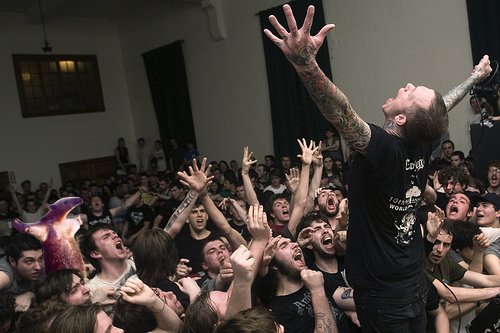
Michael Robbins has a great piece in this months Harper’s, “Destroy Your Safe and Happy Lives: A Poet’s Guide to Metal,” which, in the space of six pages, is able to reference John Milton, Rainer Maria Rilke, Black Sabbath, and Converge. I did not know that could be done. (Even R., who tends to abhor whenever anything loud and screamy even gets near our home’s turntable, enjoyed this piece.) Highlights of the short essay include: quoting a number of lines from William Blake’s “Proverbs of Hell” and commenting, “sounds pretty metal to me”; describing a Converge show where they “took over that space like a bellowing wooly rhino crashing into a Pleistocene clearing. . . . It’s war music” (a pretty accurate description); and some reflections on metal and capital: “Sometimes I wonder what metal would sound like after capitalism, or whether we would even need metal then. I wonder the same about poetry.”

More DFW stuff. Peter Finocchiaro, “What David Foster Wallace Got Wrong About Irony: Our Culture Doesn’t Have Nearly Enough of It,” which, strangely enough, is actually an interview with Jonathan Lear about irony (rather than an article specifically about DFW’s sense of irony). In my revised version of an essay that will appear in David Foster Wallace and “The Long Thing” (forthcoming July 2014), I make some similar points about the need for irony at the present time. That said, Lear seems to have a better handle on Wallace’s specific take on irony from the television essay than Finocchiaro, emphasizing that DFW was both a gifted ironist himself and that, in “E Unibus Pluram,” he is critiquing institutionalized irony, which I think all us post-ironists or new sincerity people would do well to heed, along with Lear’s acknowledgment that irony can actually be a from of earnestness: “There’s a very famous quote from Kierkegaard — or, I don’t know how famous it is, but it’s one of my favorites — where he said, it’s ‘only assistant professors’ who think irony can’t be a form of earnestness. Basically his claim is that irony when properly understood is a very high form of sincerity and earnestness, not its opposite. As he put it, it’s a real misunderstanding of what irony is to think it’s the opposite of earnestness toward commitment.” I feel the earnestness or “sincerity” of irony as it plays out in DFW’s work and thinking has been something that has been overlooked to the detriment of both our understanding of DFW and irony more generally.

Alex C. Madrigal and Adrienne LaFrance, “Net Neutrality: A Guide to (and History of) a Contested Idea.”

Dexter Filkins writes a letter from Iraq in The New Yorker, “What We Left Behind.”

And from the University of Pittsburgh’s great graduate student film blog, Kevin Flanagan on “Introduction to Applied Airport Studies.”

The Dark Side of the Digital Humanities and Other Links

This winter’s special issue of differences, “In the Shadows of the Digital Humanities,” is looking like a must read for anyone interested in the subject. A number of important essays appear in the journal by a group of notable scholars, including an introduction by Wendy Hui Kyong Chun and Lisa Marie Rhody, and articles by Matthew Kirschenbaum, Richard Grusin, Adeline Koh, Alexander R. Galloway, David Golumbia, Patrick Jagoda, and many others.

And more on “relatable”: a very interesting piece by Lucy Ferriss, “I’m Relatable, You’re Relatable,” and an older one by Kit Nicholls, “The ‘Relatable’ Fallacy.”

The 2014 Hugo Awards have been announced, and Robert Jordan’s (and Brandon Sanderson’s) Wheel of Time got the nod. (I have a few brief words on the end of the series.) Note the exception to the Hugo rules that allow The Wheel of Time‘s nomination. . . .

Chay Close on Jazzpunk (Necrophone Games, 2014), “All Videogames Are a Joke.” Looks like I have something else to add to my summer indie game program.

More from the DFW-industry: Thorin Klosowski, “David Foster Wallace’s Best Productivity Tips.” Really?

Paul Barnwell, “My Students Don’t Know How to Have a Conversation.”

Tim Wu, “Goodbye, Net Neutrality; Hello, Net Discrimination,” and Kevin Drum, “Net Neutrality Finally Dies at Ripe Old Age of 45.”

Rebecca Schuman on student evaluations.