So a new poem of mine, “A Second E(ff)luvium,” just got published in BathHouse: Hypermedia Journal. Check it out.
Author: Bradley J. Fest
Two Small Bits of Hyperarchivalism
The first bit is an amazing adaptation of The Great Gatsby into a NES game! We are truly hyperarchival when a work of classic Am. lit. gets translated into a classic late-20th c. interactive medium–the 8-bit vid.–in 2011.
Also, my good friend Dave pointed me to a review of Repo Men that has a very different take on the film than my own–i.e. it isn’t as nearly gleefully celebratory, sadly.
Some Archival Metaphysics: Caprica and Digital Heaven
[Note: I’m not wholly satisfied w/ this post, but that has more to do w/ the fact I’m just beginning to formulate some of these questions/ideas, and they consequently are quite obviously not developed.]
The SyFy network’s recent attempt to capitalize on the success of Battlestar Galactica (Redux) ended fairly inauspiciously after only one season. Caprica was canceled in October, 2010, and was off the air until SyFy “burned” the last five episodes on January 4th, 2011. I only realized this a week later, and experienced the odd enjoyment that comes from watching five hours straight of a serial television show that ends coherently.
What I finally understood about Caprica in the end, something I was perhaps conscious of during its short run but didn’t really articulate to myself, was that I don’t really think the Caprica vs. BSG comparison is particularly interesting. Yes, they’re clearly in the same universe, and are a compelling example of what Pawel Frelick calls a “dispersed narrative”[1] when considered together, but in terms of the aesthetic unity of their very different projects, it was always clear that Caprica’s production strove to distance itself from BSG, not only to attract new viewers (of course), but to create something stand-alone. The various monetary reasons for such a goal aside, I not only appreciated this consistently, but it made the Caprica/BSG discussion slightly moot/obvious/metacritical/etc., because the show ultimately achieved being able to be considered on its own, and I think it did this primarily through having as its major point of intertextuality posthuman singularity narratives in general, rather than BSG specifically. Sadly, it also failed to draw enough viewers to underwrite its fairly large budget.
Which, if there is an assessment to be made of the last episode, was ultimately in the show’s interest. They were able to give a glimpse of “Things to Come” that was not only satisfying narratively, but implied more story. W/ the dismal failures of final episodes in epic SF series of late (you know who you are), Caprica was refreshing in many, many ways. (Which is also perhaps b/c it doesn’t have to end, but just give a glimpse of the future of the world the BSG franchise is building.) But of course all of this is to say that though there may be some compelling discussions involving many aspects of this show, most of them are underscored by a persistent self-consciousness of not only SF conventions, but more importantly posthuman SF conventions; so I think it would be safe to say Caprica is entering into a posthuman discussion tropically: i.e. certain aspects of posthuman SF have enough widespread use at this point that we could categorize/list how Caprica draws from the posthuman archive.[2] Perhaps just such a list:
1) Digital, simulated utopia/heaven. Caprica projects the possibility for a space of limitless potential where immortality is a “reality.” That this space is necessarily flawed is also part of the point.
2) AI. The emergence of AI, both in anthropomorphic terms and more machinic ones. (This should probably be #1. . . .)
3) Robots w/ guns. Self-explanatory.
4) Eerily contemporary in terms of dress/civilization, but of course aestheticized in some other historical time period, in this case the American 1950s. The mobster stuff was cool, but difficult to care about other than its twist on Adama’s origin story, which, well, rests on the kid’s eye color.
5) MMOs.
6) Digital terrorists.
7) A Media Mogul, in this case a protagonist.
8) And though there are surely many others, the most important one for me: a sense of hyperarchival realism.[3]
Part of how I’m imagining hyperarchival realism as a project is that it not only attempts to underscore the posthumanity it is tropically imagining, but to do so in a fashion that shows a thorough fidelity to contemporaneity. There is a seamless integration of technology and humans throughout Caprica (always of course blurring the distinction b/t the two), but, and this is the point, it achieves this integration mostly w/ technology we already have.[4] And the dominant technology is obviously information.
How information tech. plays in Caprica: Zoe, the AI “ghost” daughter of the Media Mogul father, has composed an informational-search-algorithm that convincingly passes the Turing test (in short), creating a digital “copy” of herself. The original Zoe dies, the copy lives on (becoming a goddess in the virtual realm). This copy of Zoe is achieved through pure information. Original Zoe’s brain is not downloaded, inserted, copied, or in any other way invaded. Copy Zoe emerges through a conglomeration of info. In other words, she is a hyperarchival consciousness, emerging out of the gathering and interpretation of info.[5]
The major conflict of the show, esp. in terms of the historical and political past the BSG universe is trying to articulate, is finding and accessing this algorithm, this program, this info. The Media Mogul father needs it to run his killer robots(/apps) more efficiently, and the terrorist monotheists need it to achieve what they call “Apotheosis”—which is a kind of digital rapture: you die in reality and then you immediately reappear as a copy of yourself in digital heaven—a landscape and program that is endlessly manipulable.[6]
And this is where the show I think really achieves something, it asks (and doesn’t answer the question), is this as good as a heaven we’ll ever get? This space, the space of Apotheosis, is composed by the fringe monotheists in the polytheistic world of Caprica. But the real question of the show should perhaps be, wouldn’t it precisely be the atheists who built such a place? Those who didn’t participate in belief and faith, and just built an afterlife? Would this not be better in some way?
The show says unequivocally no, but I think it does so for the wrong reasons. Digital simulation is everywhere a part of the world of Caprica, something we never get a sense of in BSG. The original was so steeped in a kind of posthuman steampunk (i.e. 1950s tech.), that to imagine a future world not more dominated by artificial landscapes seems slightly curious even these few years after BSG.
But what Caprica does do is ask the historically major metaphysical questions, and places them firmly upon a ground of information tech., upon the archive. In this sense, in Caprica and other posthuman objects like it, metaphysics is now “archival metaphysics,” and this to me seems important, for though Caprica may not be doing anything terribly novel in the genre, b/c it is/was such a part of a major franchise, it is codifying the genre in a specific type of fashion, realizing that the old questions have to get asked all over again when the archive becomes a space in which to “live” an afterlife. And really, hasn’t the archive always been such a place?
[1] Sorry, couldn’t find a link for this one. He was the keynote speaker at the Science Fiction Research Association Conference in 2010, and delivered a talk called “Gained in Translation: Dispersed Narratives in Contemporary Culture,” where he outlined this term in great detail. Perhaps the best example of what he is calling a dispersed narrative is Southland Tales, which tells its entire tale over a graphic novel and a film. I’ve also thought that perhaps a better term for this would be “distributed narrative.”
[2] Of course I’m sure this has been done, and better than myself, but it should be noted that much of my thinking here is very larval at the moment.
[3] Note: I’m working on this term right now, so I do not quite have a coherent definition, but I am getting very close.
[4] This has been where William Gibson has been so strong as of late (w/ perhaps the exception of Zero History). (Also, b/c I read it awhile ago and didn’t post anything, perhaps a lengthy archival quote chosen somewhat at random from ZH: “‘The holy grail of the surveillance industry is facial recognition. Of course, they say it’s not. It’s already here, to a degree. Not operational. Larval. Can’t read you if you’re black, say, and might mistake you for me, but the hardware and software have potentials, awaiting later upgrade. Though what you need to understand, to understand forgetting, is that nobody’s actually eyeballing much of what a given camera sees. They’re digital, after all. Stored data sits there, stored. Not images, then, just ones and zeros. Something happens that requires official scrutiny, the ones and zeros are converted to images. But’—and he reached up to touch the edge of the bottom of the birdcage library—‘say there’s a gentleman’s agreement” [302] [Also, how cool would a bar called The Birdcage Library be?].) (Also, it is not wholly the case that Caprica uses tech. we already have.)
[6] A minor plot question—if the tech. exists for this type of multiplicitous AI, why are there only 13 brands of human-looking Cylon in the original BSG?
American Literary Traditions
For the course I’m teaching this spring, American Literary Traditions, subtitled “The American Disaster: Network Subjectivities and Apocalyptic Topologies,” my students are keeping a course blog. Check it out here. There isn’t much content yet, but that will change shortly.
Tiny Apocalypses
This is very, very cool. The following five images are miniature dioramas constructed and then photographed by Lori Nix for her project “The City.”
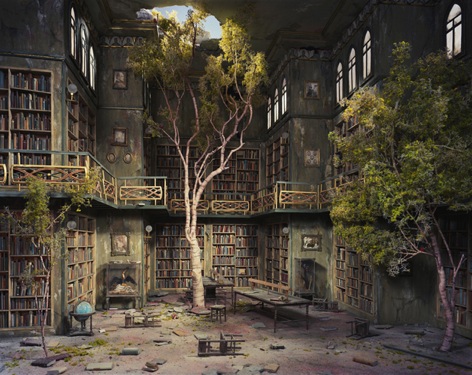
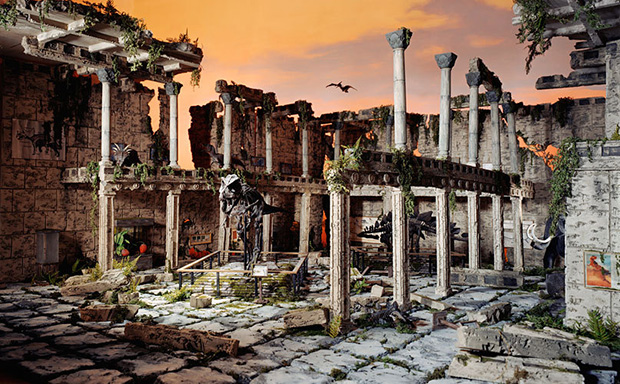

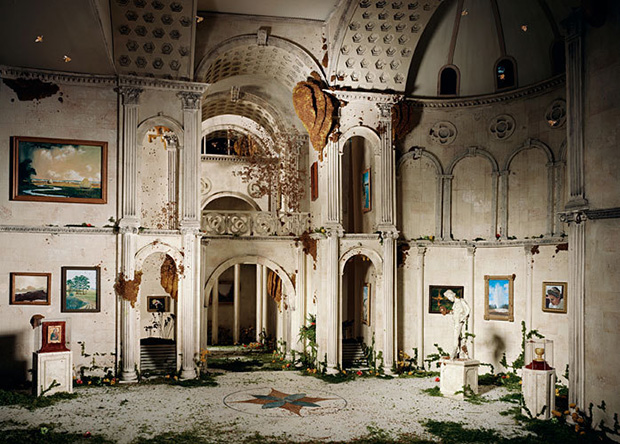

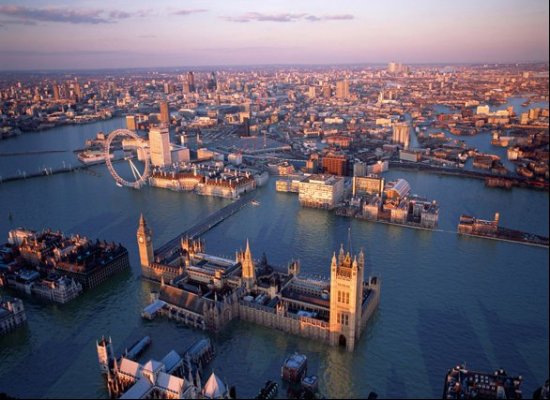
And hey, why not a couple more heavily altered images.
Taylor Baldwin: Post-Apocalyptic Studio Practice
Check out my bud Taylor Baldwin talking about his studio practice as a kind of ethical pre-figuration of post-apocalyptic artistic production, and, of course, as an entry into the archive that can never be destroyed (i.e. biodegrade):
English Grad Students in Love Part I
So, the following looks like it’s gonna be a series I’m engaged in creating with Racheal:
DFW Archive: Deleted Sections of Infinite Jest
Newsweek (of all publications. . . ) has just made available many pages from the David Foster Wallace Archive at the University of Texas available. Check out a bunch of stuff that didn’t make the cut for the final draft of Infinite Jest here.
Barth on the Novel
Whether historically the novel expires or persists as a major art form seems immaterial to me; if enough writers and critics feel apocalyptical about it, their feeling becomes a considerable cultural fact, like the feeling that Western civilization, or the world, is going to end rather soon. If you took a bunch of people out into the desert and the world didn’t end, you’d come home shamefaced, I imagine; but the persistence of an art form doesn’t invalidate work created in the apocalyptic ambience.
John Barth, “The Literature of Exhaustion”
Skyline and Adorno
(Note: The following may sound hyperbolic. It isn’t.)
I had the great misfortune to go see Skyline (The Brother’s Strause, 2010) last night, or perhaps I made the great blunder, for I went voluntarily (to the death of Western culture as we know it). I’d love to detail in every single way that it was bad—for basically, it has achieved that near-impossible feat of being an aesthetic product with absolutely no critical response possible to it—but to do so would require a dissertation in-and-of-itself. But b/c it was bad in so many, many ways, a few examples are perhaps necessary. Like, for instance, it was a disaster movie that was basically set in an apartment. So we had to care about how the characters interacted and stuff. And I didn’t. At all. In no way were sympathy, empathy, or detached irony evoked in me. It was like watching a happy meal get older (i.e. nothing happens) in terms of temporal-narrative arc. Skyline makes 2012 look like an absolute masterpiece—which maybe now to think of it, it is (see, this is the kind thinking this movie causes; see me on 2012 here and here). It was so bad I had to apologize to myself that I saw it, and indeed anyone who was unfortunate enough to be in the theater w/ me.[1] It made me wonder why I thought Spiderman 2, 3, and Once Upon a Time in Mexico were all so bad that I had to get up and walk out of the theater during them b/c Skyline was so bad I didn’t leave, it was like watching a train wreck in hyper-slo-mo.[2] So anyway, definitely the worst SF/disaster/alien/apocalypse/brain eating/brain replacing/apartment melodrama of the 2010s so far.
But this is the kicker, Skyline functions in such a way that we are invited to read the following in a different fashion:
Only by subordinating all branches of intellectual production equally to the single purpose of imposing on the senses of human beings, from the time they leave the factory in the evening to the time they clock on in the morning, the imprint of the work routine which they must sustain throughout the day, does this culture mockingly fulfill the notion of a unified culture which the philosophers of the individual personality held out against mass culture.[3]
Alright, yes, Skyline as an aesthetic product treats itself as nothing more than a vehicle for $, and the experience of watching it feels like being at a particularly nasty low-level type job (say dishwashing or sewage maintenance), where you don’t have any choice but to barrel on through, but, and this is the kicker: Skyline achieves the impossible dream of making any critique of this type of intellectual/aesthetic labor impossible within its space, b/c it has made the film so impossibly unreadable, so critically unavailable to any detached engagement, as to turn the notion of art=labor into formal/aesthetic principle. There is nothing, quite literally nothing in the film around which a coherent critical reading could grasp at something to talk about, let alone something interesting to talk about. There aren’t even that many cool explosions or special effects, which is why you go see such a film in the first place! It is like pure labor in that it doesn’t muck up the well w/ all that sublimity or beauty, a perfect moment of clarity at our total reification and the completeness w/ which the culture industry has absorbed everything. Perfect panoptic control. Here is an empty object, something we can’t even fill up w/ our own anxieties or sublimated affect, b/c its like a sucking black hole of thought and imagination, a kind of reverse-emergence (maybe it shows “demergent” properties? anyone?); it is the goddamn void at the center of being.
And this is all to say that I was writing something else and I came across this quote from Adorno, and wasn’t sure whether to use it in there or not, but surely it was an excuse to put it on here. Sklyine is some kinda hyper-Adornoian nightmare. The kind that shivers under the blankets of the actors in Endgame, the ash falling outside their windows. The kind that makes me scared that I just go see films like this so I have an excuse to write about them, and then realize, why yes I do, but I don’t even have anything to say about this other than it confounds any attempt to say anything about it w/ its profound horribleness. Well. We’ve perhaps reached the end of something.
I mean, can we ever even take aliens seriously again after this? Or eating brains for that matter? These have been two beloved b-movie tropes for decades now, and Skyline might have single-handedly sounded their death-knell. Are we only to have werewolves and vampires to look forward to? No alien destruction from the sky? No zombies slurring out a barely audible, “braaaaaaaaaaaaaaaaiiiiiiiiiiiiiiiiiiiiinnnnnnnnnnnnnnnssssssssssssss!” Hell, we can’t even take Donald Faison of Scrubs fame seriously anymore, b/c his acting on that show, in comparison, is like Lifetime Emmy Achievement Award-caliber.
And the worst part? It’s not even good as pure labor. B/c no work is done. It doesn’t make us want to buy anything. It doesn’t make us want to work more. Nor abuse substances. Nor even watch more movies and television. It doesn’t make me feel like an individual w/ hopes, dreams, aspersions, commitments, responsibilities, etc. It makes me want to sleep (perhaps). But even then. It enacts a kind of zen nothingness at the heart of capitalist entertainment, an urge to simply sit and stare endlessly. (Weird, this has been a recent theme for me, I wonder why?) Sklyine is a kind of utopian non-space outside of the dominating logic of labor. And yet it is no less controlling b/c of that.
It achieves perfect aesthetic banality. And it is freaking evil. No one should have ever been permitted to make this film, let alone show it to anybody. If art can be dangerous, deadly even, Skyline is. In short, if an “Anti-Entertainment” perhaps exists in the pages of Infinite Jest, a virus to infect the effects of “The Entertainment,” nullifying our enjoyment of anything whatsoever, it is Skyline.
[1] More entertaining than Skyline?: The throngs of teenaged girls and boys lined up to be the first in line to see Harry Potter nearly 10 hours before it premiered. They at least, like, had capes and shit.
[2] Oh yeah, and of course there was this particularly zany shot of the character’ running in slow motion, before a weird tentacle thing came and snatched the woman into a sort of womb-stomach-like thing, and then extracted its brain, and replaced its own w/ the new brain—i.e. brains are, like, batteries. (Yes, you heard right: the aliens in this movie are motivated by eating brains, a kind of über-zombie-apocalypse. Oh wait, oops, I just made this movie sound more interesting simply by using the English language in a coherent fashion—i.e. none of the character’s knew how to enunciate their dialogue—for that I apologize, for even the brain eating was stupid.)
[3] Theodor Adorno & Max Horkheimer, The Dialectic of Enlightenment: Philosophical Fragments, ed. Gunzelin Schmid NOerr, trans. Edmund Jephcott (Stanford: Stanford University Press, 2002), 104.

