Though not even in the same realm as the last “8-Bit Apocalypse,” this is an interesting apocalyptic mash-up / use of some old NES games.
Author: Bradley J. Fest
Archival Decay
In anticipation of Part 2 of “Vital Materiality and Milemarker,” check out this fairly interesting article on the disappearance of the digital rock-and-roll archive, “File Not Found.”
Repackaging the Archive (Part V): Vital Materiality and Milemarker, Part 1
We tie ourselves around poles to flag ourselves as outpatients of different regimes.
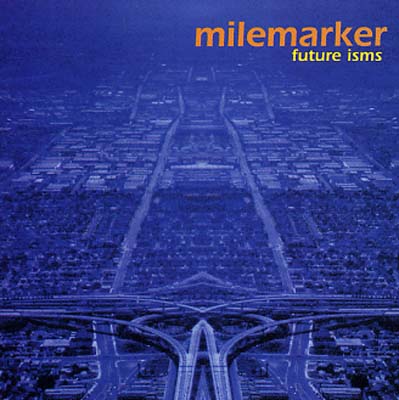
Milemarker, Future isms (The Company with the Golden Arm, 1998).
For the past few months I’ve been intending for this blog to finally enter the forum (or fray) of music criticism.[1] Ever since I read Jane Bennett’s short but thought provoking Vibrant Matter: A Political Ecology of Things[2] and experienced a deep feeling that what she was really talking about I had in fact experienced before—if on an aesthetic rather than political level—I’ve been meaning to write on some of the output from the band Milemarker (1998-2005) (myspace page, w/ songs, here), specifically they’re album Frigid Forms Sell (2000): how a significant amount of their work could be considered to be a music of vibrant matter, an aesthetico-political ecology of things. Or perhaps I simply read the book and then wandered through frozen Pittsburgh streets in a snow storm while listening to them on the ole ipod and this emphasized the vibrant, “alive” nature of the frozen, inert world around me. Chicken or egg, who cares. Either way, my point here is something else.
For I’ve been inching closer toward something like a “theory of everything” if only in that perhaps necessary fashion that accompanies any dissertation—i.e. the absolute single-mindedness of the endeavor requires that you formulate an (always already) over-simplified approach to a subject, while simultaneously necessitating that you attempt to explain everything with those all-too-familiar-blinders on that may as well be Higgs-Boson mini-Black Holes. Okay, well then, not a “theory of everything,” but more like “everything which I can then find some theory for.” No, not even that. I digress. There are basically just some things I’m working toward right now. And Bennet and Milemarker are perhaps a(n interesting) catalyst to extend some of that thinking here.
So, as I said above, I’ve been intending to write this post since about the end of January, and have multiple times started it, scrapped it, gotten frustrated, asked myself why I even bother, etc. Basically par for the course re: any writing, esp. writing that wasn’t my dissertation and felt “useless.”[3] The majority of that frustration, however, was innately connected to and a result of my long, storied, [4] and continuing tendency to begin virtually any piece of writing whatsoever w/ exhaustive apologias for simply writing what I’m writing, for taking up the reader’s time (w/ what-might-be-totally-ignorable-crap-but-I-swear-read-it-anyway-b/c-I-think-it’s-good-though-I’m-sorry-if-it’s-not,-etc.-etc.-etc.). . . in other words, I felt somehow dirty to be dredging up a fairly cherished, valued, and, of course, nostalgia laden “past,” a past where I could enjoy an object (phenomenological, aesthetic, or otherwise) w/o immediately wanting to write some self-serving academic paper on it that, maybe, like a handful of people would read/appreciate, and some of those only b/c they were my friends and can really, like, remember digging Milemarker.[5] Part of this apology was also heavily imbricated in a sense of guilt on my part: that late 1990s and early 2000s “hardcore” music was (quite often, though not always) implicitly or overtly against the institutionally sanctioned practice of academic criticism (or really anything institutionally sanctioned), and if I was to be in any way faithful to this historical moment of musical production, I would refrain from saying anything. The fact that such music has now largely disappeared—i.e. I’m not aware of or involved w/ its movements anymore. . . like, at all[6]—further exacerbates my feelings of anxiety in that I must inherently approach a topic like Milemarker archivally as something sealed, finished, done, and exhausted[7]; and as something that I can now consider myself “outside” of, or perhaps as a “part of no part.” But of course this is all to say that I will refrain from pursuing the questions that are obviously raised in the last few sentences, and rather choose to signal an apologia w/o actually giving one, and just get on w/ the damn thing, and acknowledge the even more difficult practice of actually writing something that I feel needs to be written.
Milemarker has always been an incredibly important band to me, and, to be frank, probably for intellectual reasons. B/c music is so inherently difficult to interpret (or may even at times may be pure signifier w/o a signified, who knows), I a) never really bothered to completely try to articulate to myself why they were so interesting nor why I liked them so much (total taste), and b) I didn’t really care/have to. But, of course, that is more-or-less what I do now, so w/ the full acknowledgement of touching a sacred (personal) cow, or perhaps making a sacrifice to the great gods of authenticity, I’d like to establish that I think Milemarker, while they existed (in whatever capacity), was an extremely important American band for many, many reasons. And now I’m going to essai to suggest why for reasons personal, political, and aesthetic.
The simple fact of the matter is, Milemarker has been a band that has not only profoundly affected me throughout my burgeoning adulthood, but one that I felt a deep and intimate connection w/. Their transformations tended, or so I thought, to mirror certain changes in my own constitution and outlook on the world (again, no chicken or egg here). They were the type of band—and I think everyone has something like this—that not only did I feel like I discovered, like some lost dark continent of the “soul,” but, b/c of that fortuitous and somewhat random discovery, felt like I “owned.”[8] In other words, if I am going to continue the series of writings titled “Repackaging the Archive”—writings that are at times only tangentially related to each other at best—they are not only a perfect candidate for such an exploration, but a personal/cultural phenomenon that very much deserves my nostalgic reassessment/re-appreciation. Part 1 of this essai will present some general outlines of their work, if in a highly personal fashion, and Part 2 will more specifically engage with their work in its specific and particular manifestations.
* * * End Apologia * * *
So I’d guess that starting at the beginning is not inappropriate. In late 1997 I turned 16, and w/ the privilege of having been born into a world where I received access to a car and an ample amount of parental trust and support, found myself not simply frequenting, but obsessively attending small punk rock shows at an upstart all-ages venue named Skrappy’s[9] in Tucson, AZ. Skrappy’s inhabited a very special musical-historical time and place. There hadn’t been a venue for touring punk rock in Tucson since the Downtown Performance Center shut in 1995, and Skrappy’s came into existence not only when a burgeoning re-investment in punk rock was taking place (thanks to, say, Green Day), but more importantly, there was a discernible avant-garde made possible, quite simply, by the improved communication provided by the burgeoning internet between fly-by-night groups of (sometimes quite loose) “friends” (read: bands), and equally fly-by-night “places that people could hang out” (read: Skrappy’s). So basically, on any given night I had no idea what I was getting into music-wise; I could see the worst crusty punk rock ever, or something that would force me to think about what it even meant to make music in the first place. And Milemarker was assuredly one of the latter.
The first obvious thing about Milemarker at this show in (I think) late 1997 or early 1998, was that they wore all black. Not all black like in the “gothic” sense, nor any other sense really except if you consider the distinctly large subset of people who think, out of all the t-shirts you could wear, a plain black one is the most functional and (potentially) classy a “fashion,”[10] and as such, they were able to transcend some invisible “how should a band dress on stage” line in my brain, by making it blatantly obvious. Black t-shirts. Black pants. Black shoes. For a 16 year old brain, this was like, oh. . . duh. (Maybe jeans instead, we’re cowboys, after all.) But anyway, who cares what they wore, right? I mean, I hope by now that I’ve established this isn’t People or something, the real thing was that they were the first punk rock band I ever saw that used lights.
And boy did they use them. Roby Newton, later a keyboardist in the band, played the lights. The room was entirely dark, and from her homemade light-controlling-platform-thingy she acted as an inversion of the fire in Plato’s cave or Marlow’s thrown-light by visually representing the audible. Maybe this is exactly what Marshall McLuhan means when he writes, “The electric light is pure information. It is a medium without a message, as it were, unless it is used to spell out some verbal ad or name.”[11] Well, actually no. What occurred—at least for my ability-to-be-overly-affected-by-things-cause-I-was-young—was the opposite. The electric lights were simply there to shed upon a visual scene w/ very little information, a dynamic instrumentalization of non-signifcation. (It is amazing how much visual information black clothing conceals.) The information she was actually illuminating was whatever sound was coming from the band: inverting film, to give a light-show to a soundtrack.
Okay, so this is all another way of saying they had lights. I mean, what huge rock and roll band doesn’t have lights? Aren’t lights the whole reason stadium-type shows exist (and explosions)? Why get oneself all worked up about lights?
The lights were brought w/ the band, and they were simple and cheap (something any traveling musician loves). Pretty soon, everyone was bringing their own light system on tour: simple, cheap, portable.[12] And again, this may not be a terribly impressive/important thing, but in 1997 (or 1998)—at least at Skrappy’s—I hadn’t seen this before.[13] And, if nothing else occurred to me, I realized this band didn’t exist to just kind of go play rock and roll; not only did they have “something to say,” but they cared about how it was said. Thus, lights.
But that even wasn’t the thing about the lights. Even the placement of the light (what, technician, auteur, accompanist [?], whatever) operator was significant. She stood in the audience, like, right next to me and the other 10 people who were in there. So, in a sense, she was—what we used to call back in the 1990s—having an “interactive” experience w/ the band. She was an audience member, interpreting the music back at the band in the form of lights, all the while explicitly acknowledging herself as a consumer of the music (rather than a creator), as well as a co-conspirator. And it was all delightfully analog (w/ the possible exception of some digital delay on the guitar.)
They were a three piece at the time. Ben Davis on drums, Dave Laney on guitar, and Al Burian on bass. Simple. No-nonsense, and exquisite. Total power trio. (Quick list the best ones ever.) It was like nothing I had ever experienced, and I got a killer t-shirt.

Milemarker, S/T (Clocked Out Records, 1997).
And perhaps it is only w/ the t-shirt that this story really starts to take form. Or rather, the two of them, both stories and t-shirts. For surely each t-shirt defines a (current) narrative, and each narrative I will be telling below (or in part 2) re: “vibrant matter” requires a t-shirt. This recursive object-narrative / narrative-object thing was made possible b/c they were the type of band you bought 2 t-shirts from at a time, b/c, quite simply, there was little chance you would ever hear from them again. (Or so I thought.) Fly-by-night.
Their t-shirts were very, very cool. One t-shirt I cut out the image/logo from and safely safety-pinned it to my bag. The other was simply a jaw-droppingly awesome t-shirt for a 16-17 year-old (and once the dude from I Farm seriously asked to buy it off me[14]). It was red w/ a hammer and sickle superimposed on a globe bordered by Cyrillic writing. The band had found this amazing gem at a thrift store—all their tour t-shirts from the time were from thrift stores—and they had stenciled their image on the back of it. Presumably hand drawn, it had their name in the upper left hand corner, and in black-and-white[15] a scene w/ multiple hands raised, clutching disks in collective affirmation. (This was clearly meant to evoke similar images of Mao’s little red book being held aloft. This was also 1997, so such images were of course overburdened w/ post-Cold War irony.) It was just an incredible band t-shirt. To make a long adolescent story short, my parents were less-than-enthused about it at the time, so they cut it up. I still have fragments from both shirts somewhere all these years later. But I’m not precisely sure where they are and they may in fact be thousands of miles away.
(And this leads me to a bit of an archival aside: for about an hour I was interrupted in writing this trying to find an image from this t-shirt, of course getting sucked into the zen-fugue-state one achieves while scouring the internet for any overly-specific-thing [that probably shouldn’t be there[16]]. I do this not b/c I lack the capacity to accompany the above paragraph w/ an image. . . mostly b/c: can you imagine the awkwardness and simple logistical nightmare it would be to call up my Mom and ask, “so. . . you know that big Rubbermate crate? Well, there’s this t-shirt fragment somewhere in it. Could you find it, scan it, and email me the picture?”)
Which ultimately is the point. Milemarker defined for me a personal network of objects, some of which are semi-indelible, some semi-rare, some wholly experiential, etc. And some of these are now mere fragments of cloth. (I forgot to mention I saved a piece of the “communist” shirt from the garbage after it was discarded [i.e. cut up and thrown away[17]], specifically a long Cyrillic phrase I didn’t know the meaning of.) That these fragments can continue to be affective, these images to still resonate is for the very same reason this image continues to resonate (I also could say the image I’m “looking” for vaguely resembled this):

Milemarker inhabited that late-20th / early-21st century space which could not help but to define its artistic project as a constellation of cultural production that can (now) never be totally captured, rather than as some unified, coherent aggregate of work. This, of course, is probably implicit for any contemporary rock band—i.e. not every show can be recorded, not every t-shirt saved (people wear them, you know), not every 7” can be preserved in the archive.[18] Milemarker, with audible and visible resignation, were part of a specific sub-culture, however, that was particularly fetishistic in its approach to the aesthetic object, whether it was: “that one time I saw Bright Eyes before he got big, and there were 10 people there,” or it was that major discovery of a unbelievably über-limited (and numbered!) three-color, glow-in-the dark, one-sided, skull shaped 9” with only three inches of actual music on it[19]: the entire “scene” of political/artistic hardcore was composed of an underlying hyperarchivalism, an urge to accumulate certain objects as Walter Benjamin[20] might collect books, an approach to punk rock that was weirdly museum-like. This is not to say that Milemarker particularly encouraged this, nor did anyone else. It was the result of a weirdly perfect storm of access to objects (the internet) and the relative scarcity of those objects—i.e. there weren’t very many of them made. For example, though collected on Changing Caring Humans, I cannot imagine that many copies of Milemarker’s first self-titled EP exist.[21] At one point, at the heyday of Skylab Commerce—the e-bay for obscure political hardcore—this little dandy might have gone for upwards of fifteen dollars. And I suppose, this really isn’t all that new. Scraps, letters, drafts, and uncollected fragments have always been a part of artistic production. Indeed, one of the joys of scholarship is finding the new, the unreleased, the unknown. But unlike, say, the differences between the Folio and Quarto editions of King Lear, the difficulty in acquiring the object or seeing the band absolutely constituted part of that band’s aesthetic appeal. (I mean, did anyone really like pageninetynine that much?[22]) Punk rock, in other words, had always been threatening to become a mere lifestyle: just another way of dressing and defining an accompanying world-view that was easily turned into a comfortable consumerism. The fragment, the rarity, the very fact that I cannot find the image of this t-shirt, is not only part of the appeal of a band like Milemarker, but, as mentioned above, constitutes a very different type of “ownership”—i.e. what you “buy” when you purchase something from the band or go see them—than, say, acquiring Radiohead’s most recent record.
Consequently, for a long time I suppose my urge w/ Milemarker was to immediately emphasize the fragmentary: detritus, scraps, ruins (and by this, of course, the apocalyptic. . .). But not only were they not complicit, or at least not terribly enthused w/ the very way their music was presented by way of this overly-fetishized aesthetic of rare objects, but they were constantly frustrated w/ the impossibility of presenting their work any other way. There is some evidence to support this statement. At a show in San Diego at the famous Che Café, after having already played an over-21 show earlier that evening—and for whatever reason coaxed into playing another at the Che—they ended their always amazing “New Lexicon”
with a rant at the stupidity of the kids, the scene, everything, as they brazenly smashed their instruments. I knew I was a member of the object of their ire (i.e. the audience), but I understood that ire wholly. The “scene” was a clear symptom of what they saw as the very decay of the civilization around them, if not an emergent property of a civilization already past the brink. And indeed, “New Lexicon” says this fairly clearly:
Train everyone to repeat the same inane phrases over and over again. Interlocking inarticulations will fill the spaces where conversations would have been. Self-reference down to meaningless codes. An Esperanto no one knows. We don’t need big brother to enforce the new lexicon, free of dissent and disease. We don’t need big brother to enforce the new lexicon. The kids wrote it for themselves. We enforce it on ourselves.[23]
The lingo and jargon that sprung up around places like the Che or Skrappy’s wasn’t only depressing in its consumptive vapidity, but threatened to become parsable by only the most committed of anthropologists—which we all subsequently were (we are all hyperarchivalists). Entire conversations could consist only of proper (band) names. I know name-dropping in “high society”—i.e. saying who you know though un-queried—is a particularly virulent problem, annoyance, and faux pas, but Milemarker realized that the “kids these days” had got it down to such an art that it functioned effectively not only as a language of its own, but as what Gilles Deleuze calls “control.”[24] In other words, in the old days of punk rock, the cops were the object of resistance. By the 1990s and after, the kids policed themselves. This of course is not a very novel thing to say, and it surely is an oversimplification (esp. if you consider the very real political energy of a place like Che’s or Skrappy’s), but it is to say that my very relationship w/ the band, my fetishization of scraps and fragments of t-shirts, was not only a practice they were aware of, but a practice they were hyper-critical of. To engage w/ Milemarker was simultaneously to be implicated in the very cultural practices they were critiquing.
It is worth quoting from the liner notes to Changing Caring Humans in full to demonstrate the extent of the vitriolic irony they held regarding their own position as an aesthetic/political/consumer object:
Milemarker 1997-1999: A Synopsis and Overview of Late Twentieth Century Works’
No one is completely clear what the motivations of the loose-knit organization known alternately as the Milemarker Collective, the Milemarker People’s Liberation Army, or the Milemarker Entertainment and Reprogramming Consulate are—and attempts at pinning down this agenda and its mode of implementation have proven frustratingly futile to scholars and ethnomusicologists attempting to track their virtual supervirus of cultural infection. Early reports, though haphazard and scattered, mention violent performances, broken instruments, self-immolation, spattered blood of both performers and unwitting audience. Disorienting lights and soundscapes, strange garb and unsettling chanted mantras combined to seal tight the membrane of mystery around these young rebels. As word spread, and (as is the nature of words) solidified into the formal language of labels and clichés, the collective only veered more wildly, confounding audiences searching for rote predictability with performances conducted behind black screens, video projections of simultaneously teleconferencing band members, and concerts carried out entirely by automated robots of the group’s devising. The actual music seemed at times chaotic, improvised noise, at other time’s ice-cold with synthesized contrivance. Manifestos and footnoted reference guides to the philosophical and political undercurrents of these shows were distributed in such volume that truly diligent followers of the group soon found themselves too busy underlining important passages to attend performances themselves.
Recorded output has only served to densify [sic] the ouvre [sic] of the organization. The early singles as well as the first full-length LP [Non Plus Ultra (Albany, NY: Paralogy Records, 1998)][25] served less as a representation of the live spectacle than as a deconstruction of the underground scene in which the collective found its primary adherents—grafting the rebellious rage of contemporary hardcore bands into impotent computer-generated compositions through use of highly sophisticated technologies. The result was an ambiguous, though devastating, statement about the corrosive effects of technology on art.
Critics, historians, and theorists united to scream, ‘self-destruct!’ after the first LP’s release, feeling that imploding in disgust could be the only fitting coda for such a visceral indictment of all art, but the Milemarker hit machine was not to be stopped, returning scant months later with an even angrier and more self-aggrandizingly entitled LP [Future isms], followed by a slew of new seven inch recordings. Here, the invocation to an anti-bourgeois aesthetic was made clear: ‘End it for me before I get a chance to see everything white walls and lousy carpet.’
Live, the conglomeration has only strengthened its commitment to loosening the capitalist consumer societies [sic] hypnotic grip on the audience through the shock therapy of the spectacle, utilizing epilepsy-inducing light patterns, pyrotechnics, projections of images and dogmatic slogans, fearful uniforms, samples, synthesizers, and computer-generated tones heretofore never heard by human ears.
Skeptics and adherents alike shake their heads: what can these people be trying to do? In the end, their chameleon-like transmogrification, their staunch opposition to being labeled, pigeon-holed, marketed and consumed, may answer the very question it obscures the answer to: for, if the medium is the message, the message, in the case of Milemarker, is the obliteration of all boundaries, the destruction of all regulation, rule and reason, the smashing of instruments, inducing seizures, the End Of All Things.
—Francis Haarstraub, Art Forum, November 1999 [26]
What is striking about the above passage is not merely how Milemarker anticipated just the sort of critical approach here essayed by this author, the heavily ironic construction and implicit critique/condemnation of just such an approach, nor how they “authorize” this approach by attributing it to a fictional critic (Haarstraub) for a fictional article, but how, despite the layers of irony—and the (perhaps) intentionally misspelled oeuvre—there is a certain seriousness conveyed nonetheless. By anticipating their own criticism and interpretation, both accurately and inaccurately, Milemarker effectively interrogates their audience while simultaneously letting those very listeners in on the joke.[27] The object, Changing Caring Humans, is just the sort of collection a listener of the band would be thankful for—i.e. it collects their incredibly rare and difficult to find material, all the while pointing to the ridiculous consumer practices of desiring and purchasing such a collection at the same time. It enacts, through its self-commentary on archival completion, how ridiculous it is to produce such an object in the first place.
Furthermore, there is an incredible awareness throughout their body of work of the relative impermanence of the very object they were producing, of the contingency of the object/information itself. The passage above both historically situates their work in the “late twentieth century,” implying a future, perhaps apocalyptic, historian archivally investigating their work, which ultimately serves to highlight the very eschatology inherent in critically or theoretically investigating them in the present—i.e. even the very constitution of the digital object which is Changing Caring Humans implies its own disappearance/destruction. “Human Factor” on Non Plus Ultra, though obviously under the aegis of Y2K anxieties, perhaps sums this up the best:
When all the files delete themselves and all the clock reset themselves to twelve we’ll be synchronized in eternal doomsday time. Future time is all the rage, electromagnetic dark age. The more that things decay the more room we have to play. You’ve got to make allowances for the human factor. Might be your love connection, might clear up your complexion. No money changes hands, no salesman ever calls. When all the files delete themselves I’ll microwave your cancer cells. Chemotherapy—telepathically.
The very practice of producing information and housing it in a digital archive gives that very information a certain (if destructive) agency—the files are capable of deleting themselves. Yes, Changing Caring Humans collects their difficult to find material and houses it in a convenient package, a package which is simultaneously commenting upon its packaging, but there is a constant underlying note of the “End of All Things,” of an exhausted aesthetic practice which can only attempt to collect fragments of documents, objects “that truly diligent followers of the group soon found themselves too busy underlining important passages to attend performances themselves.” In short, Milemarker’s early work fundamentally revolved around interrogating, questioning, and critiquing their own work; their artistic practice was one that recursively revolved around the object.
Following this, after having seen the band for the first time, I spent quite a good deal of energy and time constantly looking for other records of theirs. This, of course, was slightly before the instant and ubiquitous availability of any music whatsoever. Yes, I probably could have ordered some of their initial output from somewhere, or, if I had been slightly ahead of the curve, discovered some of it on Napster, but I still inhabited a world where the record store was the principal site of acquiring music, and as such, there was something quite amazing about finally finding Frigid Forms Sell in either late 2000 or early 2001, probably at Stinkweeds in Phoenix.[28]
The difficulty in finding their work, combined w/ the pleasures of discovery and acquisition, was an essential part of my object-aesthetic enjoyment of them and what they produced, a perfect synergy b/t form/content/audience. In other words, to listen to them I had to be hyperarchival (i.e. find them), but simultaneously, to listen to them was to hear, in a certain fashion, an emergent, hyperarchival expression itself, bare materiality expressing itself through sound. To construct perhaps an appropriate t-shirt/narrative/object metaphor, the fragment I have (had) of their t-shirt is both part of their work considered as an aggregate assembled “whole,” while able to be a whole in-and-of itself. It both points toward a larger assemblage while describing a particular aesthetic assemblage of personal experience—i.e. the personal narrative I cannot help but have w/r/t Milemarker. Consequently, rather than approach them as particularly fragmentary in the now quite familiar pomo fashion, we should perhaps hear in their work, specifically in Frigid Forms Sell and afterward, a non-judgmental exploration of materiality itself, of a material reality of vibrant matter vitally interacting w/ itself on multiple levels, rather than a matter that is easily parsable into fragment, part, whole; this is not an expression of the ruin, but of salvage, of re-purposing the detritus and simply seeing what happens, what emerges.
How this functions in their work specifically will be the subject of part 2 of this post (which will hopefully appear soon), as this has ballooned (word-count-wise) past what I had projected, so as to facilitate both getting this off my word processor and onto the blog, as well as to ease the reader’s understandably frustrated attention, I will truncate my thoughts here a bit prematurely. I will, however, post one more “mile marker” for the direction part 2 might take:
Why advocate a vitality of matter? Because my hunch is that the image of dead or thoroughly instrumentalized matter feeds human hubris and our earth-destroying fantasies of conquest and consumption. It does so by preventing us from detecting (seeing, hearing, smelling, tasting, feeling) a fuller range of nonhuman powers circulating around and within human bodies. These material powers, which can aid or destroy, enrich or disable, ennoble or degrade us, in any case call for our attentiveness, or even ‘respect’ (provided that the term be stretched beyond its Kantian sense). The figure of an intrinsically inanimate matter may be one of the impediments to the emergence of more ecological and more materially sustainable modes of production and consumption.[29]
[1] This is not in fact my “first” attempt at music criticism (though for all intents and purposes we should consider it as such). About ten years ago I wrote record reviews briefly for a site I don’t think exists anymore (and I can’t remember the name of it anyway). I am thankful it doesn’t. Being an archivalist (i.e. [digital] hoarder), I still have all those files and they were, quite simply, fairly wretched, ungrammatical, poorly spelled juvenile dreck. I mean, the editor found me from my (pre-Live Journal) Diaryland!(who knows if my diaryland still exists), and for some reason the tales of my pot-smoking boss and other musings from my brief tenure at an “indie” college record store (i.e. we mostly sold DMB, Phish, Bob Marley, and black light posters) somehow qualified me to write music criticism in this guy’s eyes. I was very embarrassingly young, but, to be frank, thank whatever those reviews are not available anymore. If I failed to say interesting things about music at the time, I did, however, succeed in writing about some interesting records: Kill Sadie’s Half-Cocked Concepts and Experiments in Expectation, Yaphet Kotto’s Syncopated Synthetic Laments of Love, The Album Leaf’s In an Off White Room, Orchid’s Dance Tonight! Revolution Tomorrow! and The New Brutalism’s Structural Gymnastics, among others. Perhaps one day I’ll have another go at these, but for now my thoughts on them will remain buried (along w/ my high school poetry).
[2] And, to be frank, ultimately unsatisfying—which is related far more to the fact she’s asking a question re: political ecology that, to my mind, has not been broached in the terms she’s suggesting. To put it another way: the book is about opening up a discussion rather than necessarily making a significant claim about that discussion. More on this above/below.
[3] I have a bit of a respite from that for a week or month or so, so. . . . (see my last post), hopefully much non-dissertation writing will get done.
[4] Or not so storied, since I usually try to erase any signs of this story. . . .
[5] And I cannot help but to suspect that some of this guilt is also intensely involved in my own recent subject of dissertating: David Foster Wallace.
[6] Damn the blinders of doctoral programs!
[7] This sense of anxiety was also further exacerbated by the fact that I realized Wikipedia could potentially explain such things as “hardcore,” “emo,” and “screamo” better than I ever could. The fact that this is even possible in this day and age is mildly depressing for the simple fact that the knowledge contained in these articles was one that required years of “research” in a “scene” to come to “back in the day,” and the “pleasures of the text” (i.e. why you used things like Skylab Commerce [now Gemm] or poured over zines like HeartattaCk and Skyscraper [it is also of course significant that Skylab doesn’t exist anymore, HeartattaCk is no longer published, and Skyscraper is now exclusively online]), was simply a part/result of the difficulty of getting all this knowledge in one nice authoritative and “democratically” constructed, well-cited package. How many more “scene points” could have been accumulated if only Wikipedia existed. . . .
[8] This is perhaps simply due to the peculiar nature of late-capitalism.
[9] And yes, I’ve intentionally included the Wikipedia entry to the link above. The fact that Skrappy’s has a Wikipedia entry is frankly astounding to me all these years later. Their facebook page is here. The simple fact that Skrappy’s still exists is not only a quiet, small miracle—I can’t tell you how many times over the years they almost shut their doors for good—but a miracle wholly attributed to the angelic and tireless Kathy Wooldridge.
[10] Include me in this number. The black t-shirt is not only functional but potentially provides a profound sense that you in fact, and all evidence aside, regardless of what actual empirical observation might suggest, did not just roll out of bed.
[11] Understanding Media: The Extensions of Man (Critical Edition), ed. W. Terrence Gordon (Corte Madera CA: Gingko Press, 2003), 19. He goes on to write: “This fact, characteristic of all media, means that the ‘content’ of any medium is always another medium.”
[12] For example, the first time I saw Botch, I think every time I saw Kill Sadie, and an excellent Under a Dying Sun show in San Diego later all used lights to great effect. (Of course, I bought a few lights and used them for my own projects [I think there were candles involved one time as well—the pretension of 19 year olds]).
[13] And it may be important to remember that Skrappy’s was basically the size of someone’s “pretty big” garage. And it would get hot in there.
[14] Like, we got into a “what would you take for that shirt?”-type bargaining moment. I refrained from selling it to him. I should’ve.
[15] Or in this case black-on-red.
[16] For we all secretly, deep down, don’t want every nerdy thing we can think of, every reference, image, song, whatever here (there). I mean, we all hope that at some level, most of humanity is pretty self-respecting enough not to scan/upload/etc. everything; but man, if I could’ve found a video of this tour . . . (I wouldn’t have had to write as much[!?]).
[17] The last personal aside (I hope): I had previously rescued t-shirts from the garbage: thus the cutting. I’ve learned my lesson, however. Only wear t-shirts that are totally innocuous. This was a good lesson to learn as I entered the aughts, btw.
[18] That is, of course, unless you release your uncollected works in a convenient little package, like the fantastic Changing Caring Humans (Stickfigure Distribution, 1999).
[19] This has been slightly exaggerated for effect, but not much.
[20] See Walter Benjamin, “Unpacking My Library,” Illuminations, trans. Harry Zohn, ed. Hannah Arendt (New York: Schocken Books, 1968), 59-68.
[21] See Milemarker, Milemarker (Chapel Hill: Clocked Out Records, 1997). Btw, is there even any possible way this is in the Library of Congress? (At the time of this writing, this is being sold on e-bay.)
[22] Pg. 99 was particularly notorious for their many difficult to find records.
[23] Milemarker, “New Lexicon,” Future isms (The Company With the Golden Arm, 1998[?]). It is also interesting to note that Milemarker continually returned to this song in its recorded output. My favorite version of it appears on a Jade Tree sampler (see Milemarker, “New Lexicon,” Location is Everything, Vol. 1 [Wilmington, DE: Jade Tree, 2002], track 18), which was recorded during the Anaesthetic (Wilmington, DE: Jade Tree, 2001) sessions. The version in the video above appears on Satanic Versus (Wilmington, DE: Jade Tree, 2002).
[24] “We’re moving toward control societies that no longer operate by confining people but through continuous control and instant communication” (Gilles Deleuze, “Control and Becoming,” Negotiations: 1972-1990, trans. Martin Joughin [New York: Columbia University Press, 1995], 174. See also “Postscript on Control Societies” in the same book [177-82]).
[25] Significantly, on Non Plus Ultra, Milemarker uses samples from: “Drive Like Jehu, Born Against, Universal Order of Armageddon, Team Dresch, Fugazi, [themselves and] Maximillian Colby.” Unlike, say, hip hop’s use and re-use of old recordings to make the “new,” Milemarker was remixing their contemporaries and influences into the very document (Non Plus Ultra) that was a further proliferation the present/the new. This, of course, anticipates much of the recent “mash-ups” which are beginning to dominate the airwaves.
[26] Milemarker, Changing Caring Humans: 1997-1999: A Collection of Singles and Compilation Songs (Stickfigure Records, 1999). Of course “Francis Haarstraub,” or any such article in Art Forum, does not exist.
[27] It is perhaps also useful to emphasize some recent thinking by Fredric Jameson regarding how the “new” effectively blurs the line between artist and critic: “Let’s rather imagine that these new works, or ‘texts’ as it is more appropriate to call them, are mixtures of theory and singularity, which is to say that in some fashion they transcend the old opposition between a work and its criticism or interpretation that held for an aesthetic committed to the concept of the work in general, and to the security of closure and of reified form. Now that opposition—between critic and the creator; the artist and the review—an opposition over which so much bad blood has been spilled at least since the eighteenth century—is no longer binding; and the critic has been transformed, has mutated, into something like the curator, or has indeed become indistinguishable from the writer himself” (Fredric Jameson, “New Literary History after the End of the New,” New Literary History 39 [2008]: 385).
[28] It indeed looks like Stinkweeds still has a physical location, but it is of course significant that it looks like they do most of their business online these days. Stinkweeds, for Tucson kids, was an absolutely special treat when it came to records stores. We would literally drive up to Phoenix just to shop there.
[29] Jane Bennet, Vibrant Matter: A Political Ecology of Things (Durham: Duke University Press, 2010), ix.
Abstract: Poesis and the Procedural
If it is accepted, here is an abstract for a panel my colleagues, poets Sten Carlson and Robin Clarke, and myself propose to deliver at the 2011 Society for Literature Science and the Arts Conference in Waterloo, Ontario this September.
Poesis and the Procedural
This panel will begin by framing and reading from a collaborative manuscript of poetry, Dear Human Converter Box, a book conceptually situated in the interface between artificial intelligence and poetics. The authors will read from the manuscript and gloss some of its central theoretical and political concerns, which include the procedural and collaborative processes involved in its composition. This portion of the panel will conclude with a multimedia “performance” of one poem via a text-to-voice application. The third panelist will present a general theory of “poetic assemblage” and engage specifically with Dear Human Converter Box as an instance of such assemblage.
Dear Human Converter Box: Poetry in the Age of Intelligent Machines
—Sten Carlson and Robin Clarke, University of Pittsburgh
Panelists will read from and discuss their line-for-line collaboration, Dear Human Converter Box, abook-length sequence of poems that investigates the possibilities of a machinic intelligence brought to bear on the making of poetry. Taking two texts—Giambattista Vico’s The New Science and Manuel DeLanda’s War in the Age of Intelligent Machines—as its conceptual frame of reference, the book stages the transfer of cognitive structures from humans to machines in the late twentieth century, bringing an experimental, oppositional poetics to bear on those very cognitive structures. Once artificial intelligence has been achieved, DeLanda argues, “we might imagine specialized ‘robot historians’ committed to tracing the various technological lineages that gave rise to their species.” One of the wagers of this project is that, whereas the robot historian would largely assemble genealogies to describe, illustrate, and account for the history of AI (a history, DeLanda points out, that would look very different than one written by a human historian), the robot poet would involve itself in processes of aesthetic experimentation and discovery that would interrupt, complicate and transform the fundamental forms of such an intelligence. Considering, for example, that artificial intelligence has developed largely along procedural lines in the service of the military-industrial complex, what are the implications on that intelligence of a felt and imagined machinic poesis capable of (in Vico’s terms) “perturbing to excess” its own rational, barbarous properties and processes? Put differently, how is the poem—as a site of imagination, critique, pleasure, irrelevancy, excess—a technology capable of refusing strictly rational “intelligence” as such? As a line-for-line collaboration between two poets, Dear Human Converter Box takes up these problems not only at the thematic and formal levels, but at the level of the composition process itself. Certain objective formal constraints put into place in the book, as well as freestanding language systems like ready-made word “palettes” and appropriated source materials create systems of information, knowledge, and music continually assembling themselves in ways the authors hadn’t anticipated. On the one hand, the formal techniques and collaborative processes in this project enact the very processes of assemblage and emergence that the book is about. On the other, collaboration and assemblage challenge the suppositions of much lyric poetry that posits the poem as an isolated, autonomous, and rarified aesthetic object and the author as a discreet, ahistorical and unmediated identity. As both enactment and opposition, then, the poetry in this book emerges—via mutual aid, inspiration, contradiction, multiplication—as what our co-panelist Bradley Fest calls a “poetics of assemblage.”
The Robot Poet: Toward an Assemblage Theory of Poetry / a Poetics of Assemblage
—Bradley J. Fest, University of Pittsburgh
One of the major impasses that any coherent theoretical or critical approach to poetry has historically faced was accounting for the relationship between part and whole in the poetic text. Whether it was the New Critical emphasis on looking at the whole of the poem-itself, deconstruction’s focus on parts that broke the form of the whole, theories of influence where the whole was the entire canon of Western literature, or the many other critical approaches that have flourished in the wake of theory, entire schools of literary criticism have often been defined by their approach to this problem. Drawing upon the work of Manuel DeLanda and his mobilization and codification of Gilles Deleuze and Felix Guattari’s theory of assemblage, this paper will attempt to point toward an assemblage theory of poetry. What assemblage theory offers, I will argue, is a mode of looking at poetry that can simultaneously account for the absolute heterogeneity of the various parts that make up a poem, while able to retain a complex view of the assembled whole, a view that understands any assemblage to also be a part of other poetic assemblages. To demonstrate how such a critical approach might be undertaken I will engage with the work of my colleagues on this panel, Sten Carlson and Robin Clarke, and further suggest that their ongoing collaborative project Dear Human Converter Box points toward a poetics of assemblage, a poetry that fundamentally understands itself as an emergent property of the process of imaginative assemblage.
Some Recent Apocalyptic Stuff
Over in Guernica, there are two recent articles. One is Alexis Madrigal’s “Nuclear Haze,” which discusses some of the historical markers of nuclear energy. The other is an excerpt from Slavoj Žižek’s Living in the End Times, titled (quite interestingly) “The Un-Shock Doctrine.”
David James Keaton pointed me to these 51 post-apocalyptic images (though most of them look like they come from, or are art accompanying the Fallout games). Here’s a sample:

It turns out that Leó Szilárd , one of the father’s of the atomic bomb, wrote some posthuman sf.
Junot Díaz weighs in on the apocalypse, at the Boston Review.
And an excerpt from Evan Calder Williams’s quite fascinating Combined and Uneven Apocalypse (Winchester, UK: Zero Books, 2011):
“However, The Bed Sitting Room and the salvagepunk aesthetic more generally grasps that we’ve been living after the apocalypse for a while now, and that the problem is too much of the hidden has been revealed. Too much uncovered data, too many telling images, too many public secrets. It’s piling up everywhere and making it impossible to find the correct enemies, the right cracks to widen, the right ways to attack and build better. In this sense, salvagepunk post-apocalypticism is concerned with being more apocalyptic than the apocalypse: clearing away the clutter to reveal the true hidden-in-plain-view, namely, the deep, permanent antagonisms on which capitalism runs and the untenability of that system’s capacity to run” (56).
Some Metablog Action: An Excerpt
My good friend Sten Carlson just pointed me toward this: from Jodi Dean’s fairly excellent (if slight unfortunately named) Blog Theory:
Blogging has been associated with murder and death ever since the mainstream media starting [sic] noticing it (around 2002). Just like video killed the radio star, film killed vaudeville, and television killed bowling leagues, so did blogs allegedly kill journalism and mainstream media, replacing these with idiots and amateurs who failed to check their facts and ranted about their pet issues (as well as issues with their pets). There’s a constant underlying all this killing–corporate power. Even as some media forms eclipse others, global conglomerates profit from the innovations while pernicious arrangements of state power benefit from a diverted populace. Television can’t deliver the requisite eyeballs? No problem. Switch gears, locate other sites to capitalize. The dominance of capitalism as a system requires changes in industry; innovation drives capitalism. State forms adapt as well: disintegrated spectacles allow for ever more advanced forms of monitoring, tracking, and surveillance. People plead for more cameras to keep them safe as they shop and happily relinquish personal data in exchange for saving a few cents here or there, for shaving seconds off this site or that (Jodi Dean, Blog Theory: Feedback and Capture in the Circuits of Drive [Malden MA: Polity, 2010], 39)
Toward a Hyperarchival Realism (2.0): Some Occasional Notes on the Pale King
Times they are a changing. The spring is struggling like Sisyphus to get here once and for all in the ‘burgh; one class on American Literature is ending, and my first foray into Introduction to Critical Reading [1]is beginning; one dissertation chapter’s first draft is complete, and Pynchon is officially on the docket now [2]; but in the middle of all this, and slightly unexpectedly, along comes—like a thief in the night (i.e. early), an unexpected (boredom) drug left Moses-like on my doorstep, and a cruel, cruel joke from the dissertation gods—David Foster Wallace’s The Pale King.
And oh has it come. Even the print rags are on fire about it (though surely nothing like DFW’s compatriot’s most recent novel Freedom). I haven’t even had the stomach to check out The Howling Fantods to see where they might be pointing me w/r/t Wallace’s posthumous novel. I guess I just didn’t think it would be such a big-deal release as it has proven to be; I mean, even my mom is practically cutting out newspaper articles and sending them to me. And the public attention to Wallace is, frankly, only exacerbating my weird working-relationship w/ him. I.e., I feel kinda done for a while, happy to get on to the next thing; and of course, waiting on my doorstep in the end is this novel. My students are reading it (either explicitly or clandestinely). David James Keaton, for chrissakes, sent me a text about it. [3] In other words, it feels like something to be written about. [4]
But I honestly would prefer not to. And this isn’t just because Tom McCarthy ended his recent review of the novel, “The Last Audit,” w/ a reference to the scrivener. Really, I kinda just don’t want to say anything about it right now. Everyone else who’s saying stuff is saying it pretty well. I think everyone agrees w/ the basic fact that, well, yes, this is an unfinished novel. There are moments that are intensely boring to read (I guess on purpose). And that it truly is one of the great tragedies of our time to lose such a gifted writer so young.
In terms of giving it a “critical” reception at this time, I suppose it just simply seems a bit early. I mean, the novel isn’t even fresh up out’ve the ground yet (or something).[5] That and I’m just exhausted, and basically need some DFW-breathing-room. So instead I’d like to offer a couple occasional notes that glanced across my brain which could potentially be pursued as moving toward a definition of my term “hyperarchival realism”:
—the novel is hyperarchival realism. W/o a doubt. Any discussion of this novel has to start from this point and perhaps take that as a given.
—What does this mean?
—§25 (pp. 310-313) is a particularly brutal/obvious/hammer-over-the-head-type example of this.
—Claude Sylvanshine, able to recall or forsee seemingly unimportant facts about people—he is a “fact psychic”—and how that allows Wallace to emphasize the value of certain information; being able to sort through massive amounts of data for the relevant facts is a certain kind of ethical/quasi-spiritual ontology. (See pp. 330-333.)
–Two important lengthy quotes from the substitute Jesuit teacher:
“‘In today’s world, boundaries are fixed, and most significant facts have been generated. Gentleman, the heroic frontier now lies in the ordering and deployment of those facts. Classification, organization, presentation. To put it another way, the pie has been made—the contest is now in the slicing.’”
“I think part of what was so galvanizing was the substitute’s diagnosis of the world and reality as already essentially penetrated and formed, the real world’s constituent info generated, and that now a meaningful choice lay in herding, corralling, and organizing that torrential flow of info. This rang true to me, though on a level that I don’t think I even was fully aware existed within me.”[6]
—Wallace is talking about in each of these moments is what Charles Stross calls Economy 2.0.
—Drinion is either a zen-tax-man, or a machine. I’m going for machine. Big fat posthuman tax-machine. Donna Harraway and the whole nine yards.
–It is important that in Infinite Jest, when Hal is attempting to communicate but is really just making sub-animalistic noises–he says, “‘I believe, with Hegel, that transcendence is absorption.”
—and perhaps last, this novel would have been really good if Wallace had finished it.
[1] My major intellectual struggle right now: how and why would/should I teach N.’s The Birth of Tragedy.
[2] Which also means I’ll be renaming any space/home/desk/library/cathedral of learning I may be inhabiting anytime soon The White Visitation Research Facility for Neglected Sciences.
[3] Though dude, I could totally do w/o the random nude photo the other day. dude.
[4] Even if I hesitate to, b/c, of course, there might be more dissertation here. . . .
[5] This is of course also to suggest that something like a “DFW cottage industry” has sprung up around his untimely demise, and though I cannot help but to participate in it (and tell myself I was going to be writing about him now long before 2008), it is also something I would like to avoid in a self-serving fashion if possible (which, of course, put in Wallace’s terms we all now know how such a statement would occasion perhaps a quite-lengthy aside regarding the fact that acknowledging one’s own self-serving nature did not in fact reflect/deflect the additional fact that even such a statement is capable of being eminently self-serving, etc., so will not put it in such terms), so will attempt to.
[6] David Foster Wallace, The Pale King (New York: Little, Brown & Co., 2011), 232, 240.
Others Toward a Hyperarchival Realism (1.0)
As I’m sure will be more and more often, I’m finding examples of other people attempting to account for what I have recently been calling and will continue to call, with enthusiasm, “hyperarchival realism.” (That said, I still am working through this term, so have yet to define it concretely or coherently. I imagine this will not be the case quite soon. Stay tuned.)
The first such example I will give (in what might perhaps go on to be a series of such examples) is a fairly interesting essay from the editors of n+1 on what they are calling “The Information Essay.” What they are talking about is precisely an example of hyperarchival realism.
An Excerpt from The Pale King
In commemoration of tax day tomorrow (The Pale King‘s official release date) and in light of the oh-so-wonderful government budget-slashing going on everywhere, I thought I’d provide this nice little excerpt from Wallace’s The Pale King (a conversation set in 1980):
“Let’s get back to how a Bush or Reagan would triple the [IR]Service budget for a second? Is this good for us on a District level? What are the implications for a Peoria or a Creve Coeur?”
“Of course the marvelous double irony of the Reduce Government candidate is that he’s financed by the coporations that are the backs governmnent tends to be most oppressively on the back of. Corporations, as DeWitt pointed out, whose beady little brains are lit by nothing but net profit and expansion, and who we deep-down expect government to keep in check because we’re not equipped to resist their consumerist seductions by the strength of our own character, and whose appeal to the faux rebel is the modern rhetoric that’s going to get Bush-Reagan elected in the first place, and who are going to benefit enormously from the laissez-faire deregulation Bush-Reagan will enable the electorate to believe will be undertaken in their own populist interests–in other words we’ll have for a president a symbolic Rebel against his own power whose election was underwritten by inhuman soulless profit-machines whose takeover of American civic and spiritual life will convince Americans that rebellion against the soulless inhumanity of corporate life will consist in buying products from corporations that do the best job of representing corporate life as empty and soulless. We’ll have a tyranny of conformist nonconformity presided over by a symbolic outsider whose very election depended on our deep conviction that his persona is utter bullshit. A rule of image, which because it’s so empty makes everyone terrified–they’re small and going to die, after all–”
“Christ, the death thing again.”
“–and whose terror of not really ever even existing makes them that much more susceptible to the ontological siren song of the corporate buy-to-stand-out-and-so-exist gestalt” (David Foster Wallace, The Pale King [New York: Little, Brown & Co., 2011], 149).

