Author: Bradley J. Fest
Repackaging the Archive (Part VI): No Sense of an Ending: Some Notes on the Mega-Narrative and the Reaction to the Ending of Mass Effect
Some time ago I weighed in on the ending of Lost. In that post I wrote about its final episode: “The whole format of the show—flashbacks, flashforwards, and flashes-sideways—always privileged character development, so of course the show ends on this. I’m not surprised per se, just disappointed to realize that I’ve been invested in what I thought was a fascinating show, w/ massive intellectual ambition, only to discover that all that ambition was a mere prop, mere window dressing to a fairly normative melodramatic narrative—i.e. redemption (gag).” Like the ending of Lost, the conclusion of Mass Effect, one of the most ambitious SF narratives/franchises/IPs to be launched in the last 5 years, has received similar attention from fans who felt it did not live up to the standards established by the rest of the series. The much discussed ending of Mass Effect 3, which I will spoil right now, however, enthralled me. The following is the ending I received in its entirety[1]:
And I cannot say about this ending what I said about Lost.
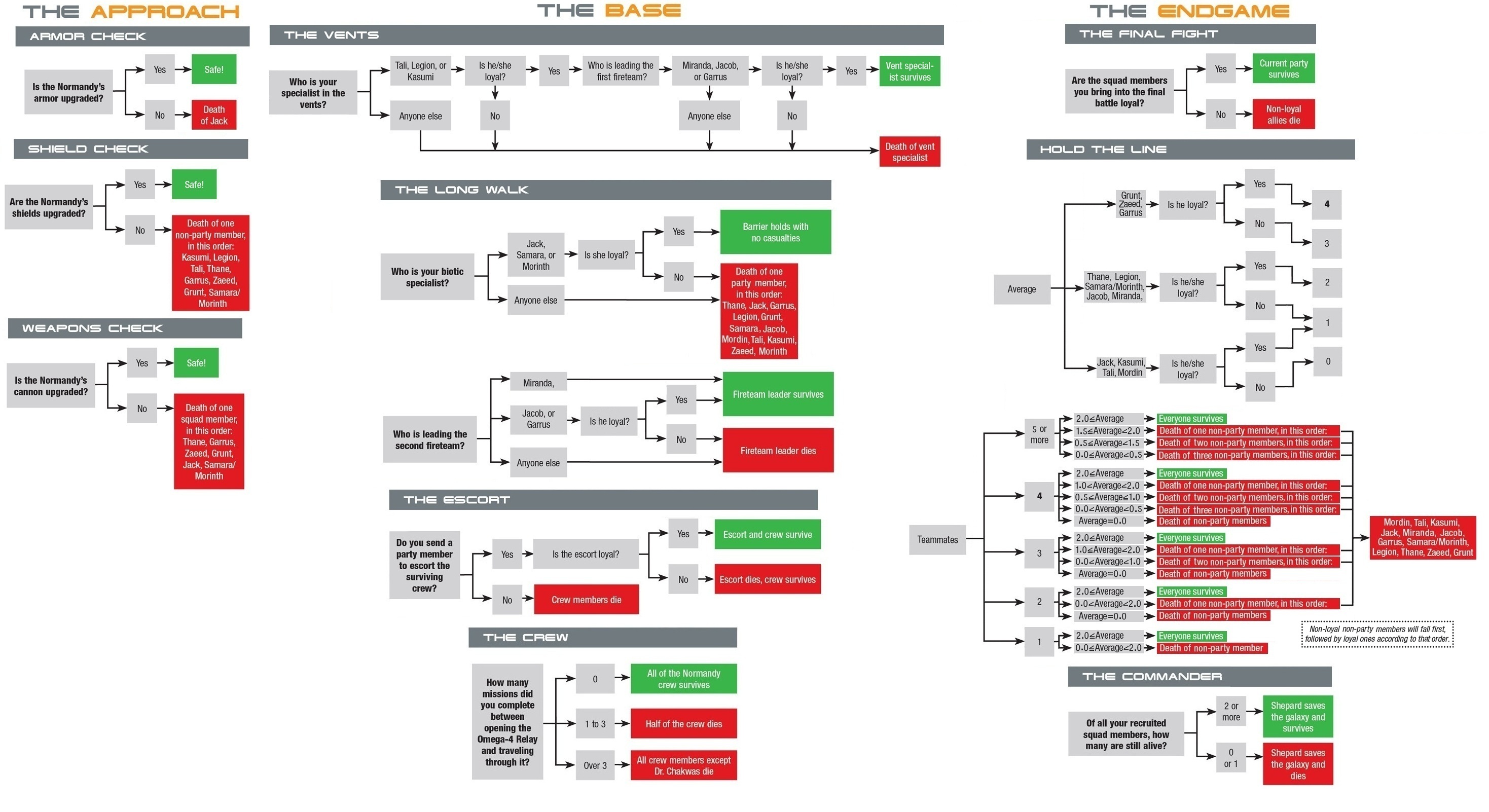
As my interest in Mass Effect is largely structural and this will ultimately involve a discussion of its narrative form, I will begin with telling my own story of the game. And indeed, this is largely the point of Mass Effect: following the branches of an immensely large decision tree, navigating a compelling and ethically complex narrative, constitutes the majority of gameplay.[2] And I imagine that the rich personalized narrative texture that results from players’ decisions constitutes the primary attraction of the game. For instance, here is the decision tree just for the endgame of Mass Effect 2:
So I’d been weaning myself off another mega-narrative w/ Skyrim, and having exhausted that, and reading Kyle Munkittrick’s bold assessment of Mass Effect, “Why Mass Effect is the Most Important Science Fiction Universe of Our Generation,” decided I’d pick up in the middest w/ Mass Effect 2. Mass Effect 3 had just appeared, and though I heard the internet rumblings of an unsatisfactory ending to the game, I didn’t know yet that it had produced Downfall-levels of nerdish-ire. Staying purposefully ignorant of such discussions, I played through 2 and 3 fairly quickly, but thoroughly (i.e. I didn’t really feel like gathering up all the space debris, nor does my clunky old X-Box have online access).
Whereas Lost was hyperarchival in terms of the frequent references it made, and how it played with its own history and temporality (among other things), Mass Effect is hyperarchival for the simple reason that it is huge, and the narrative possibilities you don’t experience far outweigh the ones that you do. To have a handle on the branching narrative paths of the game would require a) playing it for a very, very long amount of time, or b) consulting the Mass Effect wiki frequently and often. Further, as Munkittrick points out, there is a wealth of reading material in the game: emails, communications intelligence, bureaucratic tasks, a codex developing the galaxy’s deep-history, quite convincing scientific information on the various planets you come across, etc. In short, Mass Effect’s narrative is . . . massive, both in form and content. To actually experience “all” of it (say, in the fashion that it would take one a few hours to read all the books in Skyrim), really is not possible unless one wants to spend simply an ungodly amount of time w/ it. In short, Mass Effect is a mega-narrative.
By mega-narrative I mean a narrative that is simply too big to traverse without incredibly-non-trivial effort. Not infinite of course, but prohibitively large. Something that, if one attempted to see and do everything the trilogy allows one to do, I’m not sure whether it would be impressive, or else show a particular kind of obsessive behavior that one can imagine being discouraged by parents, friends, lovers, and medical professionals alike. (And of course there is an attendant sense of adolescence to the whole thing. . . .) In short, reading a mega-narrative is always prohibitive. There are aspects of the narrative you will simply never know (because who really wants to spend the time?). Unless, of course, you have access to the internet. The mega-narrative thus also functions in conjunction with other media formats—i.e. they virtually require an additional, largely user-generated tool, to be approached rigorously.[3]
It is for this reason that no other narrative aspect of Mass Effect ever could achieve the kind of wide audience, let alone the conversation, that a single ending would produce. If every ending was decidedly different, for a game that relied so heavily on individualized character development, there wouldn’t be anything to talk about; no common narrative ground would be shared. Yes, the game is obviously rich in terms of the critical approaches it immediately suggests, but we’d have to talk about narrative in more abstract terms, constantly comparing one’s own experience w/ another’s. Did you choose the Quarians or the Geth? Which character(s) did you find romance with? I could go on w/ such questions for quite a while, but will refrain because, like hearing about someone else’s dreams, I imagine that hearing what another person chose to do in the game would be weirdly boring and meaningless.
Mass Effect produces a strong connection between a player and their avatar. This is achieved by the decisions you make in the game. These decisions ultimately affect the fate of species and the entire galaxy. But the real texture of Mass Effect resides in the micro-narratives interspersed throughout. Though sometimes cheesy, and of course melodramatic, the dialogue between characters is compelling, with particularly good voice acting from such notables as Freddy Prinze Jr., Michael Hogan, Tricia Helfer, Jennifer Hale, and Martin Sheen, among many others. Sheen’s voicing of the Illusive Man, though no Captain Benjamin L. Willard, is stellar.[4] The characters are emotionally complex, and the multitude of species allows the writers to explore some interesting paths (perhaps) unavailable to a more anthropocentric speculative universe. (And really I would go on, but I don’t want to seem too gushy.)
So it is understandable that mere days after the game was released, there was already an online petition to change the ending. For, despite slight differences, Mass Effect, for all its branching narrative complexity, has what (at least at first glance) reads an awful lot like a single ending. Further, as this video loudly demonstrates, there are a few narrative inconsistencies to the final minutes of the game, not least of which is a scene that shows one character who (presumably) died on my final mission somehow getting aboard the Normandy (a spaceship) and the fact presented in the Codex, and elsewhere in the game, that destroying the mass effect relays would obliterate the solar system(s).[5] But I imagine that the uproar about the ending has far less to do w/ the inconsistencies presented in the last few minutes than the simple fact that players’ sense of their unique individual experience was felt to be invalidated. As Sparky Clarkson writes: “The end of Mass Effect 3 disregards the player’s choices on both galactic and personal scales.”[6]
The conflict here, both at a structural level and as it is expressing itself all over the web, is perhaps, if not unique, then worthy of note considering the larger history of narrative. For it is not that a different ending is being demanded, but rather many different endings appropriate to the individual player’s experience of the game. As mediums, the oral tradition, novel, film, and television simply do not allow such a uniquely tailored narrative experience. Whatever one might say about a particularly good or bad sense of an ending, no one would dream of criticizing the ending of a novel b/c it didn’t fit w/ the decisions a reader/player made when engaging w/ the text. Because massively distributed media necessarily had to be confined to a relatively limited form (in terms of how much information could be conveyed and stored in a book, etc.), such branching endings simply weren’t possible. And this is precisely what is happening w/ Mass Effect. People are upset that, regardless of what actually happens in its ending, their own unique sense of individuality, of making the game “their own,” is threatened. There is something deeply strange about the demand for what amounts to a “personalized” ending; and though I think Laura Parker has a certain point, the issues at stake go beyond arguing that, “[i]f BioWare does change the end of Mass Effect 3 to mollify a handful of goading voices, the game itself would no longer be the expression of its original creators. It would cease to be art.”[7]
Rather, a game that truly provided multiple, relatively individual, non-repeatable endings would be a profound achievement in exploring what the medium of video games can dialogically express, and would(/might) draw the video game forever into serious discussions of art—i.e. we wouldn’t have pieces in The Atlantic still reading vids as (only) adolescent, puerile, onanistic fantasies.[8] It would also evince a level of technocratic, corporate control over the individual experiences of players that would be unprecedented.[9] They didn’t achieve such a feat in Mass Effect, and though I wish they had (and also don’t), to dismiss a text for what it didn’t do is always problematic.[10] Such a game will appear that does achieve something like this. I guarantee you. It is the horizon of possibility for the mega-narrative. But for the moment, Mass Effect continues to make clear “the dissidence between inherited forms and our own reality.”[11] And perhaps we need to look closer at a few aspects of the game to understand its ending. For what is incredibly weird about the ruckus raised by the ending (the blue, green, and red similarities), no one has really said anything about the ending itself—i.e. what it means, how we might read it, why might have the narrative ended that way rather than another, etc. You know, basic hermeneutic stuff, critical attention, which the game so obviously deserves.
First off, Caleb A. Scharf’s “Mass Effect Resolves the Fermi Paradox,” deserves special attention. Scharf, an astrobiologist himself, argues that “the biggest idea, the biggest piece of fiction-meets-genuine-scientific-hypothesis is the overarching story of Mass Effect. It directly addresses one of the great questions of astrobiology—is there intelligent life elsewhere in our galaxy, and if so, why haven’t we intersected with it yet?”[12] (This question is at the root of the Fermi Paradox.) The ending(s) of Mass Effect, whichever of the actually truly distinct endings you consider, answers this question, but each in a different way. Anyone perhaps unfamiliar w/ video games will notice that, even though each ending is only a touch bit different, the sixteen endings are distinct. (See this.) For instance, my “bad” ending (my personal favorite, for obvious reasons), has galactic eschatological implications for futurity—i.e. no Earth, species cut off from each other, stranded and wandering the galaxy—as opposed to other endings where there is at least an Earth, species still cut off from one another; or else a kind of utopian possibility of the coexistence of biology and AI; or the dystopian nightmare of a Shepherd/Reaper controlled galaxy, etc. These are actually incredibly different.The “bad” ending is a kind of M.A.D.; the conflict between synthetic and organic life is projected as always apocalyptic; this conflict can result in nothing but utter destruction. I adore its nihilism. The other endings are still catastrophic, but reveal deeper levels of connection and/or control between technology and biology.[13] (And the game also shows the effects of your decision at a local level, implying that there will be distinctly different destinies for the characters and, most importantly, their progeny.) No matter the ending, however, each one concerns the simple fact that, w/o speculating a technology like the mass relays—the gateways to the stars—galactic civilization simply is not possible. In this sense, the game destroys its own initial premise in the final minutes, which is a stroke of utter metafictional brilliance, and, given what we know about physics, it explores the dissidence of inherited forms (the space opera), with reality: that travel between the stars may simply not be possible w/o the godlike hand of a massive artificial intelligence.[14] There is thus something deeply nihilistic in the shared aspect of each narrative ending. And in this sense, one might say the game moves from a kind of fantastic messianism to a nihilistic realism, from the form of the 20th c. space opera to a hyperarchival realism in which we might, and this is to acknowledge all of ME’s ambition, lay to rest the shaky physics the 20th c. space opera always depended upon for its realization—i.e. FTL travel. ME, for all its ambition and complexity, is also a highly nuanced commentary on its own form and on the tradition of SF that went before it. As such, I believe we are actually invited to read the ending w/in an even longer history of SF. (But will leave that for others.)
At the level of characters w/in the game itself, it is important to note that in the dénouement your character becomes a “Legend,” literally “The Shepherd.” The obvious Christian reference aside, she is still deified. So, it should be presumably clear that the next installment in the ME universe will probably be in the (quite distant) future.[15] Either way, the distinct endings one might receive at the end of ME3 imply different universesthat one might import to a future title. Whatever universe might be possible, it is still a universe defined by the decision you, as a player, made.[16] Yes, this decision was boiled down to three simple options. But that was the point. The entire game had presented your options in black-and-white terms. You could either decide to be a paragon or a rebel. So in one sense, the introduction of this third way, this other path, is the point.
One way of reading the questions of choice and free will the game presents, then, is to understand that Shepherd’s coming into true consciousness (rather than, say, her considerable athletic intelligence) happens as a result of her realization that there are more than two options to solve a particular problem.[17] The “difficult” decisions you were forced into throughout the game were rarely a decision between a clearly correct and incorrect path, let alone a “good” and “evil” path, to the game’s credit. Regardless of the ethical complexity constantly confronting the player, however, whatever you did choose to do put you a step closer to the end. No matter the decision, the game was overwhelmingly teleological. No matter what you did, really, the end was always contained in the beginning, even if you made considerably different decisions to get to the final scene. This, unless I’m incorrect, doesn’t really resemble anything like true choice. Shepherd, even though she is “you,” is still an archetypal hero. So one might suggest that only where fate led her was where a real choice presents itself. And of course this still isn’t much of a choice at all, but is the one choice beyond which you as a character cannot go,[18] the choice w/ the most massive effects on the galaxy. And this choice is whether to blow something up, jump into a laser, or take control of the Reapers.
So, rather than reading the end as a lack of choice, a lack of any real “meaning” to your individual decisions, perhaps we should read it as the one moment in ME where you (as a player) have the most power over shaping the narrative w/ your decisions. B/c ME’s narrative trajectory is concerned with the eschatological horizon of life, whether life continues as biological, synthetic, or what have you, and your decision determines how the ensuing manipulation of this horizon will play out, by avoiding one apocalypse, you rewrite another. This may also constitute a new galactic cycle. Though life emerges spontaneously from the galaxy, even something as immense as a galaxy has a carrying capacity, and like any ecology, has some cyclical elements. (Or else this is ME reflecting on Nietzsche’s eternal return.)
In this sense, I would like to emphasize the point that Shepherd is the vehicle through which the narrative of the world of ME is told, rather than the world being a mere setting to explore her (i.e. the player’s) narcissistic fantasies. And indeed, depending on how you play, this is a point she continually makes through dialogue. ME, then, is far less about Shepherd, at the end of the day, than it is about itself, about its world/galaxy/universe. This is why the endings are so distinct. They all imply radically different futures, radically different galaxies, even if they all share the brutal, nihilistic realism of no real galactic future civilization being possible.[19] ME’s ending(s) reveal an incredibly deep history, and so to focus on the tiny bit of that history the few years of its narrative represents, is to fundamentally misread what is at stake in the game.
As the epilogue to the game emphasizes, Shepherd is primarily a figure through which the galaxy’s history and narrative can be understood. She is a significant node (but only a node) in the development of its complex ecology. More than any decision one makes in the game, she is such b/c of whichever of the three paths you pick. Yes, there are narrative inconsistencies, which might largely be attributable to the fact that we simply don’t know what happens between Shepherd entering the Crucible and the Normandy escaping. (This will probably be in the DLC, btw.) If the mass effect relays’ destruction really does destroy the solar systems they reside in, all the better. The inevitability of extinction, the blip of galactic time sentient life thrived and communicated across species and the galaxy—it is the anomaly of this that ME concerns itself w/. What the reaction to the ending of ME reveals, then, is that it is actually a game that is quite rigorous, as it eschews the easy narrative choice of redemption in favor of a cosmic eschatological perspective. Your choices, in the galactic scheme of things, don’t matter. The importance of any one individual—even the most heroic, storied, badass individual whose final decision has galactic import and changes the very life-cycle of the galaxy—is minimal. Rather than be upset about the fact that one’s individual gaming experience was “disrespected,” perhaps we should be thankful that a text as popular as ME had the gumption to refuse narrative normativity and to critique the cult of individuality the game’s very success is grounded upon.
[1] This is more-or-less the ending I experienced, except my character was a black female w/ blond hair, blue eyes, and wickedly luminous facial scars; a striking Commander Shepherd. Also, I am firmly of the (similar) mindset that by revealing some aspects of a text’s narrative (esp. its ending) it is thus “spoiled,” really probably means there wasn’t much to be spoiled in the first place. This is not the case for Mass Effect.
[2] Though try explaining that to the people on Fox, for example.
[3] Which I will not be doing here.
[4] It need hardly be mentioned that Mass Effect also had a very large budget.
[5] These inconsistencies have even caused one particularly industrious group of people to formulate an involved (and convoluted) theory that supposedly “explains” the end in logical fashion.
[6] Sparky Clarkson, “Mass Effect 3’s Ending Disrespects its Most Invested Players,” Kotaku (3 April 2012), http://kotaku.com/5898743/mass-effect-3s-ending-disrespects-its-most-invested-players.
[7] Laura Parker, “Why BioWare Shouldn’t Change Mass Effect 3’s Ending,” Gamespot (13 March 2012), http://www.gamespot.com/features/why-bioware-shouldnt-change-mass-effect-3s-ending-6366066/.
[8] Even if they often are.
[9] This is what is so ultimately disturbing about ME and the clamor for individualized endings. It is in the interest of the corporate mega-narrative for its reader to become as absorbed as possible in their IP, potentially at the expense of all other texts. What is more absorptive (and reifying) than a massively disseminated text that is capable of giving the illusion of actual individual subjectivity and agency? No matter the potential for aesthetic realization represented by the video game mega-narrative, there is also the potential for unprecedented control—viz. WoW.
[10] I.e. why weren’t there Transformers in The Wizard of Oz!? That would’ve been so much better.
[11] Frank Kermode, The Sense of an Ending: Studies in the Theory of Fiction with a New Epilogue, 2nd ed. (New York: Oxford University Press, 2000), 130.
[12] Caleb A. Scharf, “Mass Effect Solves the Fermi Paradox?” Scientific American (15 March 2012), http://blogs.scientificamerican.com/life-unbounded/2012/03/15/mass-effect-solves-the-fermi-paradox/.
[13] I’m sure there is an excellent Deleuzian reading out there.
[14] This, to be sure, is also the problem of Charles Stross’s Accelerando (2006).
[15] And the intellectual property that is ME would obviously thrive if such games were made w/ the same attention that the trilogy received.
[16] And seriously, how much more entitled can be when becoming a god of myth and legend is not a satisfactory enough individual experience w/ a game!? Are we all such delicate little important flowers that this isn’t enough?
[17] If I do have one criticism of the ending, it is that the Bartlebian option of preferring to do nothing wasn’t available. Though of course that is one ending of ME2, to its great credit—i.e. everyone dies, you fail, galaxy destroyed, before ME3 even begins. Which, of course, is another “possible” ending to the ME universe—i.e. you don’t even get to 3.
[18] Unless she lives. Well, of course she lives. She is a comic book character. Though I prefer my ending in which she dies.
[19] The same point can and should be made about Skyrim. Your character is far less a figure that you feel connection w/ than a vehicle through which to traverse the true “hero” of the game: its complex, vibrant world.
Post-Semester Links
Here’s a couple things I’ve found interesting recently that I forgot to post amidst the work of the semester.
From The Atlantic, Taylor Clark covers Braid designer Jonathan Blow in “The Most Dangerous Gamer.”
An excellent long review of DFW’s The Pale King that I missed from last year: John Jeremiah Sullivan’s “Too Much Information,” in GQ.
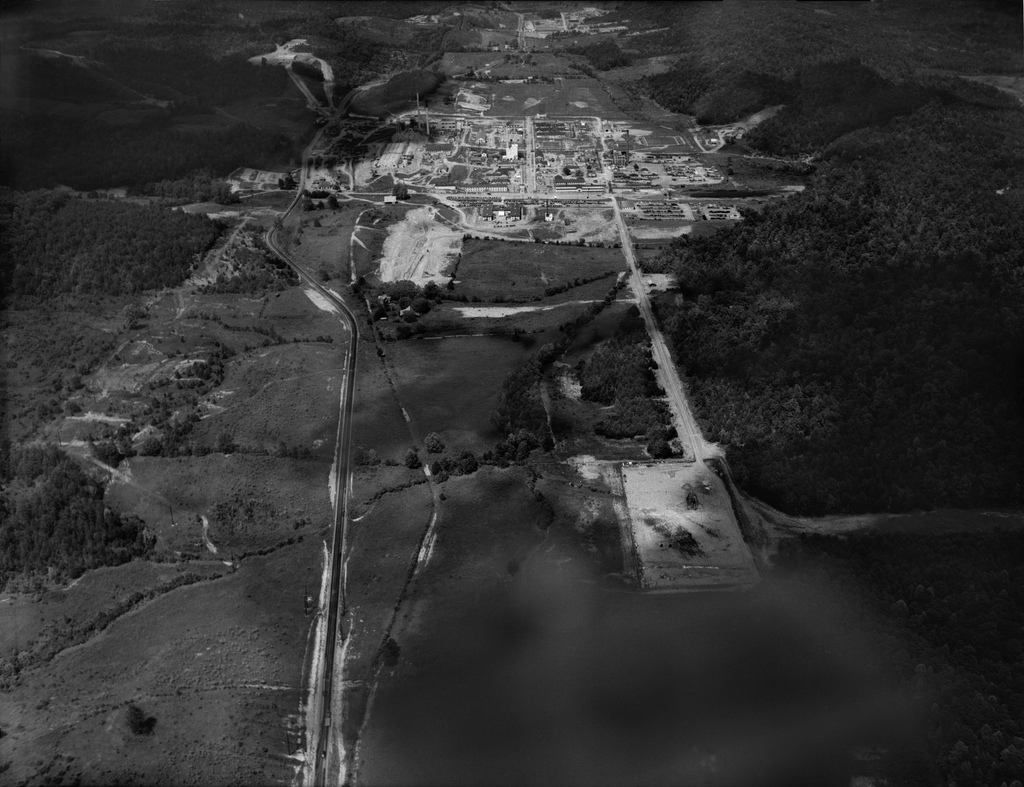
Pictures from the secret town of Oak Ridge.
15 writer’s bedrooms. This is Faulkner’s:

And Žižek on The Wire.
Freedom and the Bomb Threats at the University of Pittsburgh, Spring 2012

I have been teaching Jonathan Franzen’s Freedom (2010) for the past five weeks. During that time the University of Pittsburgh received 125+ (and counting) bomb threats,[1] with as many evacuations. That the conjunction of these things would lead a college literature course to ask more general questions of “freedom,” what it means to be free, what role institutions play, etc., is obvious. And we have had quite an interesting discussion of some of these issues. But, particularly within the context of Franzen’s novel, there are some deeper and more fundamental questions regarding freedom that these threats raise.
The terrorism the university is experiencing threatens basic academic freedoms. And not in the usual sense we ivory tower dwellers mean when discussing things like tenure or FERPA, but how something as simple as Mixmaster is powerful enough to threaten the very foundations of a major public institution. The effects such threats have on an urban campus like Pitt, with its attendant hospital buildings, adjacent universities and colleges, is considerable. And the threats are now beginning to spread outside the university.[2] When 34,000 students and attendant faculty are undergoing continual evacuations, to the point that attendance policies have been thrown out the window, the stress and anxiety in the urban/academic landscape is palpably evident.
And here we are, talking about Franzen’s novel, having a very interesting discussion online, and my students are afraid to come to class. The facebooks, with its multiple grad student/student/professor connections, has only exacerbated the situation. (Like, we all know more-or-less immediately that, in a completely unrelated incident, this happened the other day.[3]) And yet we are having class. And frankly, this has been one of the most interesting classes I have had the privilege of teaching, largely due to the fortitude of my students who are coming to class. I have made it clear to them that their attendance has ceased to be mandatory. Sure, not all of my students were there for the past two weeks, but many of them were.[4]
So it struck me last week, that since the questions of the course largely involved postmodern representation, with all the simulacra and simulation of White Noise (1985), the spectacle of 9/11 in the American imaginary, and various other writings of disaster, the form of these bomb threats and the affect they are producing deserves particular attention. Pitt is experiencing, quite simply, a simulation of terrorism, terrorism as simulation. The other night I was reading a particularly strong interpretation of the presence of aerial warfare in Virginia Woolf’s Mrs. Dalloway, and could not help but note how Paul K. Saint-Amour’s analysis of false air-raid alarms after World War I was particularly apt for the current situation:
The same assessments implied that the panic induced by false alarms was in some ways more disruptive than that caused by actual raids. Unlike the realized physical violence of a raid, a false alarm provides no catharsis for the sense of endangerment it produces; it mobilizes anxiety without providing it with a kinetic output. Thus the very falsity of the alarm emphasizes a condition of hideously prolonged expectation, a state of emergency that is both perennial, in having been detached from the arrival of violence in a singular event, and horribly deferred—the advance symptom of a disaster still to come.[5]
These bomb threats have effectively revealed that what was once an advance symptom of a disaster “to come,” has become the disaster in-and-of-itself. The state of exception, the feeling my students have of being constantly threatened, has become the norm. Campus life has adjusted, and already the bomb threats have become an old, perhaps tired point of conversation. The institution has already internalized the state of exception. Receiving 3 or so text messages daily from the university’s Emergency Notification Service is not only unsurprising,[6] but expected. And this is one aspect of what is so frightening about these bomb threats. They may never end.
Further, it was reported in both The Wall Street Journal and Forbes today that the FBI has seized the servers of activist group Riseup Networks in an effort to track the emails that are making up the bulk of the threats. Riseup provides an email service so that activists and whistleblowers can remain anonymous. Says the spokesperson for Riseup, Devin Theriot-Orr, “Our position is that anonymous speech is vital to a thriving democracy. Anonymous remailers are used by democracy activists, people in oppressive regimes and whistleblowers. There isn’t a way to run an anonymous remailer that allows good anonymous speech and not bad anonymous speech.” Theriot-Orr further added that, “[The FBI’s raid] is an attack on all forms of anonymous communications.”[7] That whoever is making these bomb threats is taking advantage of a system designed to protect freedom of speech is particularly disturbing.
Compounded with the fact that recent suspects included a transgender couple once associated with the satellite Johnstown campus, there is something disconcerting about the turn these threats are taking. At the time of this writing it is unclear why these threats are being made. No demands have been made public, and no ideological position has been taken by whoever is issuing these threats. Nonetheless, so far there is an undeniable political dimension to the (public) targets of the FBI’s investigation. And the fact that the FBI has seized the server of a group whose explicit goal is to protect speech, raises some very complex questions regarding security and privacy.
It has been difficult as an instructor to think through these questions vis-à-vis teaching Freedom. For Franzen’s novel complexly explores questions of, quite simply, freedom, and the difficulty of being “truly free.” As Lev Grossman writes in his article on Franzen for Time magazine,
For Franzen’s characters, too much freedom is an empty, dangerously entropic thing. After all, energy companies are free to ravage and poison the breeding grounds of the cerulean warbler. If Patty and Walter divorced, they would be free, but it’s a freedom they would do almost anything to avoid. At her lowest ebb, Patty reflects that she “had all day every day to figure out some decent and satisfying way to live, and yet all she ever seemed to get for all her choices and all her freedom was more miserable.” And no one is freer than a person with no moral beliefs. “One of the ways of surrendering freedom is to actually have convictions,” Franzen says. “And a way of further surrendering freedom is to spend quite a bit of time acting on those convictions.”[8]
The bomb threats have made clear that a certain level of security is necessary, and I for one, as someone who is both professionally frustrated by the constant disruption of these threats, and concerned for my student’s physical and psychological well-being,[9] want these threats to end. The question of what restrictions on freedom are necessary to achieve such a conclusion, however, when it seems quite apparent that no one has any idea who is behind the threats, and that we have gone far beyond the question of does-freedom-of-speech-protect-your-right-to-yell-fire-in-a-crowded-theater, makes the current situation a particularly problematic one. For the threat being experienced by the entire Pitt community, costing millions of dollars, potentially doing damage to Fall enrollments, and further exacerbating the financial situation of an institution already making large cuts due to decreased state funding, is, at this point, fundamentally discursive.
For my final lecture of the year yesterday, this is something I emphasized to my students. For, no matter what one may think of Freedom (warts and all [or my own take, which I am of course not as emphatic about at this point]), our reading of the novel in the context of both the larger questions of the course and the ongoing bomb threats has served to emphasize that risk projection is an incredibly powerful force in the postmodern imagination. And perhaps, despite Franzen’s own worries about the role of the Novel in the late-20th c., that reading literature forces us to ask questions about freedom, representation, and disaster, about the increasingly precarious position of public vs. private discourse, this hopefully foregrounds the vital role studying the humanities can play in attempting to comprehend and imagine an alternative to the terror Pitt has experienced for months. If I myself have learned anything from my students this semester, it is that there is something important about getting together, carrying on, and talking seriously about a novel that deals with serious issues, perhaps especially in adverse conditions. And if nothing else, I am incredibly in debt to my students for that.
[1] And, crazily, the bomb threats already have their own Wikipedia page. See link above.
[2] I do not think it improper to point out that these threats are beginning to resemble spam. . . .
[3] Further, thinking that my students would feel safer outside the frequently threatened Cathedral of Learning, they are now expressing fear about the openness of the park we are in, and the possibility of a shooting.
[4] To add another layer of mediation, not only do I find myself frequently searching “bomb threats at Pitt,” I also just got a text message (one of many), informing me that the Cathedral hasn’t blown up this time either, in so many words.
[5] Paul K. Saint-Amour, “Air War Prophecy and Interwar Modernism,” Comparative Literature Studies 42.2 (2005): 140.
[6] In fact, Pitt has recently started a video campaign played on monitors at various points on campus requesting that students not opt out of the ENS. Seriously though, receiving many text messages every day is quite annoying.
Also check out this vid from MSNBC.
[7] Qtd. in Andy Greenberg, “FBI Seizes Activists’ Anonymizing Server in the Probe of Pittsburgh’s Bomb Threats,” Forbes (19 April 2012), http://www.forbes.com/sites/andygreenberg/2012/04/19/fbi-seizes-activists-anonymizing-server-in-probe-of-pittsburghs-bomb-threats/.
[8] Lev Grossman, “Jonathan Franzen: The Wide Shot,” Time176. 8 (23 August 2010): 46, http://www.time.com/time/magazine/article/0,9171,2010185,00.html.
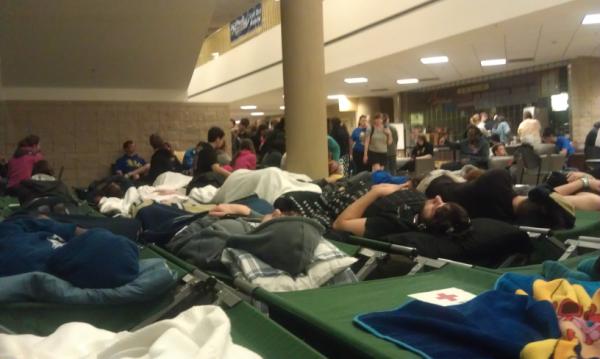
[9] One of the more despicable aspects of the threats has been the frequent and continual threats to student dormitories at late hours of the night or early morning. For instance, students have been forced to sleep on cots in the gymnasium during these threats.
Death and Taxes: if there is one thing we can count on. . .
It is that taxes will still be collected after mass-death. Yes, the IRS has a plan for how to collect taxes in the event of nuclear exchange. (Perhaps DFW was on to something w/ the Pale King.)
Thomas Pynchon Narrates Promo Video for Inherent Vice
This is pretty cool:
ENGLIT 0365: Literature and the Contemporary
I will be teaching Literature and the Contemporary this summer during the second six week session at the University of Pittsburgh. This course examines contemporary cultural expression across a range of forms and media. It investigates the contemporary as both a complex reworking of past narratives and traditions, and as the production of the experimental and the new. In particular, this section of Literature and the Contemporary, subtitled “Human/Machine: Exploring the Posthuman Imagination,” will examine how intersections between human and machine, between the biological and the technological have been represented in a wide range of texts. Beginning with Mary Shelley’s Frankenstein, we will then read significant 20th and 21st century novels that approach questions of posthumanity in complex and often quite shocking ways:
Paolo Bacigalupi, The Windup Girl (San Francisco: Night Shade Books, 2010 [2009]).
J.G. Ballard, Crash (New York: Picador, 2001 [1973]).
Jennifer Egan, Look at Me (New York: Anchor Books, 2002 [2001]).
Thomas Pynchon, The Crying of Lot 49 (New York: Perennial, 2006 [1965]).
Mary Shelley, Frankenstein (Norton Critical Edition), 2nd ed., ed. J. Paul Hunter (New York: W.W. Norton & Co., 2012 [1818]).
Videodrome (David Cronenberg, 1983).
More Apocalypse Photos
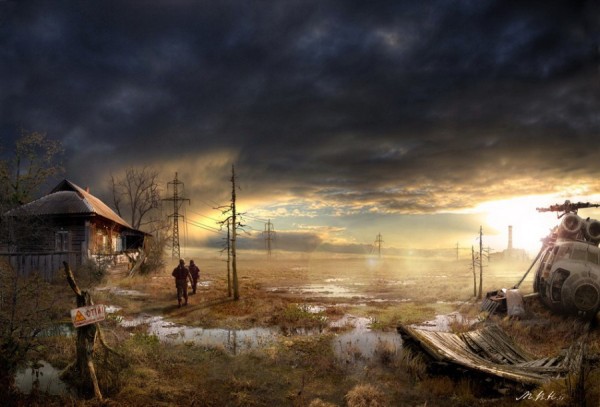
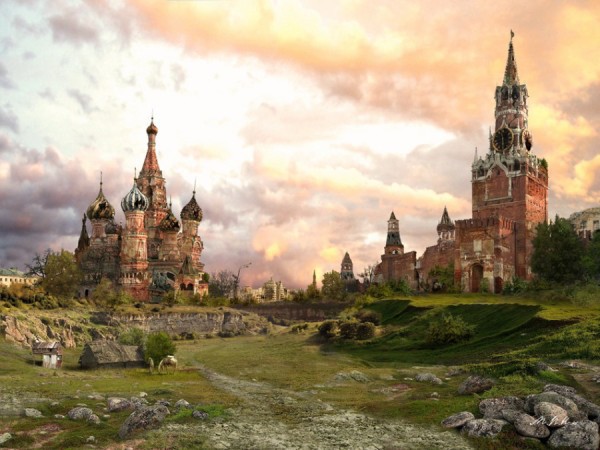
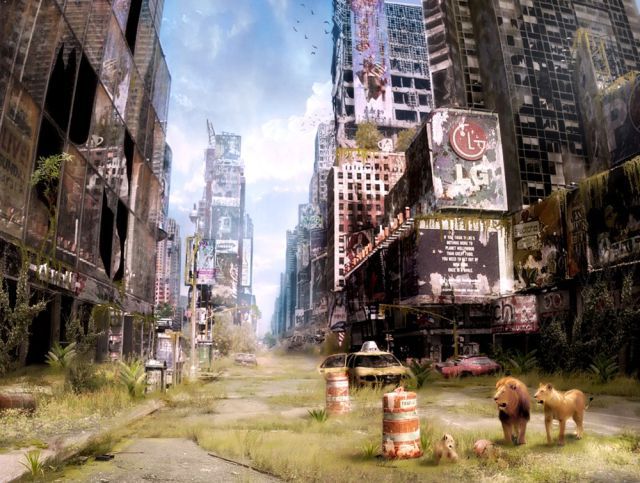
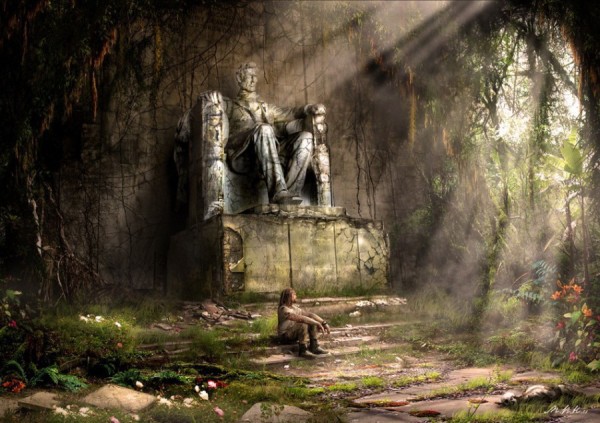
io9 has another article on apocalypse art, this time its Vladimir Manyuhin’s apocalyptic photography, where he takes photos of real things and then manipulates them to be post-apocalyptic. Hyperarchival eschatology indeed. Some samples:
NeMLA 2012: Nuclear Criticism and the “Exploding Word”
I am very excited for this roundtable discussion on nuclear criticism that I will be taking part in at this year’s Northeast Modern Languages Association Conference in Rochester, New York. I posted my abstract for this previously:
March 15th, 2:15-4:15 2.11 Aqueduct Room AB
Nuclear Criticism and the ‘Exploding Word’ (Seminar)
Chair: Michael Blouin, Michigan State University
“Hippie Mysticism, Zen Visions, and the Poetical Diffusion of the Nuclear Crisis,” Morgan Shipley, Michigan State University
“‘Literature has always belonged to the nuclear epoch’? Nuclear Criticism’s Fabulous Textuality,” Bradley Fest, University of Pittsburgh
“Time Bombs: Theories of History in the Nuclear Age,” Rebecca Evans, Duke University
“Repress, Reuse, Recycle: Fallout in the Age of Terror,” Aaron DeRosa, Purdue University
Quite the Eschatological Hyperarchive
Wow, a list of a ton of apocalyptic works (over 1700). Better start reading.
 The Hyperarchival Parallax