DFW Excerpt: “These are tense linguistic times”

My Freshman Composition course just wrapped up a lively discussion of DFW’s “Authority and American Usage” (originally published in Harper’s as “Tense Present”), and though I think I probably wanna do some different stuff w/ it next time . . . here’s a lovely excerpt:

The insecurities that drive [Politically Correct English], [Academic English], and vocab-tape ads are far from groundless, though. These are tense linguistic times. Blame it on Heisenbergian uncertainty or postmodern relativism or Image Over Substance or the ubiquity of advertising or PR or the rise of Identity Politics or whatever you will–we live in an era of terrible preoccupation with presentation and interpretation, one in which the relations between who someone is and what he believes and how he “expresses himself” [DFW’s fn.: (Notice the idiom’s syntax–it’s never “expresses his beliefs” or “expresses his ideas.”)] have been thrown into big-time flux. In rhetorical terms, certain long-held distinctions between the Ethical Appeal, Logical Appeal ( = an argument’s plausibility or soundness, from logos), and Pathetic Appeal ( = an argument’s emotional impact, from pathos) have now pretty much collapsed–or rather the different sorts of Appeals now affect and are affected by one another in ways that make it nearly impossible to advance an argument on “reason” alone. (David Foster Wallace, “Authority and American Usage,” in Consider the Lobster and Other Essays [New York: Little, Brown and Company, 2006], 116, my emphases.)

Perhaps We’re Not Bound to Our Solar System After All

So, Matt Peckham in Time Magazine has reported that NASA is “Actually Working on a Faster-Than-Light Warp Drive.” No, really. And it’s brilliant:

“By placing a spheroid object between two regions of space-time — one expanding, the other contracting — Alcubierre theorized you could create a “warp bubble” that moves space-time around the object, effectively re-positioning it. In essence, you’d have the end result of faster-than-light travel without the object itself having to move (with respect to its local frame of reference) at light-speed or faster.”

Basically, rather than accelerate an object, this method simply changes the very fabric space-time (wow). And it doesn’t violate Einstein’s special theory of relativity. And they’re gonna start lab experiments too. The assured extinction of the species when the Sun goes Red Giant on us, now looks less eschatological. Alpha Centauri or bust by 2100.

Also, this is weirdly reminiscent of the last few pages of Thomas Pynchon’s, Against the Day [2006], in which the Chums of Chance skyship, the Inconvenience, becomes capable of time travel:

Inconvenience herself is constantly having her engineering updated. As a result of advances in relativity theory, light is incorporated as a source of motive power–though not exactly fuel–and as a carrying medium–though not exactly a vehicle–occupying, rather, a relation to the skyship much like that of the ocean to a surfer on a surfboard–a design principle borrowed from the Æther units that carry the girls to and fro on missions whose details they do not always share fully with “High Command.” (1084)

Destroying the Entire Internet . . . ?

No. As George Dvorsky over at io9 reports in “Could Someone Really Destroy the Whole Internet,” the very things that make the Internet possible make it resistant to total destruction. Phew. (That is, unless you’re in this terrible looking new show. I watched the pilot, and its one of those: we stuck it in a post-apocalyptic future, but honestly, we will not have a single plot point that wouldn’t work just fine in another, less apocalyptic universe. But this way we get to have Wrigley Field covered in vines. And seriously, when I google, “revolution,” this is the first thing that comes up? We’re done for.)

Jimmy Carter’s Strategies for Nuclear War

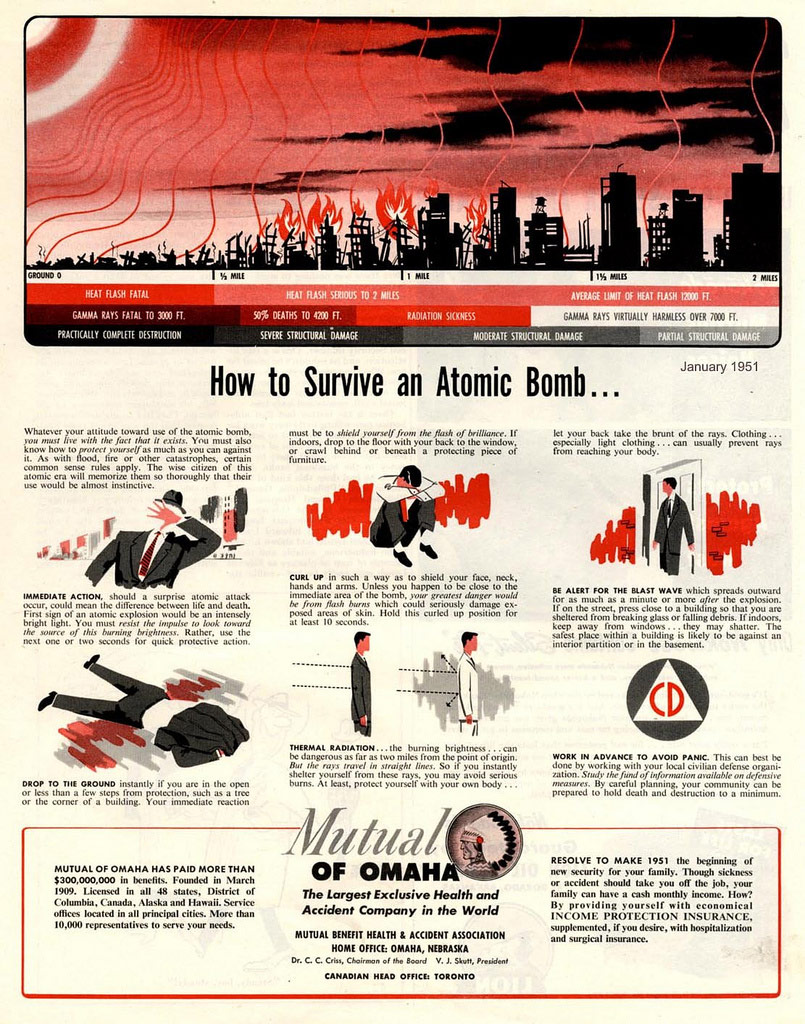
At Foreign Policy, William Burr writes in “How to Fight a Nuclear War” about President Jimmy Carter’s plans for the apocalypse:

With other recently declassified material, PD-59 shows that the United States was indeed preparing to fight a nuclear war, with the hope of enduring. To do this, it sought a nuclear force posture that ensured a “high degree of flexibility, enduring survivability, and adequate performance in the face of enemy actions.” If deterrence failed, the United States “must be capable of fighting successfully so that the adversary would not achieve his war aims and would suffer costs that are unacceptable.”

Perhaps even more remarkable than this guidance is the fact that, although the Obama administration is conducting a review of U.S. nuclear targeting guidance, key concepts behind PD-59 still drive U.S. policy to this day.

Manhattan Projects Moves to USSR

I’m becoming increasingly taken w/ Hickman and Pitarra’s comic, Manhattan Projects. The most recent issue moves us to the Soviet Union, and even has a panel of Yuri Gagarin floating in space. This comic is consistently an absolute joy to read. (Image just released the first 4 or 5 issues in TPB form [or “graphic novel”]). It is smart, funny, and you get to see scientists acting like badasses or schizophrenic psychopaths.

Mark Sussman on DFW and D.T. Max’s Biography

A buddy of mine from back in my Arizona days, Mark Sussman, has an interview with D.T. Max on his new DFW biography and DFW as a “Burkean conservative,” and an article/review of the book as well. Check’em out. (There’s also a nice little nod to Prof. Charles Sherry in the interview, who was probably one of the most important teachers I’ve ever had, even if I did write a nonsensical disaster of a senior thesis on Nietzsche for him.)

Open Utopia

This just went up: Open Utopia, an open source version of Thomas More‘s famous Utopia. An email from Stephen Duncombe sums it up nicely: “It takes a bit of audacity to introduce yet another edition of More’s Utopia into the world. Yet I’ve done so because what the world does not have, and what I believe it needs, is a complete English-language translation of Utopia that honors the primary precept of Utopia itself, that is, that all property is common property. This digital edition of Utopia is open: open to read, open to downloading, open to re-thinking, and open to modification. But Open Utopia is more than a free copy of Utopia, it’s a free platform for others to comment upon More’s text and write their own, building communities of critics and creators.  Two of the more exciting features of Open Utopia are an annotatable “Social Book” edition–created in collaboration with the Institute for the Future of the Book–and Wikitopia, a wiki platform for collective authorship of a new Utopia.”

Brett Easton Ellis . . .

. . . is making a fool of himself. Though I’ll admit D.T. Max’s Every Love Story is Ghost Story left me slightly disappointed (actually, I could probably criticize much of it, like on a sentence level, but I won’t), it is still a welcome addition to our understanding of DFW’s life and work, and it surely doesn’t make me want to submit this kind of  twitter fiasco Ellis is involved in: “Reading D.T. Max’s bio I continue to find David Foster Wallace the most tedious, overrated, tortured, pretentious writer of my generation…” It is precisely this kind of vitriolic internet rambling, of the upset nerd commenting on well, whatever, that is beginning to define the critical atmosphere of today. If Matthew Arnold was around today, and answered the question of what the function of internet criticism is at the present time, I don’t think things like Culture and Anarchy (1869), or much of anything else, would have been written; he would’ve been too despondent. Further, to me the atmosphere of constant, instant, widespread, poorly-thought-out, and loud criticism from hardly qualified and anonymous people with nothing better to do that dominates “comments”-discourse today, this culture of easy and quick dismissal (of anything), practically requires of us the most generous, considered criticism we can muster. Ellis’s words don’t make me want to read his significant oeuvre any less generously (though I do think DFW has a point in “Fictional Futures and the Conspicuously Young,” a salvo he launched against Ellis in 1987, so yes, he got the first shots in quite a while ago). In fact, for those of us who are seriously in the business of criticism, this kind of thing only re-emphasizes the need for us to be as generous, thoughtful, and, well, kind as we can. It is much easier to say what is “bad” about a work of art–really, any art, how easy is it to call, say, Jackson Pollock’s paintings bad b/c my “five year old could have painted that”–and it is esp. easy to say what is “bad” about a dead artist. It is much more difficult to figure out what is worthwhile in a work, particularly something that does not immediately strike one as worthy of one’s attention. And even more difficult is actually trying to figure out what kind of aesthetic work something is trying to do, what the poem, novel, painting is trying to say, what meaning it is constructing, etc. I have to imagine Ellis’s own work would benefit from seriously considering DFW and, if he were still around, vice versa. But, for now, being loud and mean surely gets oneself a minute of attention, “but a minute was all it was. After nature had drawn just a few more breaths the planet froze and the clever animals had to die.”[1]


[1] Friedrich Nietzsche, “On Truth and Lying in a Non-Moral Sense,” in The Birth of Tragedy and Other Writings, Trans. & ed. Ronald Speirs. Ed. Raymond Geuss (New York: Cambridge University Press, 1999), 141.