The Flood This Time: Some 2012 Weather Links

2012, by all accounts, was the warmest year on record. Among many other responses to the disastrous 2012 (w/r/t weather) both The New Inquiry and Jacobin: A Magazine of Culture and Polemic have published some excellent pieces on climate change, disaster, and our contemporary sense of an ending. Among them are Alyssa Battistoni’s excellent, “The Flood Next Time: Life After Emergency” at Jacobin. The New Inquiry has devoted an entire issue to weather , including a nice editorial, and an essay from the incomparable Gerry Canavan, “Après Nous, le Déluge.”  (This is all also coming in the wake of this nonsense.) These magazines, along w/ my good friend Alexander Provan’s Triple Canopy, also just had a very nice writeup in The Guardian. Enjoy.

The Year of DFW, According to Some

Now that it’s been pointed out by Michael Moats at Fiction Advocate, I’m realizing the gaggle of David Foster Wallace-related stuff that happened in 2012. The great deal of material that has appeared this year that is in some way connected to DFW has inspired Moats to title his (incomplete . . .) encyclopedic recounting of all this stuff, the “Year of David Foster Wallace” (part 2 is here).

Matt Bucher, administrator of the wallace-l listserv, also weighed in with, “Consider the Year of David Foster Wallace.”

To be honest, however, I don’t necessarily see this trend slowing down too considerably in 2013, as, for example, DFW’s name was mentioned a number of times in Joel Lovell’s recent review-essay in The New York Times, “George Saunders Has Written the Best Book You’ll Read This Year” (a book, titled The Tenth of December, that I very much look forward to reading). Bucher also points out that that we will probably be receiving at least 4 more books that revolve in the DFW orbit in 2013.

Though posted in November, I want to draw attention to Chris Osmond also briefly reflecting on DFW’s pedagogy in his blog post, “Hideous Teachers.” Beginning another semester of SC today where my students will be reading DFW (yet again) makes me realize how valuable his writing can be in the classroom.

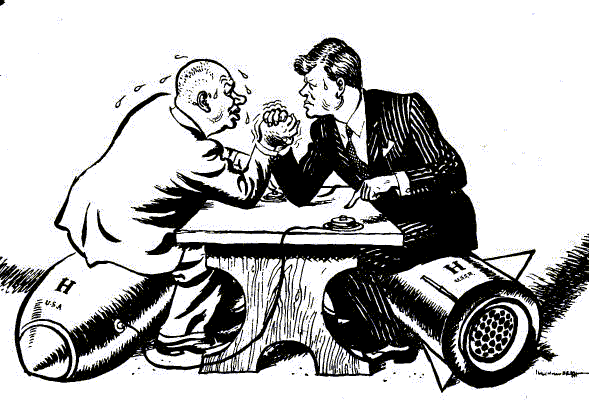
Nuclear Football

Greg Mitchell at The Nation reports on a (really a fairly bizarre) football game played in the ruins of Nagasaki on 1 January 1946, in “Football at Ground Zero: The Atom Bomb, Nagasaki, New Year’s Day, 1946”:

One of the most bizarre episodes in the entire occupation of Japan took [. . .] on January 1, 1946, in Nagasaki.

Back in the States, the Rose Bowl and other major college football bowl games, with the Great War over, were played as usual on New Year’s Day. To mark the day in Japan, and raise morale (at least for the Americans), two Marine divisions faced off in the so-called Atom Bowl, played on a killing field in Nagasaki that had been cleared of debris. It had been “carved out of dust and rubble,” as one wire service report put it.

(This really sounds like something straight outta Don DeLillo‘s End Zone [1972]).

Also, as Stuart Isett’s photography website points out, the Richland High School football team,

[i]n the fall of 1945, after an atomic bomb was dropped on Nagasaki [. . .] changed the team’s mascot to a mushroom cloud and called themselves the “Bombers.” The plutonium that was in that bomb was manufactured by workers at nearby Hanford Nuclear Site as part of the Manhattan Project. [. . .] During the Cold War, the Hanford project was expanded to include nine nuclear reactors and five massive plutonium processing complexes, which produced plutonium for most of the 60,000 weapons in the U.S. nuclear arsenal. The weapons production reactors were decommissioned at the end of the Cold War, but the manufacturing process left behind 53 million U.S. gallons of high-level radioactive waste that remains at the site. Hanford is the most contaminated nuclear site in the United States and is the focus of the nation’s largest environmental cleanup, providing thousands of jobs to residents in nearby towns such as Richland.

Check out some of the photos.

And, because we’re on the subject of “nuclear football,” I thought I’d include an image of the actual nuclear football: the satchel/black box/briefcase carried around near the President of the United States, the contents of which are capable of launching a nuclear attack.

Happy New Year!

Center for PostNatural History

R. recently drew my attention to the fact that the Center for PostNatural History exists, and it is just down the street from us in Pittsburgh. This is definitely on the list of places to visit in 2013. Their mission statement:

The Center for PostNatural History is dedicated to the advancement of knowledge relating to the complex interplay between culture, nature, and biotechnology. The PostNatural  refers to living organisms that have been altered through processes such as selective breeding or genetic engineering. The mission of the Center for PostNatural History is to acquire, interpret, and provide access to a collection of living, preserved and documented organisms of postnatural origin.

And of course their current exhibition is “Atomic Age Rodents.”

The Cold Coast Archive

Spring Semester 2013

Beginning next Tuesday I will be teaching two courses at the University of Pittsburgh during the spring semester: Seminar in Composition (ENGCMP 0200, Pitt’s freshman English) and Reading Poetry (ENGLIT 0315). I am greatly looking forward to both classes as each should prove to be interesting, challenging, and fun. These courses reprise courses taught the previous semester.

In Seminar in Composition we’ll be reading selections from the following:

David Bartholomae and Anthony Petrosky eds., Ways of Reading: An Anthology for Writers, 9th ed. (New York: Bedford/St. Martin’s, 2010).

William Strunk Jr. & E.B. White, The Elements of Style: With Revisions, an Introduction, and a Chapter on Writing, 4th ed. (New York: Longman, 2000).

David Foster Wallace,  A Supposedly Fun Thing I’ll Never Do Again: Essays and Arguments (New York: Little, Brown & Co., 1997).

And, among a number of other poems and poets, in Reading Poetry we’ll primarily be looking at:

John Ashbery,  Selected Poems (New York: Penguin, 1986).

Ben Lerner, The Lichtenberg Figures (Port Townsend, WA: Copper Canyon Press, 2004).

Robert Lowell, Life Studies and For the Union Dead (New York: Farrar, Straus & Giroux, 2007).

Harryette Mullen, Recylcopdeia: Trimmings, S*PeRM**K*T, and Muse & Drudge (Saint Paul, MN: Graywolf Press, 2006).

T.S. Eliot, The Waste Land and Other Writings (New York: The Modern Library, 2001).

Walt Whitman, Song of Myself, ed. Susan Rattiner (Mineola, NY: Dover Publications, 2001).

Apocalypse Forever

I just received (from R. for xmas) and am looking forward to reading Craig Child’s Apocalyptic Planet: Field Guide to the Everending Earth, which I imagine will fit nicely w/ this Wikipedia entry on the far future. The number of catastrophic things that have happened and will happen to the earth really dwarfs most anthropic notions of time, disaster, and crisis.

And on the other side of this spectrum, check out The Long Now Foundation.