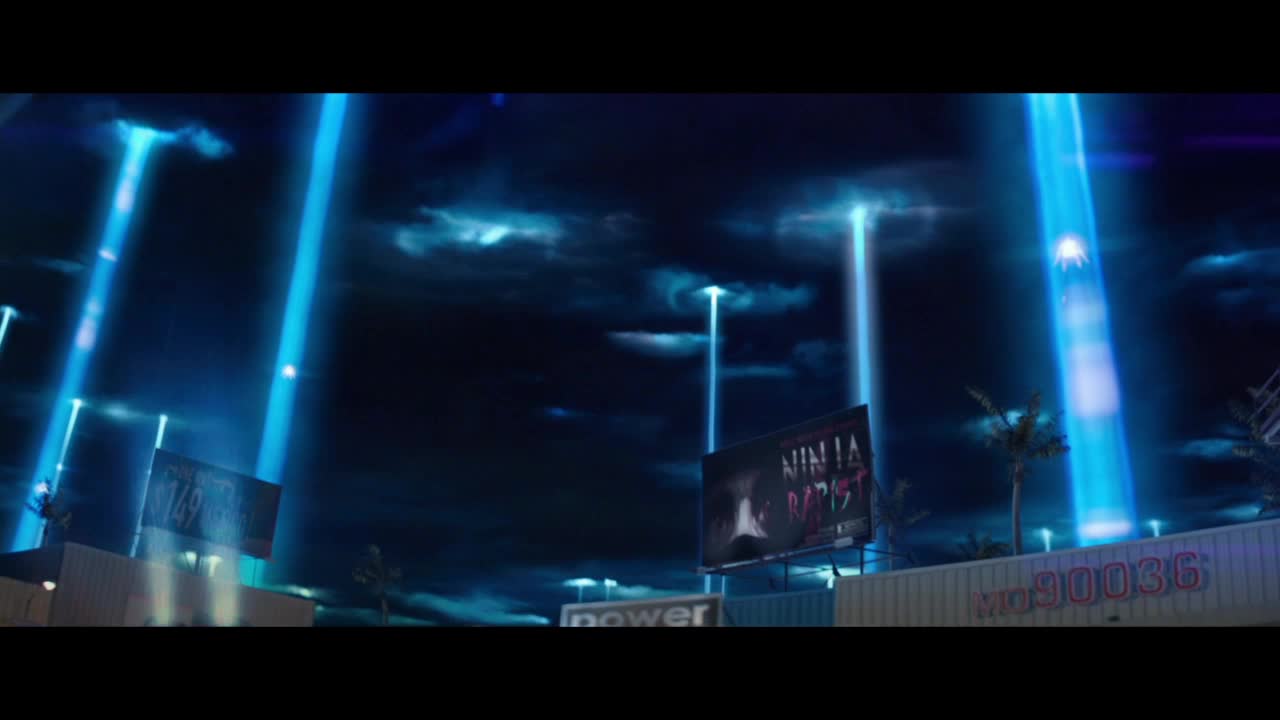
So, let’s get this out of the way quickly. This is the End (dir. Evan Goldberg and Seth Rogen, 2013) is a terrible movie. (I had a previous inkling that it was going to be pretty wretched.) It is adolescent (if self-consciously so), puerile (viz. Satan’s giant phallus), and misogynist, among its other sins. Perhaps most damning: it is poorly imagined. There are a number of other ways that actors playing themselves in a movie about the end of the world at James Franco’s house could have gone. Seriously. This is a brilliant premise[1] but This is the End is embarrassing.
Despite this pretty damning opinion, the spirit of The Hyperarchival Parallax’s subtitle obliges me to give this onanistic bropocalypse its due. For if nothing else, the film is somewhat fun. This is largely due to the constant metafiction the film is engaged in: Michael Cera is a degenerate, the Back Street Boys exist(ed) (right!?), Aziz Ansari is not generally liked, etc. And this is funny/interesting b/c each actor plays themselves.[2] (Or at least it is supposed to be [and often is] funny.)
But the true failure of This is the End lies in never asking itself what its basic premise means.[3] Namely, what does it mean to make a film about the “Christian” Apocalypse with a cast of goofballs (who made it big for whatever reason) playing themselves in 2013? Yes, the film is self-aware about how indulgent of a film it is (is it really though?), but if you are going to parody the currently (very) popular craze with representing megadeath and mass-destruction[4]—and in a time of danger, a time of surveillance, climate change, war, revolution, torture, and disaster—without once asking why one might make such a film nor why such a film might be interesting, timely, or important at this late and exhausted date in 2013 . . . this is a mistake.
To my mind, This is the End is a product of the 2013 orgy of disaster (see fn. 3) finally turning in on itself. And it is about time. (Whatever one may think about David Foster Wallace’s irony or sincerity) This is the End is very necessarily ironic in this time of serious-ass superhero movies destroying significant amounts of urban real-estate over and over. But it is not ironic enough. There are too many dick and fart jokes, and not enough acknowledgment of what it is and what it is doing: that it is metafiction satirizing contemporaneity and its multiplying disastrous projections of national fantasy. This is the End, if nothing else, emphasizes that we should be wary of the sincere expression of eschatological national fantasy at the present time.
[1] It really is. Though I will refrain from speculating too much how differently this film could have gone, it is a tempting activity.
[2] Though this is also to assuredly stress that the film could have benefitted from a quick refresher course on John Barth, Thomas Pynchon, Cynthia Ozick, David Foster Wallace, etc. Maybe especially Wallace’s “Westward the Course of Empire Takes its Way” (1989).
[3] Its other true failure rests upon its mistaken idea that, at the end of the day (literally), experiencing the end of the world w/ your friends would be kinda fun.
[4] It appears that every week a new film that imagines really massive destruction or post-apocalyptic waste will come out for the remainder of the summer. (In fact, there are a number of them playing right now!) In 2013 (just off the top of my head) we’ve seen: Olympus has Fallen (dir. Antoine Fuqua), which imagines a terrorist attack on the White House; there is the forthcoming White House Down (the new Roland Emmerich joint), also imagining a terrorist attack on the White House; there will be the xenocide of Ender’s Game (Gavin Hood); the nepotism of After Earth (M. Night Shyamalan); the (weirdly) promising looking Elysium (Neil Blomkamp); Oblivion (Joseph Kosinski) . . . ; Pacific Rim (Guillermo del Toro), which looks like it will bomb; The World’s End (Edgar Wright), another eschatological buddy-movie; World War Z (Marc Forster), Brad Pitt’s “adaptation” of Max Brook’s compelling and interesting novel of the same name (2006) (that came out today and according to Vanity Fair the film looks to be wanting); and of course finally there is Man of Steel (dir. Zack Snyder, 2013), a film I’m still puzzling over, which imagined something like two trillion dollars in damage to downtown Metropolis. There are many more such films coming out this year.
Quite simply, 2013 is the year of disaster porn. It’s everywhere. It even comes in the guise of children’s fantasy. Transformers (1984-1987) and Action Comics (1939- ) have been repurposed into visions of Armageddon and mega-death. Think about this for a second.
More selfishly, this summer blockbuster movie season is yet another reminder that a critic of the writing of the disaster will never be out of work. We are in the age of frequent, diverse, ubiquitous, and excessive disaster. It is multiplying. This is the point. The multiplication of real or imagined disaster scenarios in contemporaneity requires its own archive. Trying to deal with the reality of this requires what I have been and will continue to call hyperarchival realism.




 The Hyperarchival Parallax