The Hyperarchival Parallax Turns Five

Today marks the fifth anniversary of The Hyperarchival Parallax: Making Eschatological Anxiety Fun for 4000 Years. Somehow I have been at this for five years! I started from a relatively modest place, where I really didn’t have a coherent idea of what I was doing, why I was doing it, or how I would proceed. Since that first strange post, this blog has become, over these five long years, years in which much has happened to me as a scholar and writer, something much, much more (or at least I would like to think). I thank you for continuing to read and frequent my site. This year I have gotten more “followers” than in the previous four combined. I hope this is an indication that people like what I do here. I’m going to continue. And for at least another five years I hope to continue to map the intersections between disaster and archives. And as I will (hopefully) complete my current project on such things in the next year or so, I look forward to being able to also take this blog in other directions, perhaps even one day inviting others to contribute, turning it into something maybe a bit more ambitious.

But for now, this is also to acknowledge that I have been shirking my duties. I have been quite busy with professional matters, working on essays, writing conference papers, and most of all teaching 3 enjoyable, if time-consuming classes. (Here’s the blog to one that is just wrapping up.) So I haven’t had much time to post new content recently, and have not even posted many links. I will hope to rectify this in the coming weeks, as a major amount of work is now in my rear-view mirror. I will empty out my backlog of links (that is sitting dormant in a folder on my browser). In the coming weeks I will post a recent conference paper that I’ve been threatening to put up but haven’t yet (my discussion of The Manhattan Projects [2012- ]). And I hope to be putting up considerably more original content in the coming year.

So thank you again for reading. And here’s to five more years of The Hyperarchival Parallax.
Paranoia and Conspiracy: 2013 Style

So, amidst the nearly daily revelations of the NSA, Scott Shane for The New York Times reports that “No Morsel Too Miniscule for All-Consuming NSA”:

From thousands of classified documents, the National Security Agency emerges as an electronic omnivore of staggering capabilities, eavesdropping and hacking its way around the world to strip governments and other targets of their secrets, all the while enforcing the utmost secrecy about its own operations. It spies routinely on friends as well as foes, as has become obvious in recent weeks; the agency’s official mission list includes using its surveillance powers to achieve “diplomatic advantage” over such allies as France and Germany and “economic advantage” over Japan and Brazil, among other countries.

I am tempted to say that the NSA represents something like the capital T Truth of our global, hyperarchival reality.

And in still paranoid, but less frightening news, Carolyn Kellogg, friend and writer for The Los Angeles Times, appears on a podcast discussing Thomas Pynchon’s Bleeding Edge at Three Percent.

Just What We Always Wanted: An Immortal Archive

A less-than-surprising host for this story: Kurzweil: Accelerating Intelligence has a story about hyperarchives: “A Billion Year Storage Medium That Could Outlive the Human Race.”

Researcher Dr. Jeroen de Vries from the University of Twente MESA+ Institute for Nanotechnology suggests we could store data for one million to one billion years, using a new storage medium based on tungsten and graphene oxide.

He imagines two possible scenarios:

  • Disaster has devastated the earth and society must rebuild the world
  • We need to create a legacy for future intelligent life that evolves on Earth or comes from other worlds.

And so obviously these speculative futures require that we need to invent storage archives that will outlive us. Viva the archive!

Link Dump: Nuclear, Archival, and Other

My apologies, it’s been a busy few weeks and I haven’t had time to add anything new. So here’s couple things I’ve stumbled across recently.

In nuclear news, Craig Whitlock reports for The Washington Post that “the Air Force on Friday fired the general in charge of all land-based nuclear missiles, the second time in a week that a senior commander of the country’s nuclear arsenal has been let go for allegations of personal misconduct.” (I wonder if his misconduct had anything to do with precious bodily fluids.)

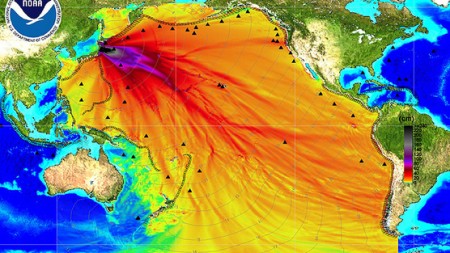
Three things from Fukushima: Mari Yamaguchi asks, “Japan’s Water Leaks: How Dangerous?” for the AP. The Sleuth Journal reports that “Radioactive Water From Fukushima Is Systematically Poisoning the Entire Pacific Ocean.”

radioactive-water

And if that weren’t bad enough, Andrew Breiner for Think Progress writes how a “Once-A-Decade Typhoon Threatens Already Leaking Fukushima Nuclear Plant.”

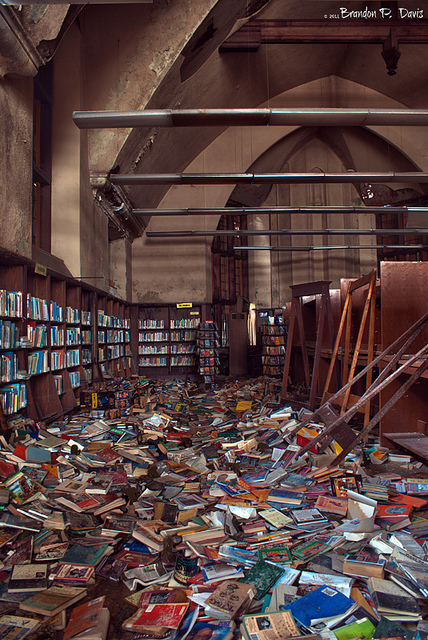
And though I think I’ve reported on this/posted a picture of this before, Flickr has an arresting series of images of archival decay from the abandoned Mark Twain Branch Library in Detroit.

SONY DSC

Continue reading

“The Inverted Nuke in the Garden” Receives SLSA’s Schachterle Prize

I am honored to have received this year’s Schachterle Prize from The Society for Literature, Science, and the Arts for my essay, “The Inverted Nuke in the Garden: Anti-Eschatology and Archival Emergence in David Foster Wallace’s Infinite Jest,” which appeared in the Fall 2012 issue of boundary 2. This year’s conference was nothing short of incredible, and it remains one of the most vibrant, stimulating, and humbling conferences I have attended. I will probably post my own paper from the conference in a few days.

The Future: Bleak, Bleaker, Bleakest

Richard Schiffman reported in The Atlantic today that “time is running out to put the brakes on the planet’s warming, says arguably the most exhaustively researched scientific paper in history,” in “What Leading Scientists Say You Should Know About Today’s Frightening Climate Report.” Thanks to my sister-in-law for drawing my attention to this. And also to my brother for being instrumental building the satellite that brings us this image.

Global WarmingGlobal Warming 02

On a Lighter Note: Thomas Pynchon and Food

In a publication that my home receives regularly (but I tend not to really glance at, being the non-culinary member of my household), Bon Appétit has an article on food in Thomas Pynchon’s novels written by Nicole Villeneuve: “All the Food in Thomas Pynchon’s Books (And What It Means, Sorta).” (That said, this article is mighty short, and I cannot imagine that this is all the food in Pynchon’s novels and stories. . . . I bet the Pynchon Wiki would be of help here. Indeed, even just a quick search of “food” in Mason & Dixon [1997] returns over five-hundred hits. I also wonder if anyone has seriously ever tried to make Pirate Prentice’s famous banana breakfast?)