“Toward a Theory of the Megatext: Speculative Criticism and Richard Grossman’s ‘Breeze Avenue Working Paper,'” the first essay from a new project on what I have been calling megatexts, will appear in Scale in Literature and Culture, edited by Michael Tavel Clarke and David Wittenberg. The collection of essays will be published by Palgrave Macmillan and will hopefully come out later this year. More information to come.
Author: Bradley J. Fest
Reading at The Bonfire Reading Series with Dan Thomas-Glass on March 4, 2017 in Pittsburgh
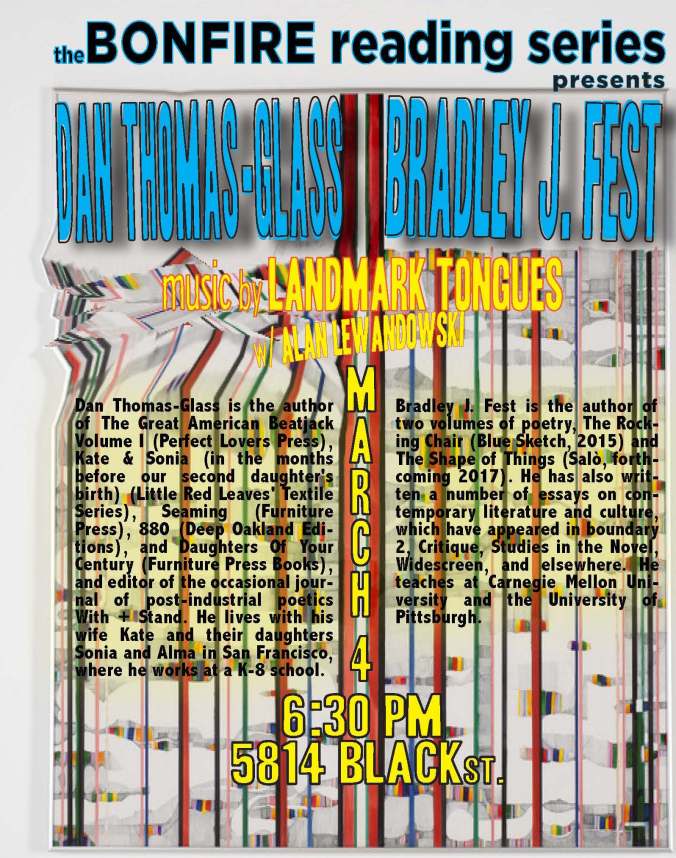 I will be reading at The Bonfire Reading Series with Dan Thomas-Glass on March 4, 2017 in Pittsburgh, PA. For more on the series, check out Guillermo Parra’s article and interview with the Bonfire Collective on The Best American Poetry blog. Landmark Tongues with Alan Lewandowski will also be performing.
The Shape of Things, Forthcoming from Salò Press
I am happy to announce that my second volume of poetry, The Shape of Things, will be published this summer by Salò Press. More details to come.
“2015.17” in The Offbeat
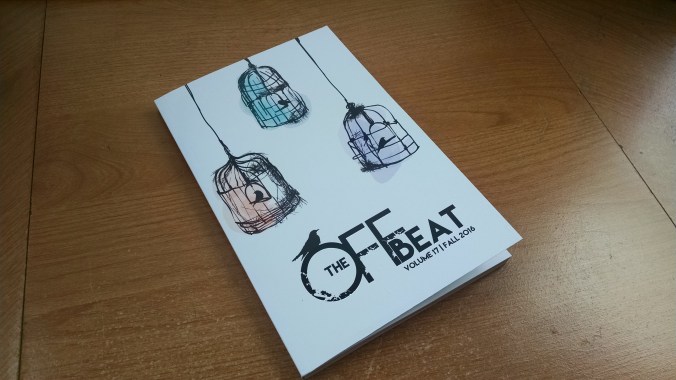
“2015.17,” a poem from my ongoing sonnet sequence, just appeared in volume 17 of The Offbeat.
Beginning of the Semester Links, Spring 2017
Nuclear and Environment
Stephen Hawking, “This Is the Most Dangerous Time for Our Planet.”
Andrew Bast, “Unpredictable,” review of Nuclear Politics: The Strategic Causes of Nuclear Proliferation, by By Nuno P. Monteiro and Alexandre Debs.
Joe Romm, “Priebus Confirms That Climate Denial Will Be the Official Policy of Trump’s Administration.”
Natasha Geiling, “Wisconsin Department of Natural Resources Deletes Accurate Climate Science from Agency Webpage.”
Madeline Conway, “Trump Threatens to Upend US Nuclear Weapons Policy.”
Sam Stein, “Trump Releases Letter From Putin Amid Talk Of Nuclear Arms Race.”
Robinson Meyer, “Human Extinction Isn’t That Unlikely.”
“The Shape of Things II” and Other Poems in Verse
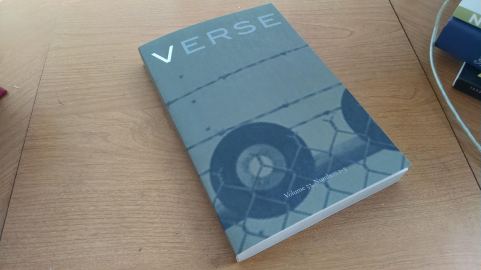
A portfolio of my poems was chosen as a finalist for the 2015 Tomaž Šalamun Prize and was just published in Verse. Included in the portfolio are “The Shape of Things I,” “Architects and Their Books,” “What We Are Looking At,” “Tristeza,” “An Ode to 2013: We Are the National Security Agency’s Children,” “Throw Out Your Life,” and an eighteen-page long poem, “The Shape of Things II,” of which I am particularly proud.
The poems appear in volume 33 of Verse, along with poems by Felicia Zamora, the winner of the 2015 Tomaž Šalamun Prize, E. C. Belli, Alex Stolis, Beth Marzoni, Michelle Murphy, Dan Ivec, Gabrielle Hovendon, Todd Melicker, Keith Jones, Catherine Taylor, Lynn Melnick, and the late James Tate. I will post a link to where one can order the issue as soon as it becomes available, but in the meantime, individual subscriptions can be ordered from Verse‘s editorial office for $18/year (check payable to Verse):
Brian Henry and Andrew Zawacki, Editors
Department of English
University of Richmond
Richmond, VA 23173
Winter Links 2016
Nuclear and Environmental
Robin Bravender, “Trump Picks Top Climate Skeptic to Lead EPA Transition.”
Ian Johnston, “Climate Change May Be Escalating So Fast It Could Be ‘Game Over,’ Scientists Warn.”
Oliver Milman, “Donald Trump Presidency a ‘Disaster for the Planet,’ Warn Climate Scientists.”
Coral Davenport, “Donald Trump Could Put Climate Change on Course for ‘Danger Zone.'”
Noam Chomsky, “The Republican Party Has Become the Most Dangerous Organization in World History.”
Generation Anthropocene, “An Interview with Kim Stanley Robinson.”
xkcd, “A Timeline of Earth’s Average Temperature.”
Douglas Fox, “Scientists Are Watching in Horror as Ice Collapses.”
And Avery Thompson, “Scientists Accidentally Discover Efficient Process to Turn CO2 Into Ethanol.”
“Mobile Games, SimCity BuildIt, and Neoliberalism” at First Person Scholar
On today of all days, I have a short essay, “Mobile Games, SimCity BuildIt, and Neoliberalism,” up at First Person Scholar.

“Metaproceduralism: The Stanley Parable and the Legacies of Postmodern Metafiction” in Wide Screen

I am pleased to announce that another essay on videogames, “Metaproceduralism: The Stanley Parable and the Legacies of Postmodern Metafiction,” just appeared in Wide Screen. The essay is part of a special issue on videogame adaptation, edited by Kevin M. Flanagan, and includes articles by Jedd Hakimi, Cameron Kunzelman, Kyle Meikle, Bobby Schweizer, and Kalervo Sinervo. It’s also open access, so anyone can read it.
Abstract: Most critics of contemporary literature have reached a consensus that what was once called “postmodernism” is over and that its signature modes—metafiction and irony—are on the wane. This is not the case, however, with videogames. In recent years, a number of self-reflexive games have appeared, exemplified by Davey Wreden’s The Stanley Parable(2013), an ironic game about games. When self-awareness migrates form print to screen, however, something happens. If metafiction can be characterized by how it draws attention to its materiality—the artificiality of language and the construction involved in acts of representation—The Stanley Parable draws attention to the digital, procedural materiality of videogames. Following the work of Alexander R. Galloway and Ian Bogost, I argue that the self-reflexivity of The Stanley Parable is best understood in terms of action and procedure, as metaproceduralism. This essay explores the legacies of United States metafiction in videogames, suggesting that though postmodernism might be over, its lessons are important to remember for confronting the complex digital realities of the twenty-first century. If irony may be ebbing in fiction, it has found a vital and necessary home in videogames and we underestimate its power to challenge the informatic, algorithmic logic of cultural production in the digital age to our detriment.
“2016.01,” “2016.19,” and “2016.23” in Masque & Spectacle
“2016.01,” “2016.19,” and “2016.23,” poems from my ongoing sonnet sequence, are in Masque & Spectacle.
 The Hyperarchival Parallax